
Basel Iii Endgame Capital Ratios
AT1 Contingent Convertibles (CoCos): 5.125% vs 7.0% Triggers, Write-Down & PONV Hierarchy
Under Basel CAP10.11, Additional Tier 1 contingent convertibles require perpetual maturity, discretionary non-cumulative coupons, and a minimum 5.125% CET1 trigger or Point of Non-Viability bail-in.
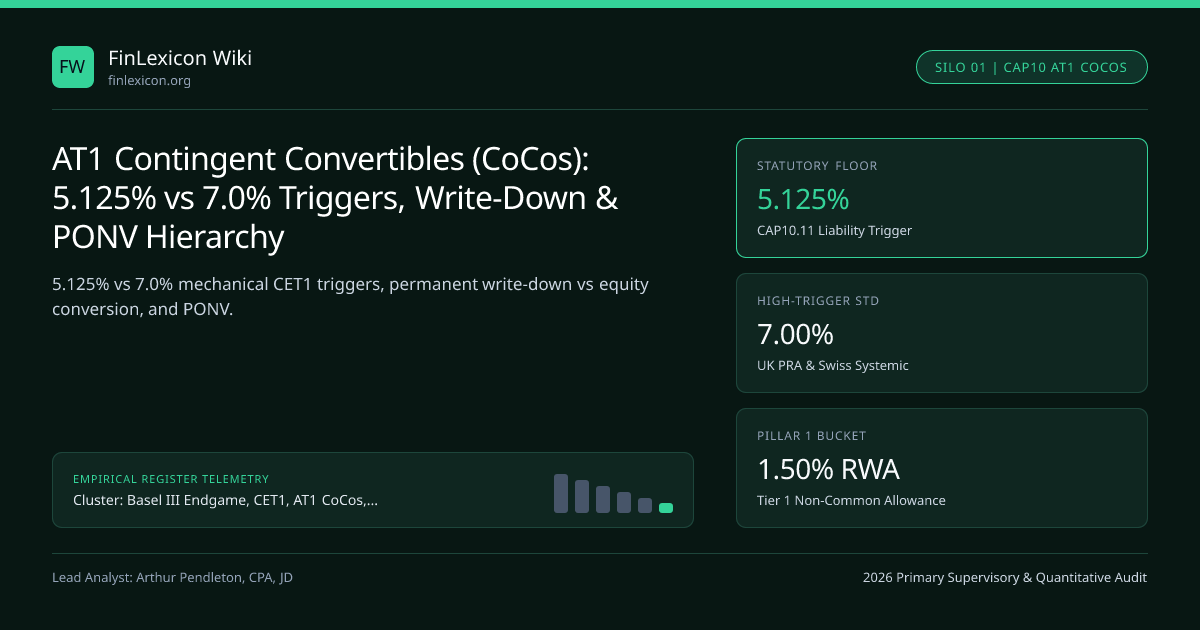
Engineered under Basel Framework chapter CAP10.11 to eliminate hybrid Tier 1 bonds that failed to absorb losses during 2008, Additional Tier 1 (AT1) Contingent Convertibles—or CoCos—are perpetual, deeply subordinated debt instruments featuring fully discretionary non-cumulative coupons and dual loss-absorption triggers. Outside the United States (where G-SIBs issue perpetual non-cumulative preferred stock instead of debt CoCos), AT1 notes fill the 1.5% RWA slice between the 4.5% Basel III CET1 Capital Adequacy Standard and the 6.0% Tier 1 minimum.
Mechanical CET1 Triggers (5.125% Low-Trigger vs 7.0% High-Trigger) vs Discretionary PONV#
CAP10.11(16) mandates that any AT1 instrument classified as an accounting liability must include an objective contractual trigger set at a minimum 5.125% CET1 ratio. Several national supervisors require higher mechanical thresholds: the UK Prudential Regulation Authority and Swiss FINMA require 7.0% CET1 high-trigger CoCos for systemic banks so going-concern recapitalization occurs well before insolvency.
Independently of the mechanical ratio, CAP10.19 imposes a statutory or contractual Point of Non-Viability (PONV) trigger across all AT1 and Tier 2 instruments. PONV fires at the earlier of a supervisory determination that the institution would become non-viable without a write-off, or a decision to inject extraordinary public-sector capital or liquidity support—as demonstrated in March 2023 when CHF 16 billion (~$17.2B) of Credit Suisse AT1 notes were permanently written down to zero alongside emergency central-bank liquidity guarantees.
Loss-Absorption Mechanics: Equity Conversion vs Permanent and Temporary Write-Down#
Issuers structure CoCo principal loss absorption across three distinct contractual blueprints that profoundly alter recovery values and creditor hierarchy:
- Equity Conversion (UK & Australian Banks): Principal converts into newly issued common shares at a pre-agreed floor conversion price, diluting existing shareholders while preserving upside recovery for CoCo holders—standard at Bank of Scotland parent groups and ANZ Bank under APRA rules.
- Permanent Write-Down (Swiss & Select Asian Structures): Principal is irrevocably extinguished to zero, generating immediate accounting CET1 gain through debt forgiveness; if common equity is not simultaneously wiped out in resolution, an apparent inversion of creditor hierarchy can occur.
- Temporary Write-Down / Discretionary Write-Up (Eurozone Standard): Used widely by Eurozone issuers like BNP Paribas, principal writes down pro rata with losses to restore CET1 to 5.125% (or 7.0%) and may be written back up out of future net profits subject to strict Maximum Distributable Amount (MDA) coupon and write-up caps.
Post-2023 Creditor Hierarchy Clarifications by ECB, EBA, BoE, and MAS#
Immediately after the March 2023 Swiss AT1 write-down roiled secondary credit spreads, the European Central Bank (jointly with EBA and SRB), the Bank of England, and the Monetary Authority of Singapore issued formal supervisory statements confirming that within their statutory resolution regimes, common equity instruments are the first to absorb losses and AT1 holders are written down in resolution only after CET1 is fully exhausted.
Nevertheless, fixed-income mandates must still price coupon-skip risk prior to resolution: under CAP10.11(7), an issuer may—and upon breaching MDA buffers, must—cancel AT1 coupons without triggering an event of default or restricting senior bond debt service, as contextualized in our Basel III Endgame & CET1 cornerstone guide.
| Jurisdiction & Regulator | Standard AT1 Instrument | Mechanical CET1 Trigger | Predominant Loss Mechanism | Resolution Hierarchy Rule |
|---|---|---|---|---|
| United States (Federal Reserve) | Perpetual Non-Cum. Preferred Stock | N/A (classified as GAAP equity) | Dividend stop; equity loss in Title II | Strict statutory equity-first order |
| Eurozone SSM (ECB) | Perpetual Subordinated AT1 Notes | 5.125% CET1 (group & solo) | Temporary write-down / equity conv. | BRRD Art. 48: CET1 wiped before AT1 |
| United Kingdom (UK PRA) | High-Trigger Convertible AT1 | 7.00% CET1 (fully loaded) | Mandatory common equity conversion | Banking Act 2009: strict seniority |
| Australia (APRA) | Additional Tier 1 Capital Notes (CPS) | 5.125% CET1 (APRA phase-out consult) | Equity conversion (with write-off fallback) | Equity conversion preserves upside |
| Singapore (MAS) & Hong Kong (HKMA) | Basel III Perpetual AT1 Capital Securities | 5.125% or 7.00% CET1 | Partial/permanent write-down or conv. | MAS clarified equity-first in res. |
Perpetual Non-Step-Up Call Architecture and Reset Spread Extension Risk#
CAP10.11(5) prohibits maturity dates, dividend pushers, and coupon step-ups that create economic incentives to redeem. Instead, AT1 notes carry an issuer call option (typically at Year 5 or Year 10, subject to prior supervisory approval and replacement with equal-or-higher-quality capital) after which coupons reset to a five-year swap or Treasury benchmark plus the initial credit reset spread.
Whenever secondary market spreads widen substantially past a bond’s locked-in initial reset margin, calling at par and reissuing at wider spreads becomes uneconomic—converting pricing from Yield-to-Call (YTC) to Yield-to-Perpetuity (YTP) and extending modified duration from ~4 years to over 11 years.
Interaction Between Output Floor RWA Inflation and Mechanical Trigger Distance#
Distance-to-trigger (measured both in basis points of CET1 and absolute billions of CET1 capital) compresses automatically when the BCBS d424 72.5% standardized RWA output floor inflates RWA denominators. Even with unchanged accounting equity, a 140 bps output-floor drop in reported CET1 narrows both distance-to-MDA and distance-to-7.0%-trigger, elevating option-adjusted spreads across the Basel III Endgame & Capital Ratios topic hub.
- DistancetoTriggerUSD = ( CET1Ratio - TriggerCET1 ) * RWAFloored
- ConversionShares = AT1ParPrincipal / max( MarketVWAP * (1 - Discount) , Floor_Price )
- Worked High-Trigger Equity Conversion ($2.0B AT1 Note, 7.0% Trigger, Floor Price = $12.50/share):
- Bank RWA_Floored = $400.0B | CET1 drops from $53.6B (13.40%) to $26.8B (6.70% < 7.00%)
- 5-Day VWAP at breach = $8.40/share => max($8.40, $12.50 Floor) = $12.50 conversion price
- Shares Issued = $2,000,000,000 / $12.50 = 160,000,000 common shares
- Immediate Mark-to-Market Value of Shares = 160M * $8.40 = $1.344B (67.2% Recovery vs 0% Write-Down)
- Post-Conversion CET1 = ($26.8B + $2.0B) / $400.0B = 7.20% (Restored Above 7.00% Trigger)
Frequently asked questions
Why do U.S. banks issue perpetual non-cumulative preferred stock instead of AT1 CoCo bonds?
Under U.S. tax law and Federal Reserve Regulation Q (12 CFR 217.20), interest on perpetual contingent write-down debt faces restrictive tax deductibility hurdles, whereas perpetual non-cumulative preferred stock qualifies natively as GAAP equity and Additional Tier 1 without needing a 5.125% debt conversion trigger.
Does skipping an AT1 coupon trigger an Event of Default or cross-default on senior bonds?
No. CAP10.11(7)–(9) mandates that issuers retain full discretion at all times to cancel distributions, that cancelled payments are non-cumulative (permanently extinguished), and that cancellation never constitutes a default or restricts operations other than common dividend stoppers.
How could Credit Suisse AT1 bonds be wiped out in 2023 while common shareholders received UBS stock?
Credit Suisse’s Swiss AT1 prospectuses contained a permanent write-down clause linked to a Viability Event triggered by extraordinary government liquidity support, and the transaction occurred via emergency ordinance outside standard formal bank insolvency liquidation.
What is APRA proposing regarding AT1 hybrid capital in Australia?
Following global lessons from 2023, the Australian Prudential Regulation Authority (APRA) initiated a phase-out framework replacing retail-held AT1 bank hybrids with simpler combinations of CET1 common equity and Tier 2 institutional subordinated debt for Australian D-SIBs.
Publication record
- Published
- 15 November 2026
- Updated
- 15 November 2026
- Author
- Arthur Pendleton, CPA, JD
- Review
- Review not recorded
- Automated fact check
- Passed in the stored pipeline record
- Source URLs
- 4 recorded
AI assistance recorded: anthropic/claude-opus-4.6. This field does not establish human review or source verification.
Academic & Institutional Attribution
Cite This Research & Embed Live Data Card
Standard academic & institutional research paper citation format.
Arthur Pendleton, CPA, JD. (2026, November 14). AT1 Contingent Convertibles (CoCos): 5.125% vs 7.0% Triggers, Write-Down & PONV Hierarchy. FinLexicon Wiki. https://finlexicon.org/wiki/at1-coco-contingent-convertible-writedown-vs-equity-triggersRelated Basel Iii Endgame Capital Ratios & Institutional Briefings
Explore Basel Iii Endgame Capital Ratios Hub (20) →Basel Iii Endgame Capital Ratios
Basel III Endgame (BCBS d424), CET1 Capital Adequacy, 72.5% Output Floor & TLAC ArchitectureBasel Iii Endgame Capital Ratios
U.S. Expanded Risk-Based Approach (ERBA) & AOCI Unrealized Securities Filter RemovalBasel Iii Endgame Capital Ratios
Countercyclical Capital Buffer (CCyB): Weighted-Average Reciprocity & Positive Neutral RatesBasel Iii Endgame Capital Ratios
G-SIB Systemic Surcharge: BCBS Method 1 Five-Category Score vs Fed Method 2 STWF ScalarBasel Iii Endgame Capital Ratios
FSB TLAC Term Sheet: 18% RWA / 6.75% Leverage Minimums & Clean Holding Company RulesBasel Iii Endgame Capital Ratios
EU BRRD II MREL Calibration: SPE vs MPE Resolution & Senior Non-Preferred Debt HierarchyBasel Iii Endgame Capital Ratios
Enhanced Supplementary Leverage Ratio (eSLR) & Total Leverage Exposure (LEV20–LEV30)Basel Iii Endgame Capital Ratios
Basel III Standardized Credit Risk (CRE20): LTV Mortgage Buckets & ADC Real Estate WeightsCorporate Governance
Analysis: Companies love a ‘rockstar’ CEO. Until they depend on oneRegulatory Compliance
SEC Proposes Executive and Director Compensation Disclosure ReformsLiquidity Coverage Nsfr Prudential
HQLA Level 1, 2A & 2B Haircuts: 40%/15% Composition Caps & Secured Funding Unwind (LCR30)Liquidity Coverage Nsfr Prudential
LCR 30-Day Deposit Run-Off Rates (LCR40): Stable Retail (3%/5%), Operational (25%) & Financial (100%)
FinLexicon Wiki Data, Benchmarks & Contributor Records
CC BY 4.0 Open Data
Open Institutional Datasets (CSV / JSON) →
Download desk-compiled quantitative series & schemas.
2026 Reference Matrix
2026 Institutional Benchmarks & Thresholds →
Statutory capital, clearing, margin & rate conventions.
Editorial Records
Authors & Review Records →
View named contributors where those records are available.
Complete Index
Master Research & Dossier Archive →
Browse all published briefings by topic pillar & date.