
Basel Iii Endgame Capital Ratios
Basel III Endgame (BCBS d424), CET1 Capital Adequacy, 72.5% Output Floor & TLAC Architecture
Under BCBS d424 Basel III Endgame prudential banking rules, modeled risk-weighted assets cannot fall below 72.5% of standardized RWA, anchoring CET1 capital adequacy, AT1 triggers, and 18% FSB TLAC bail-in buffers.
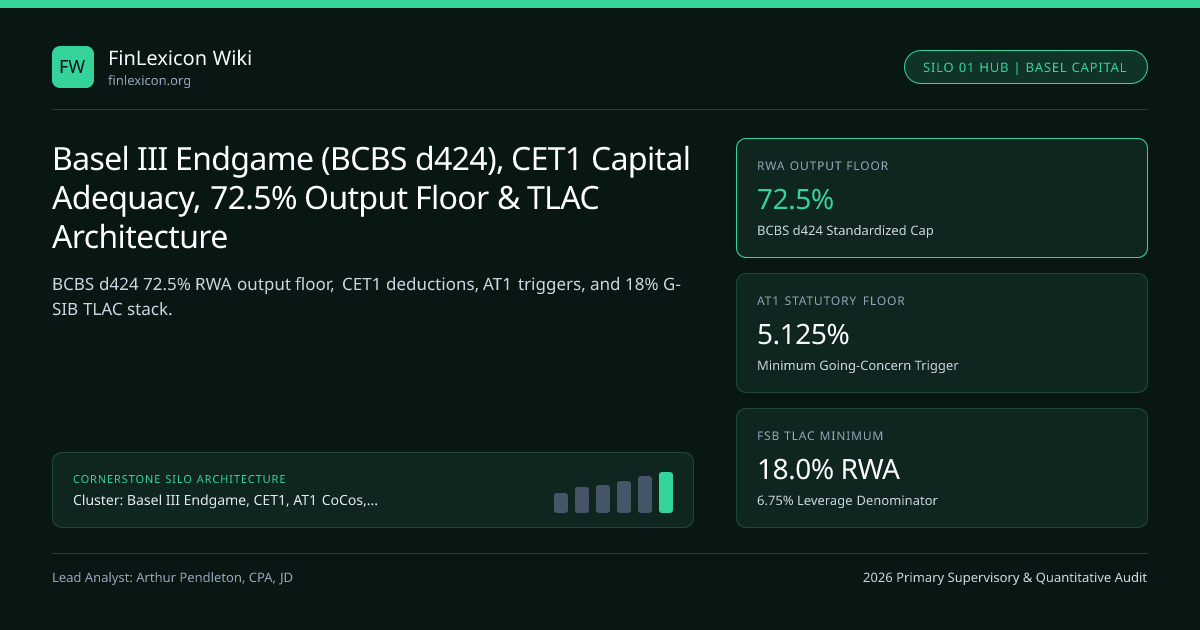
Published by the Basel Committee on Banking Supervision in December 2017 and phased into national law through 2028–2032, BCBS d424 caps internal-model capital relief by requiring aggregate risk-weighted assets (RWA) to equal or exceed 72.5% of total standardized RWA. Across the Basel III CET1 Capital Adequacy Standard and the Basel III 72.5% RWA Output Floor, global systemically important banks (G-SIBs) supervised by the BCBS / BIS framework, the U.S. Federal Reserve System, and the European Central Bank must simultaneously maintain a 4.5% minimum Common Equity Tier 1 ratio, a 2.5% capital conservation buffer, countercyclical and systemic surcharges, and an 18% RWA Total Loss-Absorbing Capacity (TLAC) standard.
Structural Architecture of Going-Concern vs Gone-Concern Bank Capital#
Modern prudential banking supervision partitions liability stacks into loss-absorbing going-concern capital—designed to absorb credit, market, and operational shocks while the institution remains solvent—and gone-concern bail-in debt engineered to recapitalize a failing group in weekend resolution without taxpayer support. Paid-in common shares, share premium, retained earnings, and accumulated other comprehensive income form the core numerator before applying strict CET1 regulatory deductions and 10%/15% threshold rules under Basel CAP30.
Above common equity sits Additional Tier 1 perpetual debt, governed by contractual AT1 CoCo write-down versus equity conversion triggers calibrated at a statutory 5.125% CET1 floor or higher 7.0% high-trigger thresholds. Tier 2 subordinated instruments carry a minimum five-year original maturity with linear amortization over the final five years, whereas external bail-in debt under the FSB TLAC 18% RWA clean holding company rule and EU BRRD II internal and external MREL hierarchy absorbs residual losses once equity and AT1 tranches are exhausted.
The 72.5% Standardized RWA Output Floor and Internal Model Constraints#
Prior to the finalized Basel III reforms, empirical BIS Quantitative Impact Studies revealed dispersion exceeding 300 basis points in modeled risk weights assigned by advanced banks to identical corporate and residential mortgage portfolios. To restore cross-border comparability across FinLexicon regulatory benchmarks, the BCBS d424 72.5% standardized RWA output floor replaces the legacy Basel I 80% transitional floor with a permanent aggregate backstop.
Simultaneously, BCBS CRE30 eliminates the Advanced Internal Ratings-Based (A-IRB) approach for exposures to equities, banks, other financial institutions, and corporate groups with consolidated revenues exceeding EUR 500 million. Institutions such as BNP Paribas and Bank of America must evaluate corporate exposures using F-IRB migration and A-IRB PD/LGD input floors alongside granular CRE20 LTV residential and commercial real estate weights and SCRA Grade A/B/C unrated bank classifications.
Transatlantic Transposition: U.S. ERBA Dual-Requirement Stack vs EU CRR III and UK Basel 3.1#
Jurisdictional implementation of BCBS d424 diverges sharply across the North Atlantic and Asia-Pacific. In the United States, federal banking agencies—the Federal Reserve, the Office of the Comptroller of the Currency, and the Federal Deposit Insurance Corporation—proposed the Expanded Risk-Based Approach (ERBA) and AOCI filter removal for banking organizations above USD 100 billion in assets, binding each firm to the higher of Collins Amendment standardized RWA and ERBA RWA.
In the European Union, Regulation (EU) 2024/1623 (CRR III) took effect in January 2025 with transitional output-floor reliefs for low-risk unrated corporates and residential mortgages through 2032. Meanwhile, the UK Prudential Regulation Authority eliminated pre-existing SME and infrastructure supporting factors while adjusting Pillar 2A offsets, and the Monetary Authority of Singapore together with the Hong Kong Monetary Authority implemented the output floor ahead of Western schedules.
| Jurisdiction & Supervisor | Transposition Instrument | Output Floor Phase-In | G-SIB Surcharge & Buffer Rule | Operational Risk ILM |
|---|---|---|---|---|
| INTL (BCBS / BIS) | BCBS d424 Consolidated Framework | 50% (2023) to 72.5% (2028) | Method 1 (1.0%–3.5% CET1 buckets) | Supervisory ILM or ILM=1 option |
| United States (Federal Reserve / FDIC) | 12 CFR Part 217 ERBA / Re-proposal | Dual Collins 100% SA + ERBA stack | Higher of Method 1 or Method 2 + SCB | ILM floored/fixed at 1.0 under ERBA |
| European Union (ECB SSM) | Regulation (EU) 2024/1623 (CRR III) | 50% (2025) to 72.5% (2030/2032) | O-SII / G-SII + SREP P2R & SyRB | ILM neutralized at 1.0 across EU |
| United Kingdom (UK PRA) | PRA PS9/24 Basel 3.1 Rulebook | Phased to 72.5% by Jan 2030 | UK G-SIB + PRA Buffer (Pillar 2B) | ILM set equal to 1.0 (Pillar 2 review) |
| Singapore (MAS) & Hong Kong (HKMA) | MAS Notice 637 / HKMA BCR Cap. 155L | 50% (2024/2025) to 72.5% (2029/2030) | D-SIB HLA 2.0% CET1 + CCyB stack | National discretion ILM=1 adopted |
Market Risk (FRTB), Operational Risk (SMA), and Securitization Capital#
Beyond credit risk, BCBS d424 overhauls non-credit denominators that historically generated severe model arbitrage. Trading desks must transition from 10-day 99% Value-at-Risk to Expected Shortfall at 97.5% calibrated across liquidity horizons from 10 to 120 days under FRTB Sensitivities-Based Method and P&L Attribution gates. Any trading desk failing backtesting or P&L Attribution tests reverts immediately to standardized sensitivities charges.
Operational risk capital abandons the Advanced Measurement Approach (AMA) in favor of the Standardized Measurement Approach (SMA) Business Indicator Component, where supervisors may neutralize historical loss multipliers by setting the Internal Loss Multiplier (ILM) equal to 1.0. Structured credit tranches are governed by SEC10–SEC40 STC securitization p-parameters, while collateralized lending relies on CRE22 comprehensive collateral haircuts.
Dynamic Capital Buffers, G-SIB Surcharges, Leverage Backstops, and MDA Restrictions#
Meeting the 4.5% Pillar 1 CET1 minimum does not prevent supervisory intervention if combined buffer requirements are breached. Above Pillar 1 and ECB SREP Pillar 2R versus Pillar 2G supervisory stacks, institutions must fund the 2.5% Capital Conservation Buffer, macroprudential Countercyclical Capital Buffer (CCyB) reciprocity rates, and systemic surcharges calculated via BCBS Method 1 versus Federal Reserve Method 2 G-SIB scores.
In the United States, the static 2.5% conservation buffer is replaced for large banks by the dynamic CCAR Stress Capital Buffer (SCB) nine-quarter depletion. Dipping into the combined buffer triggers automatic Maximum Distributable Amount (MDA) AT1 coupon and dividend caps, while risk-insensitive balance sheet expansion is constrained by the Enhanced Supplementary Leverage Ratio (eSLR) denominator. Full cross-references across all twenty entries are indexed in the Basel III Endgame & Capital Ratios topic hub and verified through our quantitative methodology.
- CET1Ratio = ( CET1Gross - DeductionsCAP30 ) / RWAFloored
- Worked G-SIB Numerical Audit:
- CET1_Gross = $148.0B | CAP30 Deductions (Goodwill + DTAs) = $22.0B => Net CET1 = $126.0B
- Modeled Pre-Floor RWA = $910.0B | Full Standardized RWA = $1,400.0B
- 72.5% Output Floor RWA = 0.725 * $1,400.0B = $1,015.0B (Floor Binds: +$105.0B RWA Add-On)
- Pre-Floor CET1 Ratio = $126.0B / $910.0B = 13.85%
- Post-Floor CET1 Ratio = $126.0B / $1,015.0B = 12.41% (-144 bps Output Floor Impact)
Balance Sheet Optimization and Capital Stack Allocation Under Output Floor Binding#
Whether the 72.5% output floor or the non-risk-based leverage ratio acts as the binding constraint depends on average portfolio risk density (RWA divided by Total Leverage Exposure). Custody banks and sovereign repo dealers typically exhibit risk densities near 20%–28%, rendering Tier 1 leverage and eSLR their primary capital constraint. Conversely, Nordic and Benelux mortgage lenders such as ASN Bank or diversified European universal banks with dense low-PD corporate books experience up to 25%–35% RWA inflation once standardized mortgage and unrated corporate weights override internal LGD estimates, prompting active significant risk transfer (SRT) synthetic securitizations and capital reallocation.
Frequently asked questions
How does the Basel III Endgame 72.5% RWA output floor interact with internal IRB and FRTB models?
A bank calculates aggregate RWA twice: once using approved internal models (F-IRB/A-IRB for credit, IMA for market risk) plus standardized operational risk, and once using pure standardized approaches across every risk class. Binding RWA equals the greater of modeled RWA or 72.5% of full standardized RWA.
What distinguishes Going-Concern Tier 1 capital from Gone-Concern Tier 2 and TLAC debt?
Going-concern capital (CET1 and AT1 CoCos with at least a 5.125% CET1 trigger) absorbs losses while the bank continues operating normally. Gone-concern instruments (Tier 2 subordinated bonds and senior non-preferred TLAC/MREL debt) absorb losses or convert to equity only at the Point of Non-Viability (PONV) or formal resolution.
Why did many jurisdictions set the SMA Internal Loss Multiplier (ILM) equal to 1.0?
Under BCBS OPE25, supervisors may neutralize the historical 10-year operational loss multiplier by fixing ILM at 1.0 so operational risk capital equals the Business Indicator Component (BIC) alone, avoiding backward-looking capital spikes from settled legacy litigation.
When does a breach of the Combined Buffer Requirement restrict AT1 coupon payments?
Whenever a bank’s CET1 ratio falls inside its Combined Buffer Requirement (CCB + CCyB + G-SIB surcharge above Pillar 1 and P2R), automatic Maximum Distributable Amount (MDA) limits cap common dividends, share buybacks, discretionary bonuses, and AT1 coupon distributions at 0%, 20%, 40%, or 60% of earnings.
Publication record
- Published
- 15 November 2026
- Updated
- 15 November 2026
- Author
- Arthur Pendleton, CPA, JD
- Review
- Review not recorded
- Automated fact check
- Passed in the stored pipeline record
- Source URLs
- 4 recorded
AI assistance recorded: anthropic/claude-opus-4.6. This field does not establish human review or source verification.
Academic & Institutional Attribution
Cite This Research & Embed Live Data Card
Standard academic & institutional research paper citation format.
Arthur Pendleton, CPA, JD. (2026, November 14). Basel III Endgame (BCBS d424), CET1 Capital Adequacy, 72.5% Output Floor & TLAC Architecture. FinLexicon Wiki. https://finlexicon.org/wiki/bcbs-d424-basel-iii-endgame-cet1-output-floor-guideRelated Basel Iii Endgame Capital Ratios & Institutional Briefings
Explore Basel Iii Endgame Capital Ratios Hub (20) →Basel Iii Endgame Capital Ratios
BCBS d424 72.5% Standardized RWA Output Floor: Phase-In Mechanics & Capital ImpactBasel Iii Endgame Capital Ratios
CET1 Regulatory Deductions (CAP30): Goodwill, DTAs, MSRs & the 10%/15% Threshold RuleBasel Iii Endgame Capital Ratios
AT1 Contingent Convertibles (CoCos): 5.125% vs 7.0% Triggers, Write-Down & PONV HierarchyBasel Iii Endgame Capital Ratios
U.S. Expanded Risk-Based Approach (ERBA) & AOCI Unrealized Securities Filter RemovalBasel Iii Endgame Capital Ratios
Countercyclical Capital Buffer (CCyB): Weighted-Average Reciprocity & Positive Neutral RatesBasel Iii Endgame Capital Ratios
G-SIB Systemic Surcharge: BCBS Method 1 Five-Category Score vs Fed Method 2 STWF ScalarBasel Iii Endgame Capital Ratios
FSB TLAC Term Sheet: 18% RWA / 6.75% Leverage Minimums & Clean Holding Company RulesBasel Iii Endgame Capital Ratios
EU BRRD II MREL Calibration: SPE vs MPE Resolution & Senior Non-Preferred Debt HierarchyLiquidity Coverage Nsfr Prudential
Basel III LCR, NSFR, HQLA Haircuts & Intraday Prudential Liquidity ArchitectureIsda Csa Derivatives Collateral
2002 ISDA Master Agreement, VM/IM CSA, ISDA SIMM v2.6, SA-CCR & Close-Out Netting ArchitectureIfrs9 Cecl Credit Provisioning
IFRS 9 Expected Credit Loss, US GAAP ASC 326 CECL, Fair Value Hierarchy & Hedge Accounting GuideCentral Clearing Ccp Waterfall
CCP Default Waterfalls, CPMI-IOSCO PFMI, VMGH, LSOC Segregation & Treasury Central Clearing Guide
FinLexicon Wiki Data, Benchmarks & Contributor Records
CC BY 4.0 Open Data
Open Institutional Datasets (CSV / JSON) →
Download desk-compiled quantitative series & schemas.
2026 Reference Matrix
2026 Institutional Benchmarks & Thresholds →
Statutory capital, clearing, margin & rate conventions.
Editorial Records
Authors & Review Records →
View named contributors where those records are available.
Complete Index
Master Research & Dossier Archive →
Browse all published briefings by topic pillar & date.