
Ifrs9 Cecl Credit Provisioning
Off-Balance-Sheet Loan Commitments & Guarantees: IFRS 9 Behavioral CCF vs ASC 326 Cancellable Rules
Credit cards and corporate revolving facilities sit largely undrawn until borrower distress triggers rapid drawdowns; IFRS 9.5.5.20 and US GAAP ASC 326-20-30-11 clash sharply over unconditionally cancellable commitments—producing multi-billion-dollar reserve gaps on credit card lines.
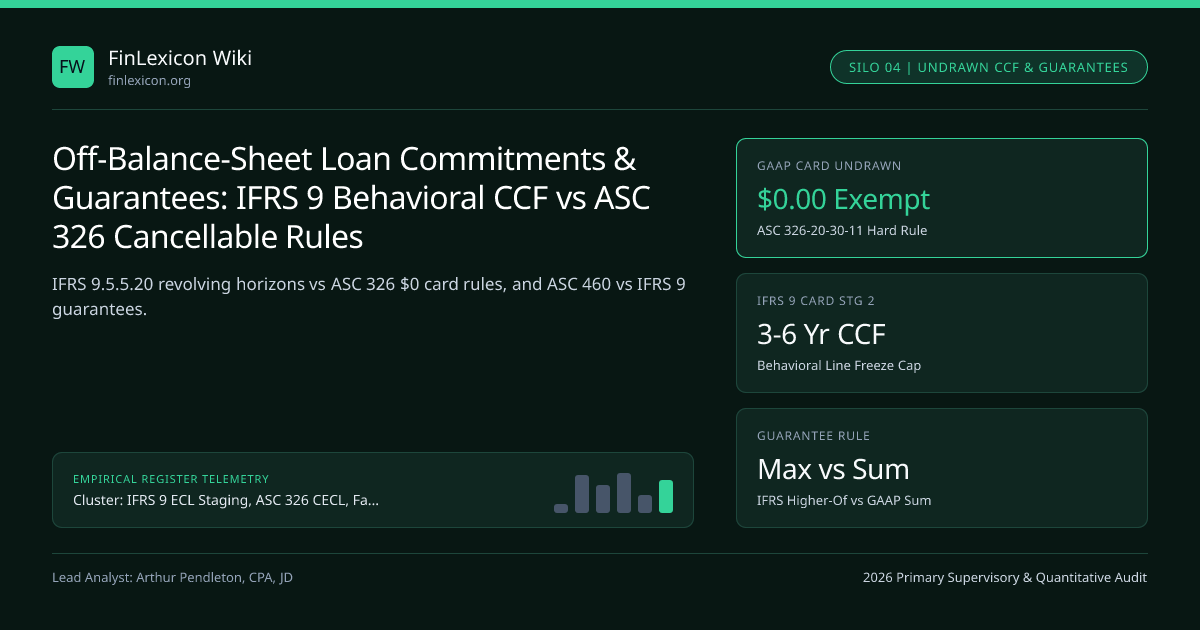
Here is one of the single biggest dollar divergences in global bank accounting: take a $100 billion portfolio of undrawn retail credit card lines (legally unconditionally cancellable by the bank at any moment without prior notice). Under US GAAP (ASC 326-20-30-11), Bank of America and American Express are statutorily required to book $0.00 (ZERO!) CECL credit allowance on the $100B undrawn credit-card limit! Under IFRS 9 (paragraph 5.5.20), BNP Paribas, Bank of Montreal, and ANZ Bank must model multi-year behavioral Credit Conversion Factors (CCFs) and book hundreds of millions in off-balance-sheet ECL provisions on those exact same undrawn card lines!
The Transatlantic Cliff: IFRS 9.5.5.20 Behavioral Revolving Horizon vs ASC 326-20-30-11 Zero-Reserve Rule#
General impairment rules cap ECL measurement at the maximum contractual period over which the lender is exposed to credit risk—normally 0 days if a facility is unconditionally cancellable. Watch how the two boards diverged, anchored in our IFRS 9, CECL & Fair Value cornerstone guide:
- US GAAP (
ASC 326-20-30-11Hard Exemption): States unequivocally that an entity shall NOT estimate expected credit losses on unfunded commitments that are unconditionally cancellable by the issuer (even if the issuer historically never cancels lines until delinquency!). Thus U.S. banks hold CECL reserves only on the already-drawn balance of credit cards and uncommitted lines—while holding full lifetime off-balance-sheet CECL Liabilities (Other Liabilities) on contractually committed corporate revolvers (RCFs), construction loans, and letters of credit! - IFRS 9.5.5.20 (
Revolving Facility Behavioral Carve-In): Carves out any instrument combining a loan AND an undrawn commitment component where contractual cancellation does not limit actual exposure in normal day-to-day risk management (retail credit cards, overdrafts, SME revolving lines). Under IFRS 9.B5.5.39–40, banks must measure Stage 1 (12-month) and Stage 2 (behavioral 3–7 year lifetime!) ECL across *BOTH the drawn balance AND expected future drawdowns (`CCF Undrawn`)** until management’s empirical credit-review cut-off kicks in!
Accounting for Financial Guarantee Contracts (FGCs) & Standby Letters of Credit (IFRS 9.4.2.1(c) vs ASC 460)#
When a bank issues a Financial Guarantee Contract (FGC) or performance/financial standby letter of credit reimbursing a beneficiary for specified debtor default losses:
- IFRS 9.4.2.1(c): Initially recognized as a liability at Fair Value (typically equal to the upfront guarantee fee received). Subsequently measured at the
HIGHER OF:
- The IFRS 9 Stage 1 / Stage 2 / Stage 3 ECL loss allowance, OR
- The unamortized upfront fee balance (
Initial Fair Value minus cumulative IFRS 15 fee amortization)!
- US GAAP (
ASC 460+ASC 326-20): Splits the liability cleanly into TWO separate balance-sheet components (no "higher-of" netting!): (a) a non-contingent ASC 460 stand-ready obligation (unamortized fee liability), PLUS (b) an ASC 326 CECL contingent credit loss liability!
IFRS 9 Behavioral CCF (EAD) vs Prudential Basel CRE20 / CRE32 Downturn CCF#
Do not plug Basel regulatory CCFs straight into IFRS 9 or CECL models without recalibration across BCBS, ECB, and OCC portfolios:
- Basel Standardized (
CRE20.94–101) & A-IRB (CRE32): Impose 10%CCF on unconditionally cancellable commitments (eliminating the old 0% CCF under Basel III Endgame!), 40% CCF on committed corporate revolvers, and downturn-floored EAD. - IFRS 9 / CECL Accounting
CCF(LEQ— Loan Equivalent Factor): Must be unbiased, probability-weighted, and forward-looking (no arbitrary Basel downturn floor!), segmented by utilization band (a 10%-utilized corporate revolver exhibits ~35%–55% pre-default drawdown CCF, whereas an 85%-utilized revolver has limited remaining headroom).
| Off-Balance-Sheet Instrument | IFRS 9 Accounting Reserve Rule | US GAAP ASC 326 (CECL) Reserve Rule | Basel III Endgame (CRE20 SA) CCF |
|---|---|---|---|
Unconditionally Cancellable Credit Cards (Undrawn) | Stage 1 (12m) / Stage 2 (3–6yr behavioral) CCF ECL! | $0.00 (Strictly Exempt — ASC 326-20-30-11) | 10% CCF (up from 0%) |
Committed 5-Year Corporate Revolver (RCF) | Stage 1 (12m) or Stage 2 (5yr contractual) CCF ECL | Day-One 5-Year Contractual Lifetime CCF ECL | 40% CCF |
Financial Guarantee / Standby L/C (FGC) | Higher Of: Unamortized Fee OR Stage 1/2/3 ECL | Sum Of: ASC 460 Unamortized Fee + CECL ECL! | 100% CCF (Direct Credit Sub.) |
Trade Finance Documentary L/C (Short-Term) | Stage 1/2 ECL over short shipment tenor | Lifetime CECL over short shipment tenor | 20% CCF |
Balance-Sheet Presentation: Asset Contra-Allowance vs Off-Balance-Sheet Liability Provision#
Under both standards, ECL on drawn loans reduces the Loan Asset carrying value (Allowance for Loan Losses), whereas ECL on undrawn commitments and guarantees is booked as a Liability (Provision for Credit Losses on Off-Balance-Sheet Exposures) (unless combined drawn+undrawn card ECL exceeds the drawn balance under IFRS 7.B8E) across the IFRS 9, CECL & Fair Value Accounting topic hub.
Discounting Off-Balance-Sheet Drawdowns at the Facility Effective Interest Rate (EIR)#
Per IFRS 9.B5.5.47, expected future losses on undrawn loan commitments are discounted back to the reporting date using the effective interest rate (EIR) of the resulting loan (or a current risk-adjusted rate if floating/undetermined), consistent with IFRS 9 Stage 1/2/3 migration rules and quantitative SICR PD triggers.
- ECLUndrawnIFRS9 = Sum{t=1..TBehav} PDMarginal(t) * [ CCF(t) * Undrawn0 ] * LGD(t) / ( 1 + EIR )^t
- Financial Guarantee Carrying Liability Comparison ($100M Guarantee; Upfront Unamortized Fee = $1.80M; Expected Credit Loss = $1.40M):
- IFRS 9.4.2.1(c) Carrying Liability = max( Unamortized_Fee , ECL ) = max( $1.80M , $1.40M ) = $1.80M!
- US GAAP (ASC 460 + ASC 326) Carrying Liability = Unamortized_Fee + CECL = $1.80M + $1.40M = $3.20M (+78% Higher Liability!)
Frequently asked questions
Why did FASB forbid CECL reserves on unconditionally cancellable credit card lines when borrowers clearly draw down before defaulting?
FASB concluded under Conceptual Framework CON 8 that a bank has no present legal obligation to extend future credit if it possesses an unconditional unilateral right to cancel the unused line at t = 0—avoiding decades-long debates over modeling 10-year future card spend and paydowns (so-called "forever card" horizon problems).
Under US GAAP CECL, how do card issuers allocate future borrower payments between the existing $12B drawn balance and future card purchases?
Because future purchases cannot be reserved, card issuers like American Express and Bank of America apply FASB-accepted payment-allocation methodologies (FIFO, Pro-Rata, or Retail Card Paydown Models) to project how fast the *existing* $12B drawn balance amortizes (typically ~2.5–3.5 years).
Under IFRS 9.5.5.20, what stops the behavioral Stage 2 horizon on a revolving credit card from stretching to 30 years?
IFRS 9.B5.5.40 caps the behavioral horizon using three empirical factors: (1) typical period before a similar risk segment defaults, (2) historical period over which defaults occur following a Stage 2 SICR trigger, and (3) credit risk management actions (such as automated line freezes upon missed payments), typically bounding Stage 2 horizons to 3 to 6 years.
Can an off-balance-sheet commitment be discounted at a risk-free rate if the resulting loan is floating-rate?
Under IFRS 9.B5.5.47–48, if the effective interest rate (EIR) of the future drawn asset cannot be determined in advance, the discount rate must reflect the current market assessment of time value of money plus risks specific to the cash flows (only to the extent risks aren’t already inside the cash-flow numerator).
Publication record
- Published
- 13 November 2026
- Updated
- 15 November 2026
- Author
- Arthur Pendleton, CPA, JD
- Review
- Review not recorded
- Automated fact check
- Passed in the stored pipeline record
- Source URLs
- 3 recorded
AI assistance recorded: anthropic/claude-opus-4.6. This field does not establish human review or source verification.
Academic & Institutional Attribution
Cite This Research & Embed Live Data Card
Standard academic & institutional research paper citation format.
Arthur Pendleton, CPA, JD. (2026, November 14). Off-Balance-Sheet Loan Commitments & Guarantees: IFRS 9 Behavioral CCF vs ASC 326 Cancellable Rules. FinLexicon Wiki. https://finlexicon.org/wiki/loan-commitments-financial-guarantees-ccf-ecl-off-balance-sheetRelated Ifrs9 Cecl Credit Provisioning & Institutional Briefings
Explore Ifrs9 Cecl Credit Provisioning Hub (20) →Ifrs9 Cecl Credit Provisioning
IFRS 9 Expected Credit Loss, US GAAP ASC 326 CECL, Fair Value Hierarchy & Hedge Accounting GuideIfrs9 Cecl Credit Provisioning
Loan Modifications, Forbearance & 10% Derecognition Test (IFRS 9.5.4.3 vs US GAAP ASU 2022-02 TDR Repeal)Ifrs9 Cecl Credit Provisioning
Day-1 P&L Deferral (IFRS 9.B5.1.2A vs US GAAP ASC 820): Level 3 Calibration Reserves & Release RulesIfrs9 Cecl Credit Provisioning
Multi-Scenario Macroeconomic Weighting & Post-Model Adjustments (PMAs / Overlays) in IFRS 9 & CECLIfrs9 Cecl Credit Provisioning
IFRS 7, ASC 326 Vintage Charge-Off Tables & ISA 540 / PCAOB AS 2501 External Audit of Credit Loss EstimatesIfrs9 Cecl Credit Provisioning
Deferred Tax Assets (IAS 12 & ASC 740 Valuation Allowances) vs Basel III CAP30 10% / 17.65% CET1 DeductionsIfrs9 Cecl Credit Provisioning
Held-to-Maturity (HTM) Tainting (ASC 320), IFRS 9.4.4.1 Reclassification & AFS/FVOCI Bond Loss RulesIfrs9 Cecl Credit Provisioning
IFRS 9 Stage 1, Stage 2 & Stage 3 ECL Migration: 12-Month vs Lifetime PD, Net Interest & Cure RulesCentral Clearing Ccp Waterfall
CCP Intraday Variation & Ad-Hoc Margin Calls: Dash-for-Cash Liquidity Spirals & One-Way Pass-ThroughCentral Clearing Ccp Waterfall
Cross-Margining Across Futures & Cleared Fixed Income: CME-FICC Treasury Offsets & Dual BD/FCMsCentral Clearing Ccp Waterfall
CLS Payment-versus-Payment (PvP) FX Settlement: Eliminating Herstatt Risk & 99% Pay-In NettingCentral Clearing Ccp Waterfall
CCP Assessment Powers & Cooling-Off Periods: Capped Cash Calls vs Uncapped Refills & Bank Capital
FinLexicon Wiki Data, Benchmarks & Contributor Records
CC BY 4.0 Open Data
Open Institutional Datasets (CSV / JSON) →
Download desk-compiled quantitative series & schemas.
2026 Reference Matrix
2026 Institutional Benchmarks & Thresholds →
Statutory capital, clearing, margin & rate conventions.
Editorial Records
Authors & Review Records →
View named contributors where those records are available.
Complete Index
Master Research & Dossier Archive →
Browse all published briefings by topic pillar & date.