
Ifrs9 Cecl Credit Provisioning
Loan Modifications, Forbearance & 10% Derecognition Test (IFRS 9.5.4.3 vs US GAAP ASU 2022-02 TDR Repeal)
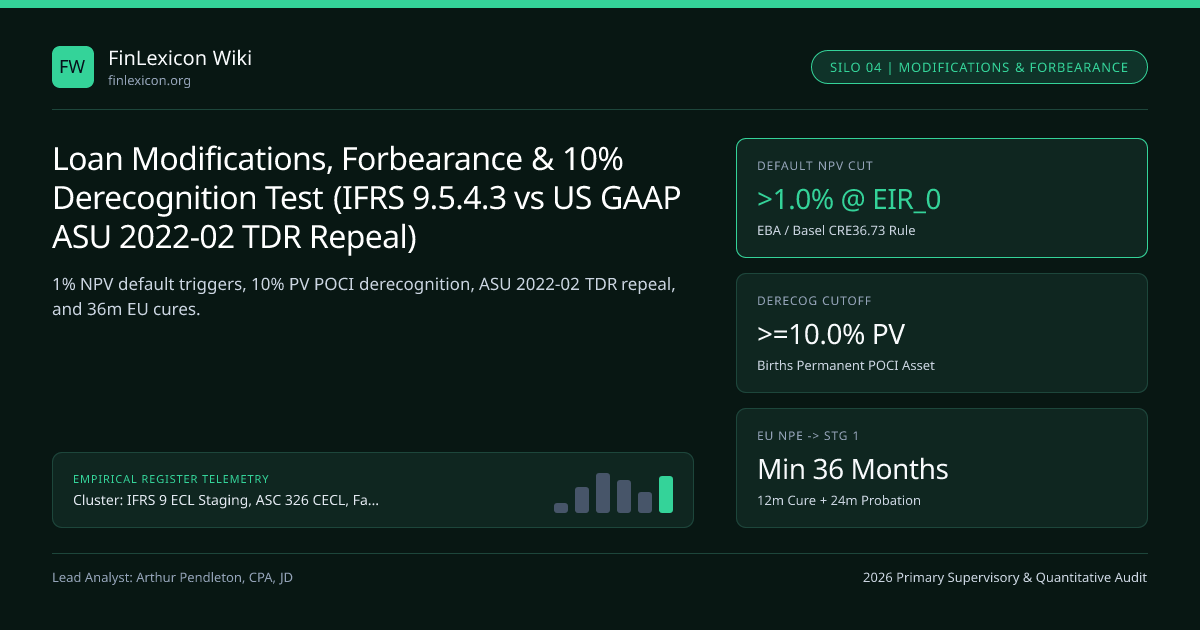
Restructuring a distressed corporate loan or mortgage triggers two tests: whether present-value cash flows shifted >=10% (derecognizing into a new POCI asset) or <10% (booking an immediate IFRS 9.5.4.3 modification loss plus EBA forbearance probation).
When a commercial real estate borrower cannot refinance at 6.75% and the lender agrees to extend maturity by 2 years while cutting the coupon to 4.25%, has the bank merely modified its existing loan, or has it extinguished the old loan and originated a brand-new one? Across BNP Paribas, Bank of America, and Bank of Ireland, the answer hinges on the 10% Present-Value Derecognition Test, IFRS 9.5.4.3 catch-up modification P&L, US GAAP ASU 2022-02’s abolition of Troubled Debt Restructurings (TDRs), and EBA statutory forbearance probation clocks!
Step 1: Substantial (>=10% PV Shift -> Derecognition & POCI) vs Non-Substantial (<10% -> IFRS 9.5.4.3 Catch-Up)#
Under IFRS 9.3.3.2 / B3.3.6 (applied analogously to financial assets alongside qualitative term-change tests like currency switches or equity kickers) and US GAAP ASC 310-20-35-9..12, accountants discount the modified contractual cash flows at the loan’s ORIGINAL Effective Interest Rate (EIR_0) and compare against the pre-modification Gross Carrying Amount (GCA_old), anchored in our IFRS 9, CECL & Fair Value cornerstone guide:
- Non-Substantial Modification (
PV Shift < 10%and No Qualitative Killer):
- The original loan is NOT derecognized and keeps its original
EIR_0! - Under IFRS 9.5.4.3, the bank immediately recalculates
GCA_new = PV(Modified_CFs ; EIR_0)and booksModification_Gain_or_Loss = GCA_new - GCA_oldstraight into Profit or Loss today! Over the remaining life, interest accrues onGCA_newatEIR_0.
- Substantial Modification (
PV Shift >= 10%or Qualitative Change like USD->EUR or Debt-for-Equity Feature):
- The old loan (along with its accumulated Stage 2/3 ECL!) is 100% derecognized.
- A brand-new financial asset is recognized at Day-1 Fair Value! Crucially, if the borrower was credit-impaired at restructuring, that new loan is born as Purchased or Originated Credit-Impaired (
POCI)—locked into Lifetime ECL forever using a Credit-Adjusted Effective Interest Rate (CAEIR) (never eligible to cure back to 12-month Stage 1)!
Why FASB Repealed Troubled Debt Restructurings (TDRs) in US GAAP ASU 2022-02#
For 45 years (FAS 15, 1977), US GAAP forced banks to tag distressed concessions as Troubled Debt Restructurings (TDRs)—locking the loan’s discount rate permanently to its pre-modification EIR_0 inside a standalone DCF impairment silo. Once US GAAP ASC 326 CECL already captured lifetime credit losses on Day 1, separate TDR accounting became redundant! ASU 2022-02 (effective 2023) abolished TDR accounting completely:
- Distressed modifications (
principal forgiveness, interest-rate reductions, payment delays, or term extensions) are now evaluated under general ASC 310-20 loan refinancing/modification rules + standard CECL pooling! - In exchange, ASU 2022-02 mandated granular quarterly vintage footnote disclosures tracking every distressed modification (
by type) granted in the trailing 12 months and subsequent re-default rates!
Supervisory Forbearance & Probation Clocks: EBA 2-Year / 1-Year Cure Rules vs Basel CRE36.73 Diminished Obligation#
Under EBA Guidelines on Non-Performing and Forborne Exposures (EBA/GL/2018/06) enforced by the European Central Bank and Basel CRE36.68–73 enforced by the OCC and FDIC:
- 1% Diminished Financial Obligation Default Trigger (
EBA RTS/Basel CRE36.73): If a distressed restructuring reduces net present value (NPV = (PV_old - PV_new) / PV_olddiscounted atEIR_0) by> 1.0%, the exposure MUST be classified immediately as Defaulted / Non-Performing (Stage 3)! - Mandatory EBA Cure & Probation Clocks:
- A Non-Performing Forborne (
Stage 3) loan must complete a minimum 1-year (12-month) cure period with full timely post-modification principal/interest payments (and zero uncertainty of full repayment) just to exit Non-Performing into Performing Forborne (Stage 2)! - Once in Performing Forborne (
Stage 2), it must serve a further minimum 2-year (24-month) probation period before exiting Forborne status and returning to Stage 1 (12-month ECL)!
| Modification Scenario | IFRS 9 Accounting Treatment | US GAAP (Post-ASU 2022-02) Treatment | EU EBA / Basel Prudential Status |
|---|---|---|---|
Commercial Rate Match (Healthy Borrower, -50 bps) | IFRS 9.5.4.3 catch-up (<10%) or new loan (>=10%); stays Stage 1 | Refinancing test (ASC 310-20); unamortized fees carried/expensed | Not Forborne (No financial difficulty) |
Distressed Coupon Cut (NPV Loss = 4.5%, <10%) | -$4.5M IFRS 9.5.4.3 Mod Loss in P&L; keep EIR_0; Stage 3! | No TDR tag; update CECL allowance + 12m mod footnote! | Defaulted NPE (>1% NPV!) -> 1yr + 2yr clock |
Deep Debt Haircut (NPV Loss = 22.0%, >=10%) | Derecognize old loan; book new POCI loan at Fair Value (CAEIR)! | Derecognize if new loan (ASC 310-20) or partial charge-off + PCD/CECL | Defaulted NPE; POCI never returns to Stage 1! |
6-Month Payment Deferral (0% NPV loss @ EIR_0) | $0 Mod Loss (interest accrues on deferred coupons); Stage 2 Forborne | Evaluated in CECL pool; disclosed as payment delay if >insignificant | Performing Forborne -> 24m probation |
Preventing "Extend and Pretend" Commercial Real Estate (CRE) Masking#
During 2023–2026 office CRE refinancing waves, supervisory examiners scrutinized interest-only (IO) extensions where sponsors injected minimal equity—verifying that Stage 2 SICR / Stage 3 triggers and NPV > 1% default flags were not bypassed across the IFRS 9, CECL & Fair Value Accounting topic hub.
Interaction Between IFRS 9.5.4.3 Modification Loss & Stage 2/3 ECL Release#
When a bank books a -$8.0M IFRS 9.5.4.3 gross modification loss (reducing GCA from $100M to $92M), its Stage 2/3 ECL allowance recalculates on the lower $92M cash flows—preventing double-deduction of the forgiven coupon!
- If Borrower in Financial Difficulty AND NPV_Pct > 1.0% => Mandatory Default / Stage 3 Classification (EBA / CRE36.73)
- If |NPVPct| < 10.0% (and Qualitatively Similar) => Non-Substantial: ModGainLossPnL = PV(CFMod; EIR0) - GCAPreMod
- If |NPV_Pct| >= 10.0% (or Currency/Equity Conversion) => Substantial Derecognition -> New POCI Asset @ Fair Value (CAEIR)
- Stage 3 Interest Revenue Rule (IFRS 9.5.4.1(b)):
- Once Credit-Impaired (Stage 3), Interest Revenue = EIROriginal * AMORTIZEDCOST (GCAnew - ECLStage3), NOT Gross Carrying Amount!
Frequently asked questions
Why is derecognizing a distressed loan into a "POCI" asset (>=10% PV cut) permanent under IFRS 9?
Unlike normal Stage 3 loans—which can eventually cure back to Stage 2 and Stage 1 (12-month ECL)—an asset born as Purchased or Originated Credit-Impaired (POCI, IFRS 9.5.5.13) has lifetime expected credit losses baked into its Credit-Adjusted EIR (CAEIR) at birth and remains in the Lifetime ECL bucket until maturity or payoff!
How does IFRS 9 calculate Interest Income differently once a modified loan enters Stage 3 ("Net vs Gross" rule)?
In Stage 1 and Stage 2, banks accrue interest revenue on the **Gross Carrying Amount (EIR * GCA). Once a loan enters Stage 3 (Credit-Impaired, IFRS 9.5.4.1(b)), interest revenue drops to EIR * Amortized Cost (GCA minus Stage 3 ECL)**—preventing banks from booking phantom interest income on impaired principal!
Did COVID-19 statutory payment moratoria automatically trigger Stage 2/3 Forbearance in 2020?
Regulators (BCBS, EBA/GL/2020/02, and U.S. CARES Act Section 4013) temporarily ruled that broad-based, economy-wide legislative payment moratoria (charging normal contractual interest during a 3–6 month pause) did *not* automatically trigger individual Forbearance/TDR or SICR—though banks still had to screen underlying sector distress!
Under US GAAP post-ASU 2022-02, must banks still use a Discounted Cash Flow (DCF) model on modified loans?
No! One of ASU 2022-02’s biggest operational reliefs was removing legacy TDR mandatory DCF measurement: banks can now measure CECL on modified loans using their standard portfolio PD/LGD or loss-rate methods (unless the bank voluntarily uses a DCF CECL model, in which case ASC 326-20-30-4 requires discounting at the post-modification EIR if rate-concessioned!).
Publication record
- Published
- 13 November 2026
- Updated
- 15 November 2026
- Author
- Arthur Pendleton, CPA, JD
- Review
- Review not recorded
- Automated fact check
- Passed in the stored pipeline record
- Source URLs
- 4 recorded
AI assistance recorded: anthropic/claude-opus-4.6. This field does not establish human review or source verification.
Academic & Institutional Attribution
Cite This Research & Embed Live Data Card
Standard academic & institutional research paper citation format.
Arthur Pendleton, CPA, JD. (2026, November 14). Loan Modifications, Forbearance & 10% Derecognition Test (IFRS 9.5.4.3 vs US GAAP ASU 2022-02 TDR Repeal). FinLexicon Wiki. https://finlexicon.org/wiki/contractual-modifications-forbearance-10-percent-derecognitionRelated Ifrs9 Cecl Credit Provisioning & Institutional Briefings
Explore Ifrs9 Cecl Credit Provisioning Hub (20) →Ifrs9 Cecl Credit Provisioning
IFRS 9 Expected Credit Loss, US GAAP ASC 326 CECL, Fair Value Hierarchy & Hedge Accounting GuideIfrs9 Cecl Credit Provisioning
Day-1 P&L Deferral (IFRS 9.B5.1.2A vs US GAAP ASC 820): Level 3 Calibration Reserves & Release RulesIfrs9 Cecl Credit Provisioning
Multi-Scenario Macroeconomic Weighting & Post-Model Adjustments (PMAs / Overlays) in IFRS 9 & CECLIfrs9 Cecl Credit Provisioning
IFRS 7, ASC 326 Vintage Charge-Off Tables & ISA 540 / PCAOB AS 2501 External Audit of Credit Loss EstimatesIfrs9 Cecl Credit Provisioning
Deferred Tax Assets (IAS 12 & ASC 740 Valuation Allowances) vs Basel III CAP30 10% / 17.65% CET1 DeductionsIfrs9 Cecl Credit Provisioning
Held-to-Maturity (HTM) Tainting (ASC 320), IFRS 9.4.4.1 Reclassification & AFS/FVOCI Bond Loss RulesIfrs9 Cecl Credit Provisioning
IFRS 9 Stage 1, Stage 2 & Stage 3 ECL Migration: 12-Month vs Lifetime PD, Net Interest & Cure RulesIfrs9 Cecl Credit Provisioning
US GAAP ASC 326 (CECL): Day-One Lifetime Loss, R&S Reversion & ASU 2025-08 M&A Double-Count ReformCentral Clearing Ccp Waterfall
Cross-Margining Across Futures & Cleared Fixed Income: CME-FICC Treasury Offsets & Dual BD/FCMsCentral Clearing Ccp Waterfall
CLS Payment-versus-Payment (PvP) FX Settlement: Eliminating Herstatt Risk & 99% Pay-In NettingCentral Clearing Ccp Waterfall
CCP Assessment Powers & Cooling-Off Periods: Capped Cash Calls vs Uncapped Refills & Bank CapitalCentral Clearing Ccp Waterfall
EU CCP Recovery & Resolution Regulation (CCPRRR 2021/23) vs US Dodd-Frank Title II/VIII: NCWO & Bail-In
FinLexicon Wiki Data, Benchmarks & Contributor Records
CC BY 4.0 Open Data
Open Institutional Datasets (CSV / JSON) →
Download desk-compiled quantitative series & schemas.
2026 Reference Matrix
2026 Institutional Benchmarks & Thresholds →
Statutory capital, clearing, margin & rate conventions.
Editorial Records
Authors & Review Records →
View named contributors where those records are available.
Complete Index
Master Research & Dossier Archive →
Browse all published briefings by topic pillar & date.