
Ifrs9 Cecl Credit Provisioning
Day-1 P&L Deferral (IFRS 9.B5.1.2A vs US GAAP ASC 820): Level 3 Calibration Reserves & Release Rules
When an exotic derivatives desk executes a 15-year structured autocallable priced off unobservable Level 3 correlations at $96.5M theoretical value against $100.0M cash received, IFRS 9.B5.1.2A defers the $3.5M Day-1 profit—whereas US GAAP ASC 820 allows immediate Day-1 P&L recognition!
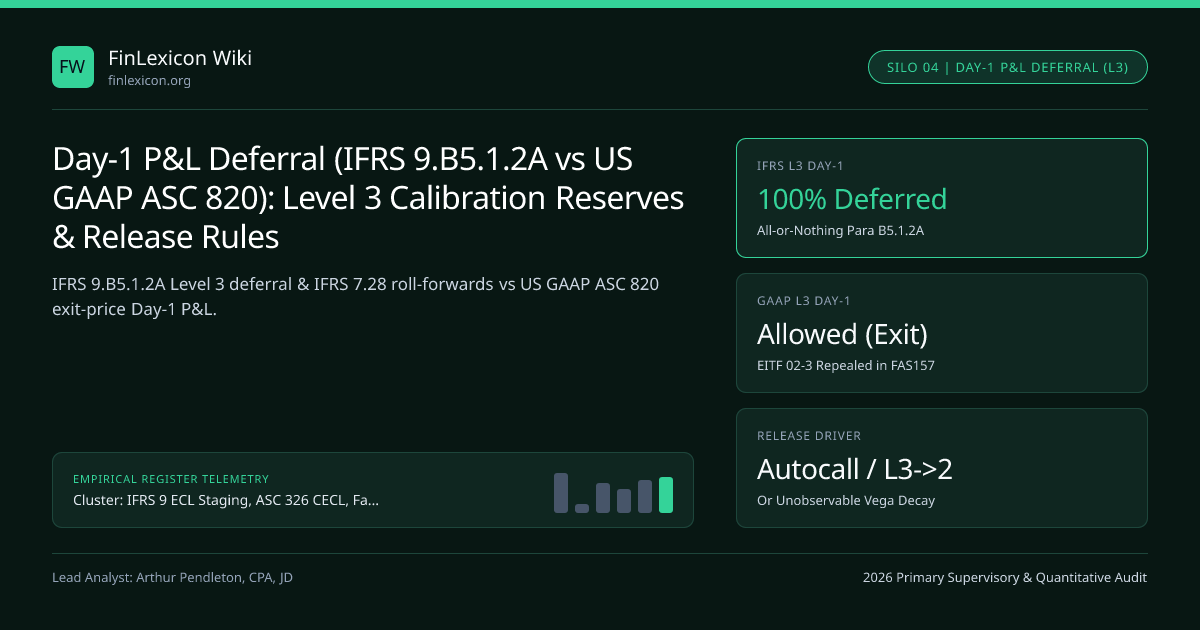
Imagine an equity derivatives desk structures a $100.0 million 10-year worst-of basket autocallable note for a private wealth distributor: the desk’s local-stochastic-volatility Monte Carlo engine values the embedded exotic options at $96.5M, implying a +$3.5 million upfront structuring margin (Day-1 P&L) at t = 0. Can the desk book +$3.5M revenue on Day 1? If the bank reports under IFRS (BNP Paribas, BMO, ANZ), NO — IFRS 9.B5.1.2A strictly defers 100% of that +$3.5M Day-1 profit! If the bank reports under US GAAP (Bank of America), YES — ASC 820-10-30-3A permits immediate Day-1 P&L recognition (net of exit bid-ask and valuation reserves)!
The Strict IFRS Gate (IFRS 9.B5.1.2A / IFRS 13.B4): Observable Level 1/2 Proof Required for Day-1 Revenue#
Under IFRS 9 paragraph B5.1.2A, the best evidence of a financial instrument’s Fair Value at initial recognition is normally the Transaction Price ($100.0M). A bank reporting under IFRS (such as BNP Paribas, Bank of Montreal, or Berenberg Bank) may recognize a Day-1 gain or loss (Fair Value != Transaction Price) in Profit or Loss ONLY IF that fair value is evidenced by:
- A quoted price in an active market for an identical asset or liability (
Level 1), OR - A valuation technique that uses ONLY data from observable markets (
Level 2— verified via S&P Totem / multi-dealer IPV)!
Whenever any significant input is unobservable (Level 3)—such as multi-stock long-dated equity correlation, bespoke longevity mortality rates, or illiquid private credit spreads—100% of the $3.5M Day-1 difference MUST be deferred as a contra-valuation adjustment (Deferred Day-1 P&L Reserve) on the balance sheet, anchored in our IFRS 9, CECL & Fair Value cornerstone guide!
Why US GAAP (ASC 820-10-30-3A, Repealing EITF 02-3) Allows Day-1 Level 3 Exit-Price Gains#
Prior to 2008, US GAAP enforced EITF Issue No. 02-3 (written right after Enron’s infamous 20-year unobservable energy derivative mark-to-model abuses!), which mirrored IFRS by banning Day-1 Level 3 gains. When FASB adopted FAS 157 (ASC 820), it nullified EITF 02-3 footnote 3!
Why? Because ASC 820 defines Fair Value strictly as an Exit Price in the Principal Market! When a retail structured-note distributor (Entry Market) pays Bank of America $100.0M for a note that Bank of America can hedge/exit in the Wholesale Inter-Dealer Market (Principal Exit Market, ASC 820-10-30-3A(d)) for $96.5M (plus $0.8M conservative model/CVA/bid-ask reserves = $97.3M), the $2.7M retail-vs-wholesale market-access spread is a real economic Day-1 exit gain under US GAAP—booked immediately at t = 0 and disclosed inside the Level 3 roll-forward footnote!
Amortizing & Releasing Deferred Day-1 P&L Reserves Under IFRS 9.B5.1.2A(b)#
Under IFRS 9.B5.1.2A(b), once $3.5M is locked inside the Deferred Day-1 P&L Reserve, Valuation Control Groups (VCG) can release it into P&L ONLY to the extent it arises from a change in a factor (including time) that market participants would price:
- Observability Passage (
Level 3 -> Level 2Decay): A 10-year FX/equity option starts in Level 3 because Totem only verifies 5-year volatility; 5 years later, its remaining 5-year tenor becomes 100% observable (Level 2) -> 100% of remaining Day-1 reserve releases immediately to P&L! - Vega / Correlation Decay Profile (
vs Straight-Line Time): Rather than crude straight-line amortization where correlation risk is front- or back-loaded, ECB and UK PRA supervisors expect amortization weighted by unobservable parameter sensitivity (e.g., remaining unobservable Vega/Cega decay) or early autocall knock-out termination!
| Accounting Dimension | IFRS 9.B5.1.2A (IFRS 13.B4) | US GAAP ASC 820-10-30-3A (Post-FAS 157) |
|---|---|---|
| Level 1 / Level 2 Day-1 Gain/Loss | Recognized immediately in P&L (net of bid-ask & xVA) | Recognized immediately in P&L (net of bid-ask & xVA) |
| Level 3 Unobservable Day-1 Gain/Loss | 100% Deferred on Balance Sheet (0% Day-1 P&L!) | Recognized in Day-1 P&L if Exit Market != Entry Market (EITF 02-3 repealed) |
| Balance-Sheet Classification of Reserve | Netted directly against Derivative Asset / Liability carrying FV | Model uncertainty booked inside Level 3 FV calibration |
Subsequent Release Triggers (IFRS) | Unobservable risk decay, L3 -> L2 roll-down, or early termination | N/A (subsequent MTM flows through Level 3 P&L) |
| Footnote Transparency | IFRS 7.28 Deferred Day-1 P&L roll-forward table! | ASC 820-10-50-2 Level 3 roll-forward footnote |
Interaction With EU/UK CRR Art. 105 Prudent Valuation (Model Risk & MPU AVAs)#
At European G-SIBs, an unreleased IFRS 9 Deferred Day-1 P&L Reserve already depresses accounting Fair Value and CET1—so under EBA RTS 2016/101 Prudent Valuation rules, Valuation Control teams verify whether that deferred reserve offsets Model Risk AVA or requires incremental 90%-confidence CET1 deductions across the IFRS 9, CECL & Fair Value Accounting topic hub.

Audit Controls Over "Day-2 Release" Abuse & Calibration Shifting#
External auditors under ISA 540 / PCAOB AS 2501 strictly police Day-2 re-marking—ensuring traders cannot lock a zero Day-1 P&L via a calibrated Day-1 fudge factor and then delete the fudge factor on Day 2!
- CarryingAmountIFRS(t) = ModelFairValueL3(t) + Day1DeferredReserve0 * ( UnobsSensitivity(t) / UnobsSensitivity(0) )
- Worked 5-Year Worst-Of Autocallable Note ($100.0M Client Cash; Model Mid = $95.8M; Bid-Ask + xVA = -$0.7M -> Net Exit Model = $96.5M Liability):
- IFRS 9.B5.1.2A: Books $96.5M Model Liability + $3.5M Deferred Day-1 Reserve = $100.0M Liability -> Day-1 P&L = $0.00M!
- (If note autocalls at Year 1 coupon observation -> $3.5M Deferred Reserve releases 100% into Year 1 P&L!)
- US GAAP ASC 820: Books $96.5M Wholesale Exit Liability + Conservative Model Uncertainty ($0.8M) = $97.3M -> Day-1 P&L = +$2.70M!
Frequently asked questions
If only 15% of an exotic trade’s risk comes from an unobservable correlation and 85% is observable SOFR/FX, can an IFRS bank recognize 85% of the Day-1 profit?
NO! Under IFRS 9.B5.1.2A and IFRS 13.73, Day-1 P&L deferral is an all-or-nothing instrument-level test: if that unobservable correlation is *significant* to the instrument’s fair value (classifying the trade in Level 3), 100% of the Day-1 profit must be deferred (zero partial split)!
What happens under IFRS 9 if a Level 3 trade shows a Day-1 LOSS (Model Value is worse for the bank than Transaction Price)?
IFRS 9.B5.1.2A is symmetrical—technically deferring both Day-1 gains *and* Day-1 losses when unobservable! However, Valuation Control Groups investigate any apparent Day-1 loss immediately for mispricing, unauthorized trader concessions, or credit impairment, often booking an immediate operational/valuation reserve.
Why did BNP Paribas, Société Générale, and Barclays accumulate EUR 500M–1B+ in IFRS 7.28 Deferred Day-1 P&L reserves?
European investment banks are global powerhouses in multi-asset equity autocallables, dispersion trades, and QIS structured notes; because multi-underlying equity correlation (>2–3 years) is rarely observable in liquid inter-dealer markets, billions of structured notes enter Level 3 with deferred Day-1 margins!
Why did FASB repeal EITF 02-3 when adopting ASC 820 (FAS 157)?
FASB reasoned that forcing a dealer to carry a liability at $100.0M retail entry cash when wholesale dealers would exit it for $97.3M violated ASC 820’s core definition of Fair Value as an Exit Price—relying instead on strict Valuation Control IPV, PCAOB AS 2501 audit scrutiny, and Level 3 roll-forward disclosures.
Publication record
- Published
- 13 November 2026
- Updated
- 15 November 2026
- Author
- Arthur Pendleton, CPA, JD
- Review
- Review not recorded
- Automated fact check
- Passed in the stored pipeline record
- Source URLs
- 3 recorded
AI assistance recorded: anthropic/claude-opus-4.6. This field does not establish human review or source verification.
Academic & Institutional Attribution
Cite This Research & Embed Live Data Card
Standard academic & institutional research paper citation format.
Arthur Pendleton, CPA, JD. (2026, November 14). Day-1 P&L Deferral (IFRS 9.B5.1.2A vs US GAAP ASC 820): Level 3 Calibration Reserves & Release Rules. FinLexicon Wiki. https://finlexicon.org/wiki/day-1-p-and-l-deferral-ifrs-9-b5-1-2a-unobservable-model-reserveRelated Ifrs9 Cecl Credit Provisioning & Institutional Briefings
Explore Ifrs9 Cecl Credit Provisioning Hub (20) →Ifrs9 Cecl Credit Provisioning
IFRS 9 Expected Credit Loss, US GAAP ASC 326 CECL, Fair Value Hierarchy & Hedge Accounting GuideIfrs9 Cecl Credit Provisioning
Multi-Scenario Macroeconomic Weighting & Post-Model Adjustments (PMAs / Overlays) in IFRS 9 & CECLIfrs9 Cecl Credit Provisioning
IFRS 7, ASC 326 Vintage Charge-Off Tables & ISA 540 / PCAOB AS 2501 External Audit of Credit Loss EstimatesIfrs9 Cecl Credit Provisioning
Deferred Tax Assets (IAS 12 & ASC 740 Valuation Allowances) vs Basel III CAP30 10% / 17.65% CET1 DeductionsIfrs9 Cecl Credit Provisioning
Held-to-Maturity (HTM) Tainting (ASC 320), IFRS 9.4.4.1 Reclassification & AFS/FVOCI Bond Loss RulesIfrs9 Cecl Credit Provisioning
IFRS 9 Stage 1, Stage 2 & Stage 3 ECL Migration: 12-Month vs Lifetime PD, Net Interest & Cure RulesIfrs9 Cecl Credit Provisioning
US GAAP ASC 326 (CECL): Day-One Lifetime Loss, R&S Reversion & ASU 2025-08 M&A Double-Count ReformIfrs9 Cecl Credit Provisioning
IFRS 9 vs CECL Procyclicality in Stress & Basel CET1 Regulatory Capital Transitional Phase-InsCentral Clearing Ccp Waterfall
CLS Payment-versus-Payment (PvP) FX Settlement: Eliminating Herstatt Risk & 99% Pay-In NettingCentral Clearing Ccp Waterfall
CCP Assessment Powers & Cooling-Off Periods: Capped Cash Calls vs Uncapped Refills & Bank CapitalCentral Clearing Ccp Waterfall
EU CCP Recovery & Resolution Regulation (CCPRRR 2021/23) vs US Dodd-Frank Title II/VIII: NCWO & Bail-InCentral Clearing Ccp Waterfall
CCP Initial Margin Models (Expected Shortfall vs SPAN 2): 5-Day House vs 7-Day Client MPOR & Porting
FinLexicon Wiki Data, Benchmarks & Contributor Records
CC BY 4.0 Open Data
Open Institutional Datasets (CSV / JSON) →
Download desk-compiled quantitative series & schemas.
2026 Reference Matrix
2026 Institutional Benchmarks & Thresholds →
Statutory capital, clearing, margin & rate conventions.
Editorial Records
Authors & Review Records →
View named contributors where those records are available.
Complete Index
Master Research & Dossier Archive →
Browse all published briefings by topic pillar & date.