
Ifrs9 Cecl Credit Provisioning
xVA Valuation Adjustments (CVA, DVA, FVA, KVA & MVA): IFRS 13 / ASC 820 Accounting vs Basel MAR50 Capital
Modern OTC derivative desks price five interlocking Valuation Adjustments (CVA, DVA, FVA, MVA, KVA)—yet IFRS 13 / ASC 820 accounting fair value, Basel CAP30 CET1 DVA filters, and Basel MAR50 CVA RWA treat each adjustment very differently!
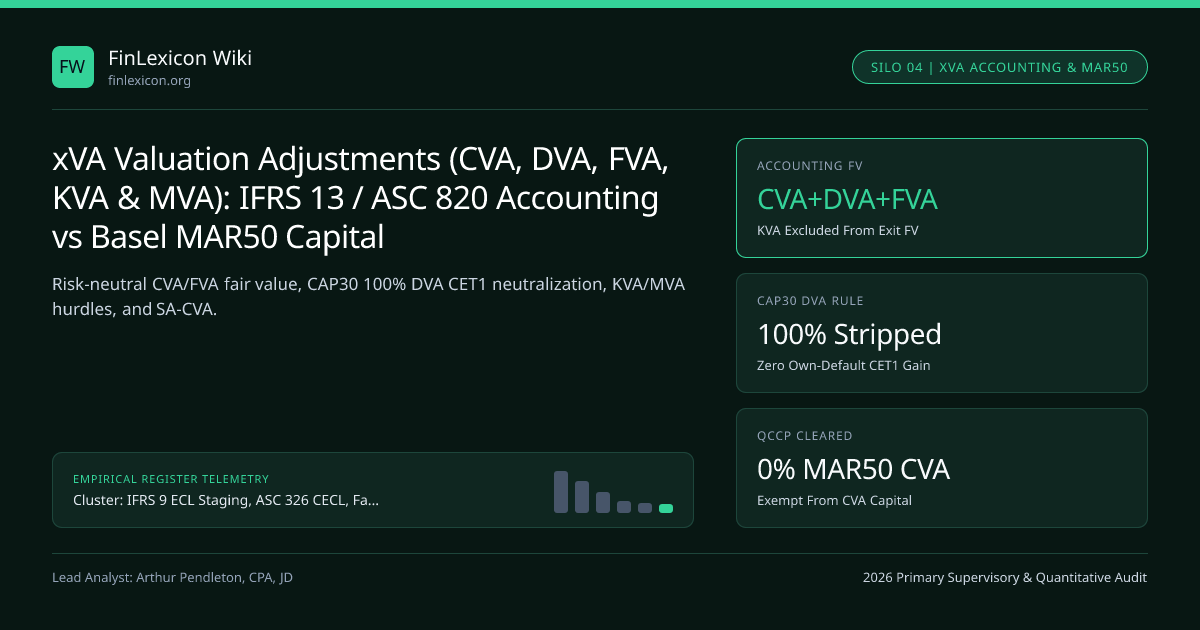
During the 2007–2009 crisis, two-thirds of bank counterparty credit losses came NOT from actual counterparty bankruptcies, but from mark-to-market Credit Valuation Adjustment (CVA) write-downs as counterparty CDS spreads widened! Today, centralized xVA Desks at Bank of America, BNP Paribas, and Bank of Montreal price five coupled adjustments (CVA, DVA, FVA, MVA, and KVA)—navigating sharp boundaries between IFRS 13 / ASC 820 Accounting Fair Value, Basel CAP30 CET1 Filters, and Basel III Endgame MAR50 CVA Capital!
Which xVAs Belong Inside IFRS 13 / ASC 820 Fair Value vs Economic Deal Pricing Only?#
Under IFRS 13.42 and ASC 820-10-35-16BB, Fair Value must reflect all assumptions market participants would price into an exit transfer, including non-performance risk, anchored in our IFRS 9, CECL & Fair Value cornerstone guide:
CVA(Credit Valuation Adjustment — 100% In Accounting FV): Risk-neutral expected value of counterparty default losses (LGD * Integral EPE(t) * dPD_Q(t)), priced off market-implied CDS spreads (never historical physical PDs!).DVA(Debit Valuation Adjustment — In Accounting FV, 100% Stripped Out of Basel CET1!): Mirror-image gain from the bank’s own default risk (LGD_own * Integral ENE(t) * dPD_own(t)). Wait: if a bank’s own CDS spread widens+200 bpsbecause the bank is failing, accountingDVAbooks a fair-value GAIN! Because a bank cannot use its own insolvency gain to absorb going-concern losses, BaselCAP30.15deducts 100% of cumulative Derivative DVA gains (and reverses DVA losses!) straight out of CET1!FVA(Funding Valuation Adjustment — In Accounting FV Since 2012–2014): Asymmetric treasury funding cost (FCA) and benefit (FBA) on uncollateralized derivative receivables hedged with Cash-VM inter-dealer/CCP swaps (JPMorgan’s landmark $1.5B Q4 2013 FVA adoption cemented industry exit-price consensus).MVA(Margin Valuation Adjustment) &KVA(Capital Valuation Adjustment — Economic Pricing / PVA Only!): Cost of funding segregated UMR SIMM / CCP Initial Margin (`MVA`) and earning a10%–12%hurdle ROE on lifetime SA-CCR + CVA + Market RWA (`KVA`). Because KVA is an entity-specific regulatory capital return hurdle rather than a market-wide cash flow, IFRS 13 / ASC 820 generally EXCLUDE KVA from balance-sheet Fair Value (charging KVA in upfront commercial trade quotes while booking Day-1 P&L reserves or Prudent Valuation `IFC` AVAs where unobservable!).
The Accounting-vs-Basel Hedge Mismatch & Finalized Basel III MAR50 (SA-CVA vs BA-CVA)#
Look at the classic CDS CVA Hedge Accounting Mismatch solved partially by Basel III Endgame chapter MAR50 across Federal Reserve, ECB (CRR III), and UK PRA rules:
- Under Basel III 2010, CVA capital covered only counterparty credit spread risk—ignoring the interest-rate and FX exposure hedges that xVA desks execute to hedge CVA’s
EPEexposure leg! Worse, in the EU, CRR I exempted Non-Financial Corporates, Sovereigns, and Pension Funds from CVA capital, so buying a single-name CDS to hedge a corporate’s accounting CVA actually penalized FRTB market risk RWA! - Finalized
MAR50Overhaul: Abolishes internal VaR CVA models in favor of two standardized tiers:
- Standardized Approach for CVA (
SA-CVA, supervisory approval required): Adapted directly from FRTBSBM! Recognizes BOTH counterparty credit-spread hedges (CDS/CDX) AND market-risk exposure hedges (IR swaps,FX forwardshedging EPE sensitivity!), calibrated to align closely with IFRS 13 accounting CVA! - Basic Approach for CVA (
BA-CVA): Splits into Reduced BA-CVA (no hedges recognized;DS = 0.65scalar) and Full BA-CVA (0.25 * K_reduced + 0.75 * K_hedged, recognizing single-name & index CDS hedges only).
Wrong-Way Risk (WWR) Multiplication in xVA Monte Carlo Engines#
Standard independent CVA = LGD * Sum EPE(t_i) * PD(t_{i-1}, t_i) fails catastrophically under Specific or General Wrong-Way Risk—such as buying oil protection from an oil producer or selling USD/TRY swaps to a Turkish bank (EPE explodes at the exact moment PD jumps to 100%!), requiring correlated hazard-rate Monte Carlo simulation and a 1.2x–1.4x IMM alpha multiplier.
| xVA Component | Economic Driver | In IFRS 13 / ASC 820 Fair Value? | Basel CAP30 CET1 Filter? | Basel MAR50 / RWA Capital Link |
|---|---|---|---|---|
| CVA (Credit Valuation Adj.) | Counterparty default loss on EPE(t) | YES (100% Mandatory) | Flows into CET1 via P&L | Taxed for spread vol in MAR50 SA-CVA / BA-CVA |
| DVA (Debit Valuation Adj.) | Own bank default gain on ENE(t) | YES (Non-performance risk) | YES — 100% Deducted/Reversed! | 0% DVA offset allowed in Basel CVA RWA |
| FVA (Funding Valuation Adj.) | Treasury spread on unmargined MTM vs CCP VM | YES (Industry standard since 2014) | Flows into CET1 (IFC AVA in EU) | Driven by 100% NSFR RSF on uncollat. assets |
| MVA (Margin Valuation Adj.) | Funding cost of segregated SIMM / CCP IM | Partial / Emerging (ColVA/MVA) | Captured in IFC AVA if material | Driven by 85% NSFR RSF on posted IM |
| KVA (Capital Valuation Adj.) | ~11% ROE cost on lifetime SA-CCR + CVA RWA | NO (Excluded from exit FV!) | Not on balance sheet | Commercial hurdle priced upfront to client |
Quantifying All-In xVA Hurdles on Corporate Uncollateralized Swaps#
On a 10-year uncollateralized BBB corporate swap, FVA (~8–14 bps) + KVA (~10–18 bps) routinely exceed CVA (~6–10 bps)—explaining why dealers reward voluntary Cash VM CSAs across the IFRS 9, CECL & Fair Value Accounting topic hub.
Cross-Checking Derivative DVA vs Bond Own-Credit OCI Rules#
Distinguish Derivative DVA (flows through P&L under IFRS 9/ASC 820, then deducted 100% from CET1 under CAP30.15!) from Fair-Value-Option Structured Note Own Credit (routed directly to OCI under IFRS 9.5.7.7 & ASC 825-10, ALSO deducted from CET1!).
- FVASymmetric = Sum{k=1..N} dtk * DFOIS(tk) * [ sFundBorrow(tk) * EPEUncollat(tk) - sFundLend(tk) * ENEUncollat(t_k) ]
- KVAEconomic = ( HurdleROE - rOIS ) * Sum{k=1..N} dtk * DFOIS(tk) * E[ CET1RatioReq * ( RWASACCR(tk) + RWACVA(t_k) ) ]
- Worked Basel CAP30.15 Derivative DVA CET1 Neutralization Audit (Bank’s Own 5Y CDS Widens +120 bps in Crisis Quarter):
- 1. IFRS 13 / ASC 820 Income Statement: Books +$280.0M Pre-Tax Bilateral DVA Gain (+$210.0M After-Tax Gain in GAAP/IFRS Equity!).
- 2. Basel CAP30.15 Prudential Adjustment: Deducts -$210.0M Cumulative Post-Tax DVA Gain from CET1 => Net CET1 Impact = $0.00M!
Frequently asked questions
Why MUST IFRS 13 / ASC 820 CVA use market-implied CDS "Risk-Neutral" PDs instead of historical Moody’s / IFRS 9 PDs?
Because Fair Value is an Exit Price—the price another swap dealer would demand today to take over the counterparty credit risk and hedge it dynamically in the CDS market! Market CDS spreads (~110 bps on BBB) are 3x–5x higher than physical historical default losses (~25 bps), so plugging historical PDs into CVA violates IFRS 13 and draws immediate audit restatements!
Why did the European Union create a controversial "CVA Exemption" for Non-Financial Corporates and Sovereigns in CRR, and did CRR III keep it?
European corporates and sovereign debt offices argued in 2013 that charging Basel CVA RWA on unmargined corporate hedges hurt real-economy hedging; EU CRR III largely preserved the Pillar 1 CVA exemption for qualifying NFCs/sovereigns/pension funds while requiring Pillar 3 disclosure (CCR2) and ECB Pillar 2 monitoring of "excluded CVA risk"!
What happens if an xVA desk buys a single-name CDS to hedge a corporate’s accounting CVA when that corporate is exempt from EU CVA capital?
Without a special rule, the CDS hedge would sit naked inside the FRTB Trading Book, *increasing* Market Risk RWA! EU CRR Art. 386 / MAR50 explicitly allows banks to carve eligible CVA hedges of exempted counterparties out of FRTB market risk RWA so prudent economic hedging isn’t penalized!
Why does posting UMR SIMM Initial Margin replace CVA/KVA with MVA rather than making bilateral swaps free?
Posting $200M of two-way segregated SIMM Initial Margin collapses counterparty default loss (CVA -> ~0) and dampens SA-CCR (KVA drops), but borrowing $200M of Treasury bonds/cash (85% NSFR RSF!) for 10 years to lock inside BNY Mellon/Euroclear costs 50–85 bps funding spread = MVA!
Publication record
- Published
- 13 November 2026
- Updated
- 15 November 2026
- Author
- Arthur Pendleton, CPA, JD
- Review
- Review not recorded
- Automated fact check
- Passed in the stored pipeline record
- Source URLs
- 4 recorded
AI assistance recorded: anthropic/claude-opus-4.6. This field does not establish human review or source verification.
Academic & Institutional Attribution
Cite This Research & Embed Live Data Card
Standard academic & institutional research paper citation format.
Arthur Pendleton, CPA, JD. (2026, November 14). xVA Valuation Adjustments (CVA, DVA, FVA, KVA & MVA): IFRS 13 / ASC 820 Accounting vs Basel MAR50 Capital. FinLexicon Wiki. https://finlexicon.org/wiki/xva-valuation-adjustments-cva-dva-fva-kva-mva-accounting-baselRelated Ifrs9 Cecl Credit Provisioning & Institutional Briefings
Explore Ifrs9 Cecl Credit Provisioning Hub (20) →Ifrs9 Cecl Credit Provisioning
IFRS 9 Expected Credit Loss, US GAAP ASC 326 CECL, Fair Value Hierarchy & Hedge Accounting GuideIfrs9 Cecl Credit Provisioning
Own-Credit Risk on Fair-Value Option Liabilities (IFRS 9.5.7.7 & ASC 825-10): OCI & Basel CET1 FiltersIfrs9 Cecl Credit Provisioning
IFRS 9 General Hedge Accounting vs US GAAP ASC 815: Rebalancing, Cost of Hedging OCI & Effectiveness RulesIfrs9 Cecl Credit Provisioning
Portfolio Macro Fair-Value Hedge Accounting: EU IAS 39 Carve-Out, US GAAP Portfolio Layer Method & IASB DRMIfrs9 Cecl Credit Provisioning
Off-Balance-Sheet Loan Commitments & Guarantees: IFRS 9 Behavioral CCF vs ASC 326 Cancellable RulesIfrs9 Cecl Credit Provisioning
Loan Modifications, Forbearance & 10% Derecognition Test (IFRS 9.5.4.3 vs US GAAP ASU 2022-02 TDR Repeal)Ifrs9 Cecl Credit Provisioning
Day-1 P&L Deferral (IFRS 9.B5.1.2A vs US GAAP ASC 820): Level 3 Calibration Reserves & Release RulesIfrs9 Cecl Credit Provisioning
Multi-Scenario Macroeconomic Weighting & Post-Model Adjustments (PMAs / Overlays) in IFRS 9 & CECLCentral Clearing Ccp Waterfall
FICC Capped Contingency Liquidity Facility (CCLF): Cover-1 Repo Liquidity Sizing & Bank LCR ImpactCentral Clearing Ccp Waterfall
CCP Margin Anti-Procyclicality (APC): EMIR RTS Article 28 25% Buffer, 10-Year Stress Weight & Margin FloorsCentral Clearing Ccp Waterfall
CCP Default Management Groups (DMG), Macro Hedging, Auction Juniorization & 2018 Nasdaq LessonsCentral Clearing Ccp Waterfall
Basel III CRE54 Qualifying CCP (QCCP) Capital: 2% vs 4% Client Trade Exposure Risk Weights & K_CCP
FinLexicon Wiki Data, Benchmarks & Contributor Records
CC BY 4.0 Open Data
Open Institutional Datasets (CSV / JSON) →
Download desk-compiled quantitative series & schemas.
2026 Reference Matrix
2026 Institutional Benchmarks & Thresholds →
Statutory capital, clearing, margin & rate conventions.
Editorial Records
Authors & Review Records →
View named contributors where those records are available.
Complete Index
Master Research & Dossier Archive →
Browse all published briefings by topic pillar & date.