
Ifrs9 Cecl Credit Provisioning
Portfolio Macro Fair-Value Hedge Accounting: EU IAS 39 Carve-Out, US GAAP Portfolio Layer Method & IASB DRM
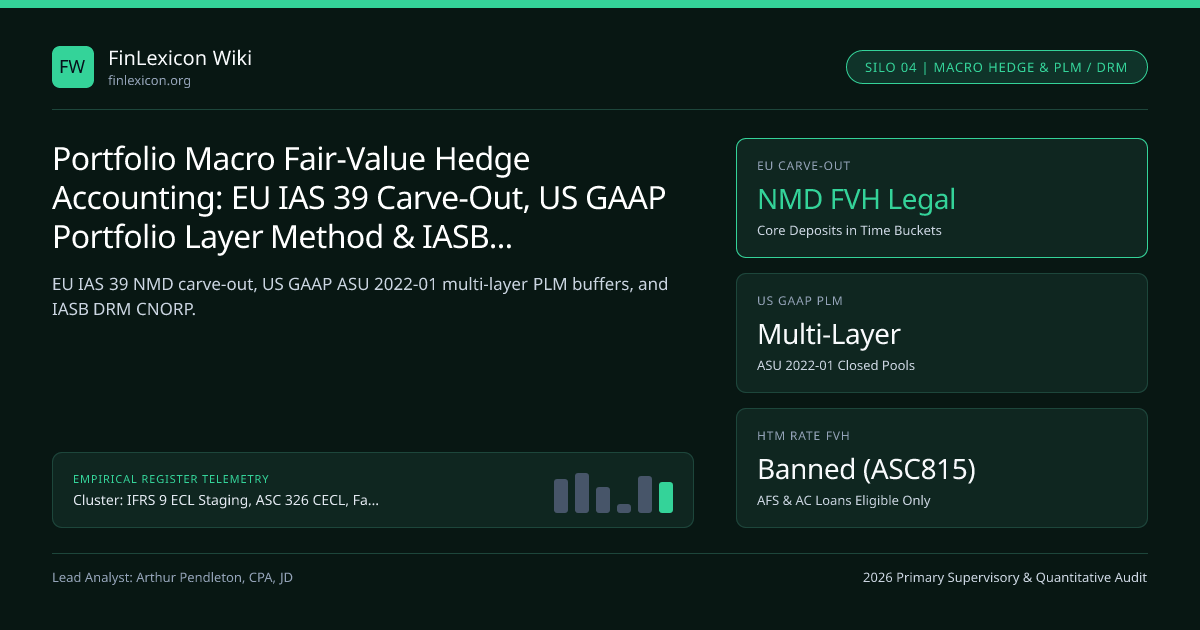
Commercial banks manage Interest Rate Risk in the Banking Book (IRRBB) dynamically across open portfolios of prepayable mortgages and core demand deposits—driving the EU IAS 39 Carve-Out, US GAAP Portfolio Layer Method (ASU 2022-01), and the IASB Dynamic Risk Management (DRM) model.
Retail and commercial banks never hedge one $350,000 residential mortgage or one $8,000 checking account at a time: Asset-Liability Committees (ALCOs) manage net duration dynamically across open, constantly churning portfolios of millions of prepayable loans and 0% non-maturing core demand deposits (NMDs). Yet standard micro hedge accounting (IFRS 9 Chapter 6) breaks down on open portfolios—explaining why IFRS 9.6.1.3 explicitly lets banks keep applying IAS 39’s Macro Fair-Value Hedge rules, why the European Union enacted its statutory IAS 39 Carve-Out, and why FASB launched the Portfolio Layer Method (ASU 2022-01)!
Why Unadjusted IAS 39 Failed on Core Demand Deposits & Prepayable Mortgages — and What the EU Carve-Out Deleted#
In full IFRS (IAS 39.AG114–AG132), two rigid clauses crippled European retail banks like BNP Paribas, ASN Bank, and Bank of Ireland supervised by the European Central Bank, anchored in our IFRS 9, CECL & Fair Value cornerstone guide:
- The Demand-Deposit Fair-Value Floor (
IAS 39.49/IFRS 13.47): States that the fair value of a financial liability with a demand feature (e.g., retail checking accounts legally withdrawable today at $100 par) cannot be less than the amount payable on demand—so full IAS 39 banned designating0%core deposits in a Fair Value Hedge (forcing non-EU IFRS banks like Bank of Montreal and ANZ Bank to use Cash Flow Hedges of variable-rate assets instead!). - Bottom-Layer Prepayment Ineffectiveness: Full IAS 39 treated unscheduled mortgage prepayments inside a time bucket as proportional across the whole bucket rather than absorbed first by the unhedged top buffer.
European Commission Regulation (EC) No 2086/2004 (The EU IAS 39 Carve-Out) literally crossed out specific paragraphs of IAS 39 for EU-endorsed IFRS financial statements—allowing Eurozone banks to slot behavioral core demand deposits (5–10 year replicating-portfolio duration) and prepayable fixed-rate French/Dutch mortgages (bottom-layer protection) directly into Portfolio Macro Fair-Value Hedge time-bucket schedules, recording a clean Line-Item Fair-Value Hedge Adjustment on the balance sheet!
US GAAP’s Breakthrough: ASU 2022-01 "Portfolio Layer Method" (PLM, Upgrading Last-of-Layer)#
Across the Atlantic at Bank of America and Ally Financial under Federal Reserve oversight, FASB replaced its 2017 single-layer Last-of-Layer rule with *ASU 2022-01 (Portfolio Layer Method — PLM, ASC 815-20-25-12A)*:
- Closed Portfolio, Multiple Staggered Layers: Inside a closed
$20Bpool of 30-year fixed-rate agency MBS (Held-to-Maturitynot eligible—must be AFS or Amortized Cost loans!) or fixed-rate auto/mortgage loans, treasury designates multiple bottom layers (e.g.,$4B3-year swap,$5B5-year swap,$3B7-year swap =$12Bhedged out of$20B!). - Prepayment & Default Shield: So long as cumulative prepayments and defaults (
<$8B) stay inside the$8Bunhedged top buffer soRemaining Pool >= $12Bat each horizon, prepayment speed changes (CPRshocks) cause ZERO hedge ineffectiveness! - Portfolio-Level Basis Adjustment: Basis adjustments stay at the portfolio layer level (never pushed down to individual loans until breach!), avoiding any tainting interaction with ASC 326 CECL loan-level credit allowances!
The Next Frontier: IASB’s Dynamic Risk Management (DRM) Accounting Model#
To replace the 20-year-old IAS 39 Carve-Out globally, the IASB’s Dynamic Risk Management (DRM) project introduces a single Current Net Open Risk Position (CNORP) uniting fixed-rate assets, floating-rate assets, AND behavioral core demand deposits, measured against management’s Target Profile via a Benchmark Derivative—booking the "lower-of" aligned swap offset in a dedicated DRM Adjustment on the balance sheet (with zero AOCI distortion).
| Macro Hedge Dimension | Full IFRS (IAS 39 Uncarved — UK/CA/AU) | EU-Endorsed IAS 39 Carve-Out (Eurozone) | US GAAP ASU 2022-01 (Portfolio Layer) | Future IASB DRM Model |
|---|---|---|---|---|
| Portfolio Open vs Closed | Scheduled maturity buckets | Open dynamic behavioral buckets | Closed pool (periodic re-pooling) | Open dynamic CNORP |
0% Core Demand Deposits (NMDs) | Banned in FVH (use Asset CFH!) | Permitted in Macro FVH | Banned in FVH (ASC 815-20-25-43) | Included in CNORP |
| Multiple Staggered Tenor Layers | Limited / proportional CPR hit | Permitted (Bottom-Layer Carve-Out) | Permitted (Multiple Layers in ASU 2022-01) | Captured via Target Profile |
| Eligible Debt Securities | FVOCI / Amortized Cost | FVOCI / Amortized Cost | AFS Debt & AC Loans ONLY (No HTM!) | AC & FVOCI Banking Book |
Why Silicon Valley Bank (SVB) & 2023 Regional Failures Revealed Macro Hedge Mismanagement#
During 2022, SVB voluntarily terminated billions in receive-floating / pay-fixed swaps (permitted under US GAAP ASC 815!) right before the Fed hiked +500 bps to crystallize short-term gains—leaving $91B of unhedged HTM MBS exposed across the IFRS 9, CECL & Fair Value Accounting topic hub!
Linking Accounting Macro Hedging to BCBS SRP31 IRRBB (Delta EVE & Delta NII)#
Properly structured EU Macro FVH and US GAAP PLM hedges simultaneously stabilize GAAP/IFRS Net Interest Income and slash BCBS SRP31 Delta EVE (15% Tier 1 outlier test).
- If Breached at Horizon t* : DeDesignateSlice = Sum(Layers) - RemainingPrincipal => ImmediatePnLRelease( ProRataBasisAdj )
- IASBDRMAlignmentTest : DRMAdjustmentBalanceSheet(t) = - sign(Benchmark) * min( |CumulActualDerivs(t)| , |CumulBenchmark_Deriv(t)| )
- Worked Non-EU IFRS / US GAAP Workaround for $30B Sticky 0% Core Demand Deposits:
- Since IAS 39.49 & ASC 815 BAN Fair-Value Hedging of 0% Demand Deposits -> Designate $30B Receive-Fixed Swaps as a CASH FLOW HEDGE of $30B Floating-Rate Loans!
Frequently asked questions
Why are Held-to-Maturity (HTM) securities completely ineligible for the US GAAP Portfolio Layer Method (ASU 2022-01)?
Under ASC 815-20-25-43, interest-rate risk cannot be designated as the hedged risk in a Fair Value Hedge of an HTM debt security (only credit or FX risk can!), because asserting an intent to hold to maturity irrespective of interest-rate moves conflicts conceptually with marking interest-rate risk to fair value!
How do Canadian, UK, and U.S. banks hedge $100B of 0% checking accounts if they cannot use the EU IAS 39 Carve-Out?
They flip the designation to the Asset Side: since $100B of 0% fixed deposits fund $100B of floating-rate SOFR/SONIA commercial loans, receiving fixed on $100B of swaps designated as a Cash Flow Hedge of the floating-rate loans locks in Net Interest Margin identically—routing swap MTM to CFHR (filtered out of CET1!)!
Why haven’t European banks switched from IAS 39 to IFRS 9 Chapter 6 for macro hedging yet?
IFRS 9 paragraph 6.1.3 explicitly excluded macro hedging and granted an accounting policy choice allowing banks to keep applying IAS 39 hedge accounting (either for *all* hedges or solely for *macro fair-value portfolio hedges* under IFRS 9.6.1.3) until the IASB finishes its Dynamic Risk Management (DRM) standard!
How does US GAAP ASU 2022-01 prevent double-counting credit losses between PLM basis adjustments and ASC 326 CECL?
ASU 2022-01 explicitly prohibits banks from considering the portfolio-level fair-value basis adjustment when estimating ASC 326 CECL Expected Credit Losses on the underlying loan pool—keeping interest-rate basis adjustments and credit loss allowances 100% orthogonal!
Publication record
- Published
- 13 November 2026
- Updated
- 17 November 2026
- Author
- Arthur Pendleton, CPA, JD
- Review
- Review not recorded
- Automated fact check
- Passed in the stored pipeline record
- Source URLs
- 4 recorded
AI assistance recorded: anthropic/claude-opus-4.6. This field does not establish human review or source verification.
Academic & Institutional Attribution
Cite This Research & Embed Live Data Card
Standard academic & institutional research paper citation format.
Arthur Pendleton, CPA, JD. (2026, November 16). Portfolio Macro Fair-Value Hedge Accounting: EU IAS 39 Carve-Out, US GAAP Portfolio Layer Method & IASB DRM. FinLexicon Wiki. https://finlexicon.org/wiki/portfolio-macro-fair-value-hedge-accounting-ias-39-carve-out-drmRelated Ifrs9 Cecl Credit Provisioning & Institutional Briefings
Explore Ifrs9 Cecl Credit Provisioning Hub (20) →Ifrs9 Cecl Credit Provisioning
IFRS 9 Expected Credit Loss, US GAAP ASC 326 CECL, Fair Value Hierarchy & Hedge Accounting GuideIfrs9 Cecl Credit Provisioning
Off-Balance-Sheet Loan Commitments & Guarantees: IFRS 9 Behavioral CCF vs ASC 326 Cancellable RulesIfrs9 Cecl Credit Provisioning
Loan Modifications, Forbearance & 10% Derecognition Test (IFRS 9.5.4.3 vs US GAAP ASU 2022-02 TDR Repeal)Ifrs9 Cecl Credit Provisioning
Day-1 P&L Deferral (IFRS 9.B5.1.2A vs US GAAP ASC 820): Level 3 Calibration Reserves & Release RulesIfrs9 Cecl Credit Provisioning
Multi-Scenario Macroeconomic Weighting & Post-Model Adjustments (PMAs / Overlays) in IFRS 9 & CECLIfrs9 Cecl Credit Provisioning
IFRS 7, ASC 326 Vintage Charge-Off Tables & ISA 540 / PCAOB AS 2501 External Audit of Credit Loss EstimatesIfrs9 Cecl Credit Provisioning
Deferred Tax Assets (IAS 12 & ASC 740 Valuation Allowances) vs Basel III CAP30 10% / 17.65% CET1 DeductionsIfrs9 Cecl Credit Provisioning
Held-to-Maturity (HTM) Tainting (ASC 320), IFRS 9.4.4.1 Reclassification & AFS/FVOCI Bond Loss RulesCentral Clearing Ccp Waterfall
Basel III CRE54 Qualifying CCP (QCCP) Capital: 2% vs 4% Client Trade Exposure Risk Weights & K_CCPCentral Clearing Ccp Waterfall
CCP Intraday Variation & Ad-Hoc Margin Calls: Dash-for-Cash Liquidity Spirals & One-Way Pass-ThroughCentral Clearing Ccp Waterfall
Cross-Margining Across Futures & Cleared Fixed Income: CME-FICC Treasury Offsets & Dual BD/FCMsCentral Clearing Ccp Waterfall
CLS Payment-versus-Payment (PvP) FX Settlement: Eliminating Herstatt Risk & 99% Pay-In Netting
FinLexicon Wiki Data, Benchmarks & Contributor Records
CC BY 4.0 Open Data
Open Institutional Datasets (CSV / JSON) →
Download desk-compiled quantitative series & schemas.
2026 Reference Matrix
2026 Institutional Benchmarks & Thresholds →
Statutory capital, clearing, margin & rate conventions.
Editorial Records
Authors & Review Records →
View named contributors where those records are available.
Complete Index
Master Research & Dossier Archive →
Browse all published briefings by topic pillar & date.