
Basel Iii Endgame Capital Ratios
Maximum Distributable Amount (MDA): CET1 Buffer Quartiles & AT1 Coupon Restrictions
When a bank’s CET1 ratio falls inside its Combined Buffer Requirement (RBC30 / CRD Art. 141), automatic Maximum Distributable Amount quartiles cap common dividends, AT1 coupons, and variable bonuses.
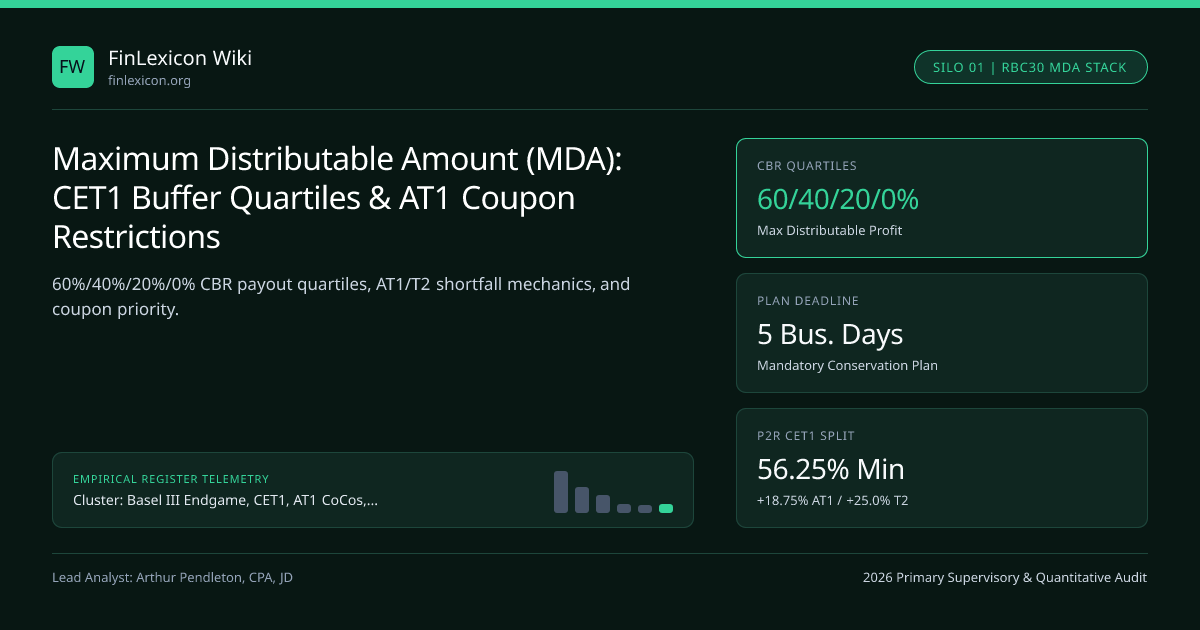
Hard-coded into Basel Framework chapter RBC30.4, EU Capital Requirements Directive Article 141, UK PRA Capital Buffers rules, and U.S. 12 CFR 217.11 ("Eligible Retained Income" payout limits), the Maximum Distributable Amount (MDA) acts as the automatic tripwire conserving Common Equity Tier 1 before a bank ever nears statutory insolvency. Breaching the top of the Basel III CET1 Capital Adequacy Standard Combined Buffer Requirement immediately caps common dividends, share buybacks, AT1 CoCo coupon payments, and staff discretionary bonuses.
How AT1 and Tier 2 Issuance Shortfalls Secretly Elevate the CET1 MDA Trigger#
Investors frequently make the costly analytical error of summing only CET1 requirements (4.5% Pillar 1 + CET1_P2R + CCB + G-SIB + CCyB) when calculating a bank’s MDA trigger. Under Basel CAP10 and EU CRD Article 104a, Pillar 1 requires 1.50% AT1 and 2.00% Tier 2 (plus 18.75% AT1 and 25.00% Tier 2 shares of ECB SREP Pillar 2R).
Whenever an institution under-issues AT1 or Tier 2 relative to those slices, excess CET1 is automatically diverted downward to fill the Tier 1 and Total Capital shortfalls first, rendering that CET1 unavailable to satisfy the Combined Buffer Requirement! Consequently, a 45 bps AT1 shortfall raises the effective CET1 MDA trigger point-for-point by +45 bps, as emphasized in our Basel III Endgame & CET1 cornerstone guide.
The Four CBR Quartiles: 60%, 40%, 20%, and 0% Earnings Retention Multipliers#
Once available buffer-eligible CET1 falls below the Combined Buffer Requirement (CBR = 2.5% CCB + G-SIB/O-SII + CCyB + Systemic Risk Buffer), the maximum fraction of annual/quarterly distributable profits that may be paid out across dividends, buybacks, AT1 coupons, and variable remuneration steps down across four equal quartiles of CBR:
- 4th (Top) Quartile (
75% < CET1_Buffer <= 100% of CBR): Up to 60% of earnings may be distributed (minimum 40% retained). - 3rd Quartile (
50% < CET1_Buffer <= 75% of CBR): Up to 40% distributed (60% retained). - 2nd Quartile (
25% < CET1_Buffer <= 50% of CBR): Up to 20% distributed (80% retained). - 1st (Bottom) Quartile (
0% <= CET1_Buffer <= 25% of CBR): 0% distributed (100% of earnings retained; complete ban on dividends, buybacks, bonuses, and AT1 coupons!).
Current-Year Net Loss Trap under EU CRD Art. 141 vs U.S. Four-Quarter Eligible Retained Income#
Notice a critical transatlantic nuance when a bank reports a negative net income in a single stress year while sitting in the 4th (60% payout) quartile:
Under EU CRD V Article 141, MDA equals (Interim + Year-End Unappropriated Profits Net of Tax) * Quartile_Factor. Prior to CRD V clarifications allowing inclusion of interim/year-end profits not yet in CET1, if a Eurozone bank overseen by the European Central Bank suffers a current-year net loss (Profit <= 0) while inside its CBR, MDA = 0 * 0.60 = EUR 0—forcing an immediate 100% AT1 coupon skip even in the top quartile!
Under U.S. 12 CFR 217.11, the Federal Reserve revised Eligible Retained Income (ERI) in March 2020 to equal the greater of (a) four-quarter net income net of distributions, or (b) the average of the preceding four quarters’ net income (ignoring prior distributions), smoothing one-quarter stress losses for institutions like Bank of America and Ally Financial.
| CET1 Buffer Position (% of CBR) | Basel / EU CRD Art. 141 MDA Factor | U.S. Part 217 ERI Payout Cap (SCB Stack) | Permitted AT1 Coupon Priority | Mandatory Supervisory Filing |
|---|---|---|---|---|
| Above 100% of CBR (>MDA Trigger) | Unrestricted (100% Discretionary) | Unrestricted (subject to CCAR plan) | Paid in full ahead of common div. | Routine ICAAP / SREP reporting |
| Quartile 4: >75% to 100% of CBR | 60% of current-year net profits | 60% of 4-quarter avg ERI | Discretionary inside 60% MDA pool | Capital Conservation Plan (5 days) |
| Quartile 3: >50% to 75% of CBR | 40% of current-year net profits | 40% of 4-quarter avg ERI | Discretionary inside 40% MDA pool | Capital Conservation Plan (5 days) |
| Quartile 2: >25% to 50% of CBR | 20% of current-year net profits | 20% of 4-quarter avg ERI | Discretionary inside 20% MDA pool | Capital Conservation Plan (5 days) |
| Quartile 1: 0% to 25% of CBR | 0% (Zero Distributions Allowed) | 0% (Zero Distributions Allowed) | 100% Cancelled (Non-Cumulative) | Immediate remediation & P2R action |
Parallel Leverage-MDA (L-MDA) and MREL-MDA (M-MDA) Stacks#
Post-CRD V / CRR II, G-SIBs actually track three simultaneous MDA stacks: Risk-Based Capital MDA (CET1 vs CBR), Leverage-Ratio MDA (L-MDA) against the G-SIB Tier 1 leverage buffer, and MREL-MDA (M-MDA) under EU BRRD II MREL hierarchy rules. Whichever stack leaves the smallest buffer headroom sets the binding distribution ceiling.
Management Capital Targets and Capital Conservation Plan Deadlines (5 Business Days)#
Because equity and AT1 markets violently reprice any bank approaching MDA, boards at BNP Paribas, ANZ Bank, and Bank of Ireland maintain an internal 150 to 250 bps management buffer above MDA; any actual breach mandates submitting a formal Capital Conservation Plan to supervisors within 5 business days across the Basel III Endgame & Capital Ratios topic hub.
- Tier2Shortfall = max( 0 , (0.020 + 0.2500 * P2R) - Tier2Ratio - max(0, AT1_Ratio - (0.015 + 0.1875 * P2R)) )
- EffectiveMDAPct = 0.045 + 0.5625 * P2R + AT1Shortfall + Tier2Shortfall + CBR_Pct
- MDADollarPool = max( 0 , NetDistributableProfit ) * QuartileFactor( (CET1Ratio - (EffectiveMDAPct - CBRPct)) / CBRPct )
- Worked Audit (RWA = EUR 200B, P2R = 2.00%, CBR = 4.00%, Actual AT1 = 1.40%, Actual T2 = 2.60%, CET1 = 11.40%, Annual Profit = EUR 1.80B):
- Required AT1 = 1.50% + 0.375% = 1.875% => AT1_Shortfall = 1.875% - 1.400% = +0.475% (Excess T2 cannot fill AT1!)
- Required T2 = 2.00% + 0.500% = 2.500% => Tier2_Shortfall = max(0, 2.50% - 2.60%) = 0.000%
- Hard Pre-CBR CET1 Needed = 4.50% + 1.125% + 0.475% = 6.100% | EffectiveMDAPct = 6.100% + 4.000% = 10.100%
- Suppose Stress Drops CET1 to 8.900%: Buffer Remaining = 8.90% - 6.10% = 2.80% (= 70.0% of 4.00% CBR -> Quartile 3: 40% Factor)
- Maximum Allowed Combined Payout (AT1 Coupons + Dividends + Bonuses) = 0.40 * EUR 1.80B = EUR 720M!
Frequently asked questions
Can excess Additional Tier 1 capital cover a Tier 2 capital shortfall without hurting MDA?
Yes! Because Tier 1 capital is strictly higher quality than Tier 2 capital, excess AT1 above 1.50% + 18.75% * P2R flows down to satisfy Tier 2 requirements (2.00% + 25.00% * P2R), whereas excess Tier 2 can never flow upward to cover an AT1 shortfall.
Are Tier 2 subordinated bond coupons restricted when a bank breaches its MDA threshold?
No. Tier 2 subordinated bonds carry mandatory contractual interest coupons (non-payment constitutes an Event of Default unless in formal resolution/PONV), so Tier 2 interest is an operating expense outside MDA restrictions.
If a bank is in Quartile 3 (40% MDA), must it cut AT1 coupons by 60% alongside common dividends?
No. MDA caps the *aggregate dollar sum* of common dividends, buybacks, AT1 coupons, and variable bonuses at 40% of profits; because annual AT1 coupons typically consume only 5%–12% of normal bank net income, management almost always zeroes common dividends first to pay 100% of AT1 coupons.
Does dipping below ECB Pillar 2 Guidance (P2G) trigger automatic MDA restrictions?
No. Pillar 2 Guidance sits *above* the Combined Buffer Requirement; dipping into P2G triggers confidential supervisory dialogue with the ECB Joint Supervisory Team, not automatic Article 141 MDA restrictions.
Publication record
- Published
- 14 November 2026
- Updated
- 15 November 2026
- Author
- Arthur Pendleton, CPA, JD
- Review
- Review not recorded
- Automated fact check
- Passed in the stored pipeline record
- Source URLs
- 3 recorded
AI assistance recorded: anthropic/claude-opus-4.6. This field does not establish human review or source verification.
Academic & Institutional Attribution
Cite This Research & Embed Live Data Card
Standard academic & institutional research paper citation format.
Arthur Pendleton, CPA, JD. (2026, November 14). Maximum Distributable Amount (MDA): CET1 Buffer Quartiles & AT1 Coupon Restrictions. FinLexicon Wiki. https://finlexicon.org/wiki/maximum-distributable-amount-mda-cet1-stack-at1-coupon-stopRelated Basel Iii Endgame Capital Ratios & Institutional Briefings
Explore Basel Iii Endgame Capital Ratios Hub (20) →Basel Iii Endgame Capital Ratios
Basel III Endgame (BCBS d424), CET1 Capital Adequacy, 72.5% Output Floor & TLAC ArchitectureBasel Iii Endgame Capital Ratios
Standardized Credit Risk Assessment (SCRA): Grade A, B & C Interbank Risk Weights (CRE20)Basel Iii Endgame Capital Ratios
U.S. Stress Capital Buffer (SCB): CCAR Nine-Quarter PPNR & Peak CET1 Drawdown MechanicsBasel Iii Endgame Capital Ratios
ECB SREP Pillar 2 Requirement (P2R) vs Pillar 2 Guidance (P2G) & UK PRA Pillar 2A/2BBasel Iii Endgame Capital Ratios
Basel CRE22 Credit Risk Mitigation: Comprehensive Haircuts, Repo VaR Removal & GuaranteesBasel Iii Endgame Capital Ratios
Basel III Securitization Framework (SEC10–SEC40): STC Criteria, p-Parameter & Senior FloorsBasel Iii Endgame Capital Ratios
BCBS d424 72.5% Standardized RWA Output Floor: Phase-In Mechanics & Capital ImpactBasel Iii Endgame Capital Ratios
CET1 Regulatory Deductions (CAP30): Goodwill, DTAs, MSRs & the 10%/15% Threshold RuleLiquidity Coverage Nsfr Prudential
Central Bank Liquidity Facilities: Fed Standing Repo (SRF), Discount Window, BoE ILTR & HQLA MonetizationLiquidity Coverage Nsfr Prudential
Held-to-Maturity (HTM) Unrealized Losses, Uninsured Deposit Runs & the Solvency-Liquidity Doom LoopLiquidity Coverage Nsfr Prudential
Cross-Currency LCR (LCR30.45), Off-Balance-Sheet FX Swap Funding Gaps & CLS PvP LiquidityLiquidity Coverage Nsfr Prudential
NSFR Interdependent Assets & Liabilities (NSF30.35): 0% Pass-Through, Promotional Loans & CCP IM
FinLexicon Wiki Data, Benchmarks & Contributor Records
CC BY 4.0 Open Data
Open Institutional Datasets (CSV / JSON) →
Download desk-compiled quantitative series & schemas.
2026 Reference Matrix
2026 Institutional Benchmarks & Thresholds →
Statutory capital, clearing, margin & rate conventions.
Editorial Records
Authors & Review Records →
View named contributors where those records are available.
Complete Index
Master Research & Dossier Archive →
Browse all published briefings by topic pillar & date.