
Basel Iii Endgame Capital Ratios
U.S. Stress Capital Buffer (SCB): CCAR Nine-Quarter PPNR & Peak CET1 Drawdown Mechanics
Under Federal Reserve Regulation Y (12 CFR 225.8), the dynamic Stress Capital Buffer replaces the static 2.5% conservation buffer with CCAR nine-quarter peak CET1 depletion plus four quarters of common dividends.
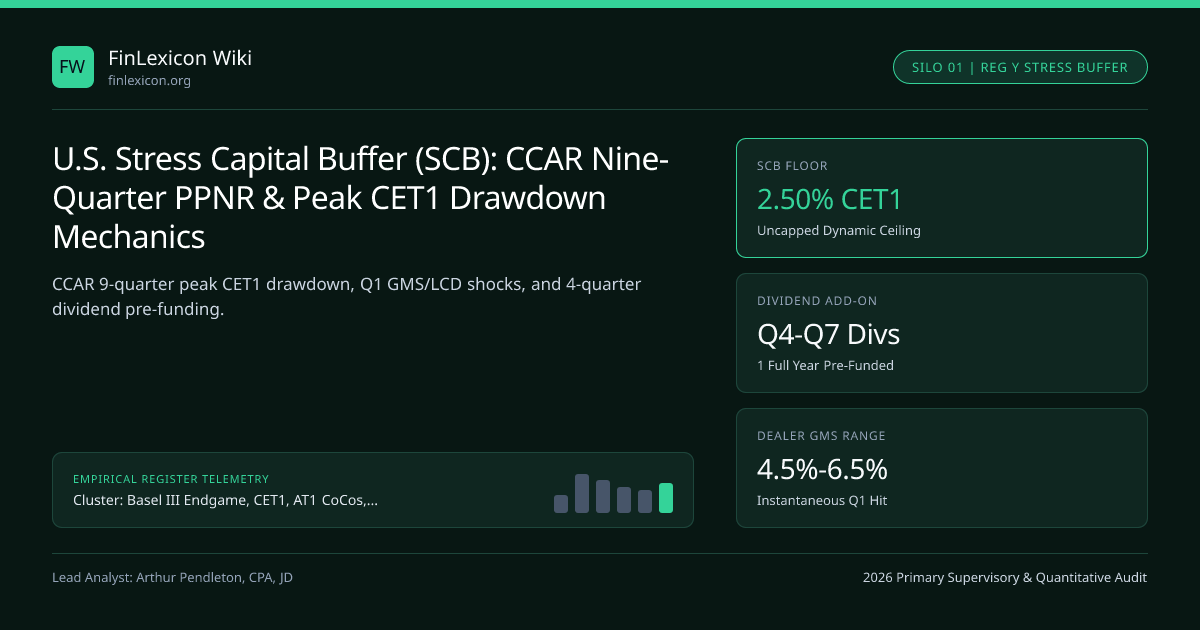
Implemented by the U.S. Federal Reserve System in March 2020 under 12 CFR 225.8 and 12 CFR 217.11, the Stress Capital Buffer (SCB) seamlessly integrates forward-looking Dodd-Frank Act Stress Tests (DFAST) and Comprehensive Capital Analysis and Review (CCAR) directly into point-in-time Pillar 1 Standardized capital requirements. For Category I–IV bank holding companies above USD 100 billion, SCB replaces the static 2.50% Basel Capital Conservation Buffer with a dynamic, bank-specific CET1 buffer floored at 2.50% and carrying no upper cap.
Anatomy of the SCB Formula: Peak Nine-Quarter CET1 Drawdown + Four Dividend Quarters#
Each spring, Federal Reserve supervisory models project every covered BHC’s income statement and balance sheet across a nine-quarter Severely Adverse macroeconomic scenario (typically featuring a 10% unemployment spike, 35%–40% commercial real estate crash, 50%+ equity selloff, and widening corporate bond spreads). As linked in our Basel III Endgame & CET1 cornerstone guide, a bank’s SCB effective October 1 equals:
SCB = max( 2.50% , [ (CET1_Starting_Q0 - CET1_Minimum_Projected_Q1..Q9) ] + [ Sum_Q4..Q7(Planned_Common_Dividends) / RWA_Projected_Quarter ] ).
Notice two structural subtleties: (1) supervisory stress projections now assume zero share repurchases and constant standardized RWA balance sheets (eliminating unrealistically optimistic balance-sheet shrinkage during crises), and (2) adding four quarters of planned common stock dividends (Quarters 4 through 7 of the planning horizon) pre-funds one full year of shareholder distributions inside CET1!
Global Market Shock (GMS) and Largest Counterparty Default (LCD) Instantaneous Hits#
While retail/auto lenders like Ally Financial and card networks like American Express experience gradual nine-quarter loan-loss provisioning offset by Pre-Provision Net Revenue (PPNR), U.S. G-SIBs with major trading operations—such as Bank of America—face two instantaneous Quarter-1 shocks layered atop the macroeconomic recession:
- Global Market Shock (GMS): Instantaneous mark-to-market shock across trading-book and fair-value option positions (driving 150–350 bps of peak CET1 drawdown before PPNR can accumulate!).
- Largest Counterparty Default (LCD): Instantaneous default in Quarter 1 of the single non-sovereign, non-QCCP derivative and securities-financing counterparty generating the largest stressed net loss after collateral haircuts.
Consequently, capital-markets-intensive G-SIBs routinely receive SCBs ranging from 4.0% to 6.5%+ (vs 2.5% floor at traditional commercial banks), compounding atop their Fed Method 2 G-SIB surcharge!
Why SCB Applies Only to Standardized RWA (Not Advanced / ERBA Stacks)#
In the current U.S. dual-requirement architecture, the dynamic SCB sits exclusively atop Standardized Approach RWA (4.5% Min + SCB [>=2.5%] + GSIB_M2 + CCyB), whereas the Advanced / ERBA stack retains the static 2.50% Capital Conservation Buffer (4.5% Min + 2.50% CCB + GSIB_M2 + CCyB). Why? Because ERBA already embeds stressed FRTB market risk and SMA operational risk inside its RWA denominator—layering a full GMS/op-loss SCB atop ERBA would double-count identical trading and operational tail shocks!
| U.S. BHC Archetype | Supervisory Stress Drivers | Typical Peak CET1 Drawdown | 4Q Dividend Add-On | Resulting SCB & Total CET1 Req. |
|---|---|---|---|---|
| Custody G-SIB (Low Credit/GMS) | High fee PPNR; low loan losses | 0.8% – 1.6% depletion | ~0.50% RWA | 2.50% Floor -> 8.5%–9.5% CET1 |
| Universal Commercial G-SIB (Bank of America) | Balanced PPNR vs consumer/CRE + GMS | 2.4% – 3.3% depletion | ~0.60% RWA | 3.0%–3.9% SCB -> 10.5%–11.9% CET1 |
| Capital-Markets / IB Dealer G-SIB | Heavy Q1 GMS + LCD counterparty hit | 4.8% – 5.9% depletion | ~0.55% RWA | 5.4%–6.4% SCB -> 13.4%–14.5% CET1 |
| Card-Focused Category III (American Express) | High card charge-offs offset by high PPNR | 0.5% – 1.8% depletion | ~0.70% RWA | 2.50% Floor -> 7.00% CET1 |
| Auto/Consumer Category IV (Ally Financial) | Elevated auto CECL reserve build | 2.2% – 3.6% depletion | ~0.45% RWA | 2.7%–4.1% SCB -> 7.2%–8.6% CET1 |
Year-to-Year SCB Volatility and Two-Year Averaging Reforms#
Because exploratory shifts in supervisory PPNR regressions and GMS directional shocks caused bank SCBs to swing by 80–150 bps in a single annual cycle (effective each October 1 with preliminary results in June), the Federal Reserve advanced administrative APA transparency reforms—averaging consecutive two-year DFAST stress results, publishing supervisory model specifications for public comment, and extending the effective date window to January 1 so banks have six months rather than three to adjust capital plans.
Category IV Biennial Testing Cycle vs Annual Category I–III Stress Cadence#
Under the 2019 tailoring framework (under review post-2023), Category I, II, and III BHCs undergo supervisory DFAST/SCB resets annually, whereas Category IV firms ($100B–$250B assets) undergo supervisory stress testing every two years (even-numbered years) unless material risk profile changes trigger an off-cycle recalculation across the Basel III Endgame & Capital Ratios topic hub.
- DivAddOnPct = Sum{t=4..7} ( PlannedCommonDividendsQt / RWAProjectedQt )
- SCBRequirement = max( 2.50% , PeakDepletionPct + DivAddOn_Pct )
- BindingUSCET1$ = max( RWAUSSA * (4.5% + SCB + GSIBM2 + CCyB) , RWAERBA * (4.5% + 2.5% + GSIBM2 + CCyB) )
- Worked CCAR Audit (Starting Q0 CET1 = 13.20%, Trough Q5 Stressed CET1 = 9.85%, Q4–Q7 Quarterly Common Div = 0.16% of RWA):
- PeakDepletionPct = 13.20% - 9.85% = 3.35%
- DivAddOnPct = 4 * 0.16% = 0.64%
- Raw SCB = 3.35% + 0.64% = 3.99% => Rounded/Calibrated SCB = 4.0% (exceeds 2.50% floor by +150 bps)
- With 3.0% Method 2 G-SIB Surcharge: Standardized CET1 Requirement = 4.5% + 4.0% + 3.0% = 11.50%!
Frequently asked questions
Why are Preferred Stock dividends excluded from the 4-quarter SCB dividend add-on?
Preferred stock (Additional Tier 1 in the U.S.) carries contractual stated dividend rates already deducted inside the 9-quarter stressed CET1 numerator path, whereas common stock dividends are discretionary equity distributions pre-funded via the Q4–Q7 SCB add-on.
Can a bank formally appeal its preliminary June CCAR Stress Capital Buffer?
Yes. Under 12 CFR 225.8(h)–(i), a bank holding company may request reconsideration within 15 calendar days of receiving notice of its preliminary SCB, or alternatively lower its planned Q4–Q7 common stock dividend to trim the dividend add-on component.
How does Day-One CECL provisioning interact with the Federal Reserve’s DFAST/SCB projections?
Under DFAST rules, supervisory models project credit losses using supervisory loss-rate and PD/LGD equations rather than banks’ internal CECL models, ensuring uniform cross-bank comparability across the 9-quarter stress horizon.
Does the Stress Capital Buffer apply at the Insured Depository Institution (IDI) bank level?
No! SCB is a holding-company rule under Federal Reserve Regulation Y (12 CFR 225.8); insured depository subsidiaries regulated by the OCC and FDIC remain subject to the static 2.50% Capital Conservation Buffer plus Prompt Corrective Action (6.5% well-capitalized CET1).
Publication record
- Published
- 14 November 2026
- Updated
- 15 November 2026
- Author
- Arthur Pendleton, CPA, JD
- Review
- Review not recorded
- Automated fact check
- Passed in the stored pipeline record
- Source URLs
- 3 recorded
AI assistance recorded: anthropic/claude-opus-4.6. This field does not establish human review or source verification.
Academic & Institutional Attribution
Cite This Research & Embed Live Data Card
Standard academic & institutional research paper citation format.
Arthur Pendleton, CPA, JD. (2026, November 14). U.S. Stress Capital Buffer (SCB): CCAR Nine-Quarter PPNR & Peak CET1 Drawdown Mechanics. FinLexicon Wiki. https://finlexicon.org/wiki/stress-capital-buffer-scb-ccar-nine-quarter-cet1-depletionRelated Basel Iii Endgame Capital Ratios & Institutional Briefings
Explore Basel Iii Endgame Capital Ratios Hub (20) →Basel Iii Endgame Capital Ratios
Basel III Endgame (BCBS d424), CET1 Capital Adequacy, 72.5% Output Floor & TLAC ArchitectureBasel Iii Endgame Capital Ratios
ECB SREP Pillar 2 Requirement (P2R) vs Pillar 2 Guidance (P2G) & UK PRA Pillar 2A/2BBasel Iii Endgame Capital Ratios
Basel CRE22 Credit Risk Mitigation: Comprehensive Haircuts, Repo VaR Removal & GuaranteesBasel Iii Endgame Capital Ratios
Basel III Securitization Framework (SEC10–SEC40): STC Criteria, p-Parameter & Senior FloorsBasel Iii Endgame Capital Ratios
BCBS d424 72.5% Standardized RWA Output Floor: Phase-In Mechanics & Capital ImpactBasel Iii Endgame Capital Ratios
CET1 Regulatory Deductions (CAP30): Goodwill, DTAs, MSRs & the 10%/15% Threshold RuleBasel Iii Endgame Capital Ratios
AT1 Contingent Convertibles (CoCos): 5.125% vs 7.0% Triggers, Write-Down & PONV HierarchyBasel Iii Endgame Capital Ratios
U.S. Expanded Risk-Based Approach (ERBA) & AOCI Unrealized Securities Filter RemovalLiquidity Coverage Nsfr Prudential
NSFR Interdependent Assets & Liabilities (NSF30.35): 0% Pass-Through, Promotional Loans & CCP IMLiquidity Coverage Nsfr Prudential
Collateral Swaps, Securities Lending & Liquidity Upgrade Trades: LCR30.36 Unwind & LCR40.48 OutflowsLiquidity Coverage Nsfr Prudential
Contingent Funding Plans (CFP), Early Warning Indicators (EWIs) & Liquidity Funds Transfer Pricing (LFTP)Isda Csa Derivatives Collateral
ISDA Section 2(a)(iii) Condition Precedent: Payment Suspension, Lomas & 2014 Sunset Amendment
FinLexicon Wiki Data, Benchmarks & Contributor Records
CC BY 4.0 Open Data
Open Institutional Datasets (CSV / JSON) →
Download desk-compiled quantitative series & schemas.
2026 Reference Matrix
2026 Institutional Benchmarks & Thresholds →
Statutory capital, clearing, margin & rate conventions.
Editorial Records
Authors & Review Records →
View named contributors where those records are available.
Complete Index
Master Research & Dossier Archive →
Browse all published briefings by topic pillar & date.