
Basel Iii Endgame Capital Ratios
Foundation IRB (F-IRB) Migration & A-IRB PD/LGD Input Floors (CRE30–CRE32)
Basel CRE30 bans A-IRB modeling for banks, financials, and large corporates (>EUR 500M revenue), migrating lenders to Foundation IRB (40% unsecured LGD) while imposing 5 bps PD and LGD input floors.
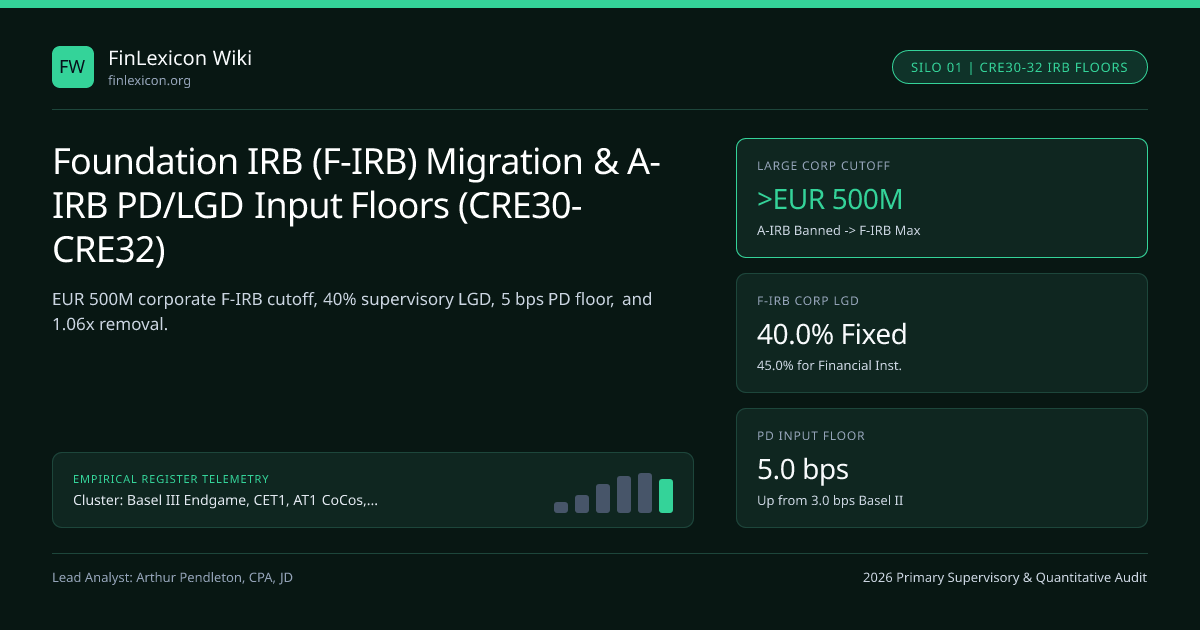
Alongside the aggregate 72.5% output floor, Basel Framework chapters CRE30–CRE32 directly constrain internal-model optimism at the parameter level by banning the Advanced Internal Ratings-Based (A-IRB) approach for low-default portfolios and imposing strict PD, LGD, and EAD input floors on remaining modeled exposures. Simultaneously, BCBS d424 retires the legacy 1.06 IRB scaling factor and lowers supervisory Foundation IRB (F-IRB) unsecured corporate Loss Given Default from 45% to 40%.
Mandatory Migration From A-IRB to F-IRB or Standardized for Low-Default Portfolios#
Empirical studies by BCBS / BIS revealed that banks lack sufficient historical default observations to statistically validate internal LGD and Credit Conversion Factor (CCF) models for financial institutions and multinationals. Consequently, CRE30.32–CRE30.35 establishes strict asset-class model ceilings summarized in our Basel III Endgame & CET1 cornerstone guide:
- Equities: Both A-IRB and F-IRB are prohibited; all non-trading equity investments migrate to CRE20 Standardized Credit Risk (250% general equity weight; 400% speculative unlisted equity).
- Banks and Other Financial Institutions (including insurers and leveraged funds): A-IRB is banned; banks may model PD only under F-IRB while applying supervisory LGD (45% senior unsecured financial) and supervisory CCFs.
- Large and Mid-Sized Corporates (Consolidated Group Revenue > EUR 500M): A-IRB is banned; exposures migrate to F-IRB, where senior unsecured corporate LGD is fixed at 40% (down from 45% under Basel II) and effective maturity
Mfollows contractual cash-flow formulas capped at 5 years.
Granular PD, LGD, and EAD Parameter Input Floors for Remaining A-IRB Portfolios#
Where A-IRB remains permissible—specifically mid-market corporates (<= EUR 500M group revenue), specialized lending, residential mortgages, qualifying revolving retail (QRRE), and other retail—CRE30.55 and CRE32 impose binding floor parameters on every obligor facility:
- Probability of Default (PD) Floor: Increases from 3 bps (0.03%) under Basel II to 5 bps (0.05%) across corporate, bank, and mortgage exposures, and 10 bps (0.10%) for QRRE transactors vs 5 bps standard.
- Loss Given Default (LGD) Floors: Unsecured corporate A-IRB LGD cannot fall below 25% (historically some lenders modeled 10%–15% on covenant-heavy loans!), unsecured retail LGD floors at 30% (50% for QRRE credit cards), and collateralized corporate LGD floors scale from 0% (financial collateral) to 10% (receivables/real estate) and 15% (other physical collateral), blended pro rata with the unsecured slice.
- EAD / CCF Floors: Modeled A-IRB revolving CCFs cannot fall below 50% of the equivalent standardized CCF.
Removal of the 1.06 Scaling Factor and Vasicek Asymptotic Single Risk Factor Mechanics#
Under Basel II, every IRB risk-weighted asset output from the Vasicek Asymptotic Single Risk Factor (ASRF) Gaussian copula formula was multiplied by an ad-hoc 1.06 scaling factor designed in 2004 to maintain aggregate system capital neutrality. Because BCBS d424 tightened input floors, banned large-corporate A-IRB, and added the BCBS d424 72.5% RWA output floor alongside CRE22 collateral haircut rules, CRE31 removes the 1.06 multiplier—providing an automatic -5.66% (1 - 1/1.06) offset across remaining IRB equations!
| IRB Exposure Sub-Class | Max Model Allowed | PD Input Floor | Unsecured LGD Rule / Floor | Secured LGD Floor (RE / Fin) |
|---|---|---|---|---|
| Financial Institutions & Banks | F-IRB Only | 0.05% (5 bps) | 45% Fixed Supervisory (75% Sub.) | Supervisory F-IRB LGD* Haircuts |
| Large Corporates (>EUR 500M Rev) | F-IRB Only | 0.05% (5 bps) | 40% Fixed Supervisory (75% Sub.) | 0% Fin / 10% RE / 15% Physical |
| Mid-Market Corporates (<=EUR 500M) | A-IRB Permitted | 0.05% (5 bps) | 25% Minimum A-IRB Floor | 0% Fin / 10% RE / 15% Physical |
| Residential Retail Mortgages | A-IRB Permitted | 0.05% (5 bps) | N/A (Fully RE Collateralized) | 5.0% Minimum Portfolio/Loan Floor |
| Qualifying Revolving Retail (Cards) | A-IRB Permitted | 0.05% / 0.10% Rev. | 50% Minimum A-IRB LGD Floor | N/A (Unsecured Revolving Lines) |
Why Large Corporate Revolving Credit Facilities Suffer the Steepest F-IRB Jump#
Migrating Fortune 500 and Euro Stoxx 50 backstop revolvers at lenders like BNP Paribas, Bank of Montreal, and Bank of England-regulated wholesale banks from A-IRB to F-IRB triggers a triple compounding effect: (1) PD floors jump from 3 bps to 5 bps, (2) senior unsecured LGD jumps from internal estimates around 20%–25% to the fixed 40% F-IRB supervisory LGD, and (3) undrawn revolving commitment CCFs adjust to standardized 40% (down from 75% Basel II F-IRB, though often higher than internal 20%–25% A-IRB estimates).
Supervisory Slotting vs IRB for Project, Object, and Commodities Finance#
Specialized lending exposures—project finance, object finance (aircraft/shipping), commodities finance, and high-volatility commercial real estate—retain A-IRB eligibility because their revenues are asset-specific rather than >EUR 500M corporate group balance sheets, though institutions lacking validated PD models apply CRE33 supervisory slotting weights (70% Strong [50% if <2.5Y], 90% Good, 115% Satisfactory, 250% Weak, 0% Default w/ provisions) across the Basel III Endgame & Capital Ratios topic hub.
- b_Mat = (0.11852 - 0.05478 * ln(PD))^2
- K_IRB = [ LGD * N( (1 - R)^(-0.5) * G(PD) + (R / (1 - R))^(0.5) * G(0.999) ) - PD * LGD ] * (1 + (M - 2.5) * b) / (1 - 1.5 * b)
- RWACRE31 = 12.5 * KIRB * EAD (Note: Legacy 1.06 multiplier removed in BCBS d424!)
- Worked Large Corporate Revolver ($100M Undrawn, PD = 0.0005 [5 bps floor], F-IRB LGD = 0.40, CCF = 0.40, M = 2.5Y):
- R_Corr = 0.2370 | G(0.0005) = -3.2905 | G(0.999) = +3.0902 | Maturity Factor (at M=2.5Y) = 1.3486
- K_IRB = [ 0.40 * N(-1.986) - 0.0002 ] * 1.3486 = [ 0.40 * 0.0235 - 0.0002 ] * 1.3486 = 0.01241 -> ~0.0147 w/ M adj.
- EAD = 0.40 * $100.0M = $40.0M => RWA = 12.5 * 0.01470 * $40.0M = $7.35M (18.38% RW on EAD)
Frequently asked questions
How is the EUR 500 million corporate revenue threshold measured for F-IRB migration?
Under CRE30.34, consolidated audited revenue of the corporate group to which the obligor belongs is averaged over the prior three fiscal years; if group total assets also exceed EUR 500M where revenue is non-meaningful, F-IRB mandatory migration applies.
Why did BCBS reduce F-IRB unsecured non-financial corporate LGD from 45% to 40%?
Multi-decade workout loss datasets compiled across North American and European defaulted senior corporate debt showed average economic discounted recoveries closer to 60% than 55%, justifying a 40% supervisory LGD for non-financial corporates while retaining 45% for financial institutions.
How do collateralized corporate loans calculate LGD* under the modified F-IRB rules?
CRE32.9–CRE32.15 computes a weighted average of the unsecured 40% LGD on the uncollateralized exposure fraction (after comprehensive He and Hc haircuts) and supervisory secured LGD floors (0% financial, 20% receivables/real estate, 25% other physical collateral in F-IRB).
Does the 1.25x asset-value correlation (AVC) multiplier for large financials still exist?
Yes! Under CRE31.5, IRB exposures to regulated financial institutions with total assets >= USD 100 billion and all unregulated financial institutions regardless of size retain the 1.25x correlation scalar (R_fin = 1.25 * R_corp), steeply increasing systemic tail capital.
Publication record
- Published
- 14 November 2026
- Updated
- 15 November 2026
- Author
- Arthur Pendleton, CPA, JD
- Review
- Review not recorded
- Automated fact check
- Passed in the stored pipeline record
- Source URLs
- 3 recorded
AI assistance recorded: anthropic/claude-opus-4.6. This field does not establish human review or source verification.
Academic & Institutional Attribution
Cite This Research & Embed Live Data Card
Standard academic & institutional research paper citation format.
Arthur Pendleton, CPA, JD. (2026, November 14). Foundation IRB (F-IRB) Migration & A-IRB PD/LGD Input Floors (CRE30–CRE32). FinLexicon Wiki. https://finlexicon.org/wiki/f-irb-vs-a-irb-input-floors-corporate-lgd-pd-migrationRelated Basel Iii Endgame Capital Ratios & Institutional Briefings
Explore Basel Iii Endgame Capital Ratios Hub (20) →Basel Iii Endgame Capital Ratios
Basel III Endgame (BCBS d424), CET1 Capital Adequacy, 72.5% Output Floor & TLAC ArchitectureBasel Iii Endgame Capital Ratios
Operational Risk Standardized Measurement Approach (SMA): BIC Buckets & ILM=1 DiscretionBasel Iii Endgame Capital Ratios
FRTB Market Risk (MAR21/MAR30): Sensitivities-Based Method (SbM), PLA Test & NMRF CapitalBasel Iii Endgame Capital Ratios
Maximum Distributable Amount (MDA): CET1 Buffer Quartiles & AT1 Coupon RestrictionsBasel Iii Endgame Capital Ratios
Standardized Credit Risk Assessment (SCRA): Grade A, B & C Interbank Risk Weights (CRE20)Basel Iii Endgame Capital Ratios
U.S. Stress Capital Buffer (SCB): CCAR Nine-Quarter PPNR & Peak CET1 Drawdown MechanicsBasel Iii Endgame Capital Ratios
ECB SREP Pillar 2 Requirement (P2R) vs Pillar 2 Guidance (P2G) & UK PRA Pillar 2A/2BBasel Iii Endgame Capital Ratios
Basel CRE22 Credit Risk Mitigation: Comprehensive Haircuts, Repo VaR Removal & GuaranteesLiquidity Coverage Nsfr Prudential
NSFR Required Stable Funding (RSF) Weights (NSF30): Asset Encumbrance, 65% Mortgages & NPLsLiquidity Coverage Nsfr Prudential
Asymmetric NSFR Derivatives Treatment (NSF30): Cash VM Offsets & the 20% Gross Liability Add-OnLiquidity Coverage Nsfr Prudential
BCBS 248 Intraday Liquidity Monitoring Tools: RTGS Peak Net Debit & Time-Specific ObligationsLiquidity Coverage Nsfr Prudential
IRRBB Standards (BCBS d368 / SRP31): Six EVE Shock Scenarios, 15% Tier 1 Outlier Test & Delta-NII
FinLexicon Wiki Data, Benchmarks & Contributor Records
CC BY 4.0 Open Data
Open Institutional Datasets (CSV / JSON) →
Download desk-compiled quantitative series & schemas.
2026 Reference Matrix
2026 Institutional Benchmarks & Thresholds →
Statutory capital, clearing, margin & rate conventions.
Editorial Records
Authors & Review Records →
View named contributors where those records are available.
Complete Index
Master Research & Dossier Archive →
Browse all published briefings by topic pillar & date.