
Basel Iii Endgame Capital Ratios
Standardized Credit Risk Assessment (SCRA): Grade A, B & C Interbank Risk Weights (CRE20)
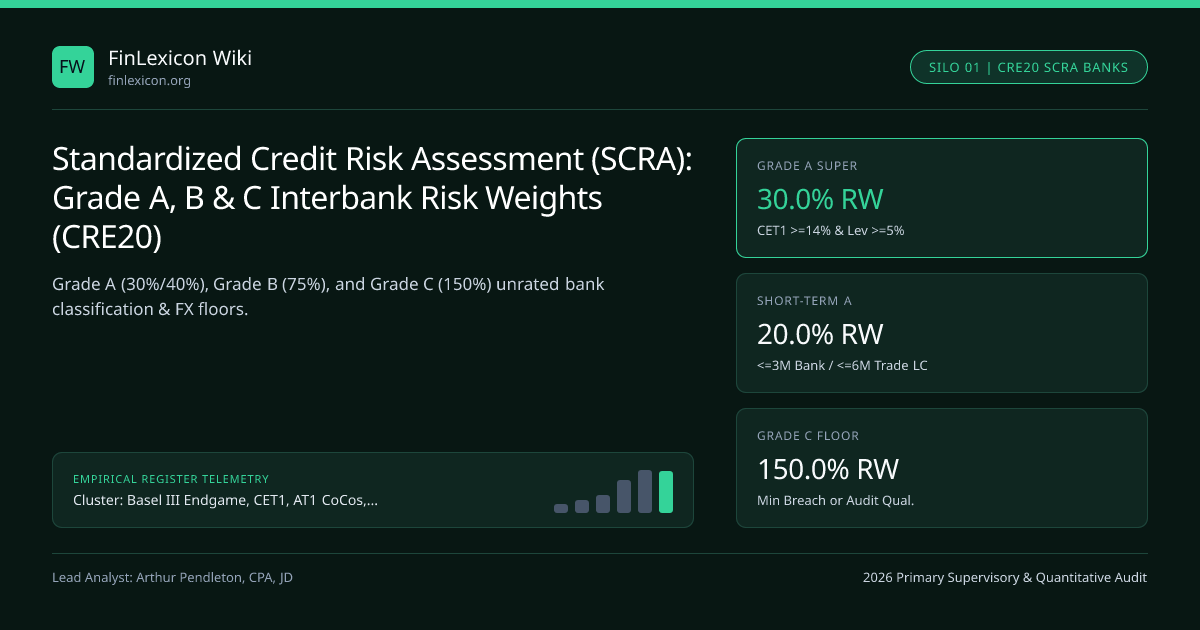
Under Basel CRE20.16–32, banks must classify unrated interbank exposures into SCRA Grade A (40%/30% RW), Grade B (75% RW), or Grade C (150% RW) while enforcing mandatory due-diligence downgrades on rated banks.
Responding to G20 Financial Stability Board mandates to end mechanistic reliance on external credit rating agencies—and accommodating jurisdictions like the United States where Section 939A of the Dodd-Frank Act bans statutory references to S&P, Moody’s, and Fitch—Basel Framework paragraphs CRE20.16–CRE20.32 establish the Standardized Credit Risk Assessment Approach (SCRA) for interbank claims, trade finance letters of credit, and nostros.
Two-Track Architecture: ECRA (With Mandatory Due Diligence) vs Unrated SCRA#
In jurisdictions permitting external ratings (EU CRR III, UK PRA, Singapore MAS, Hong Kong HKMA), banks apply the External Credit Risk Assessment Approach (ECRA) to rated bank counterparties (20% AAA–AA, 30% A [cut from 50% under Basel II!], 50% BBB, 100% BB–B, 150% <B-) and SCRA to all unrated banks. However, CRE20.19 adds a teeth-baring mandatory due-diligence override: if internal credit analysis reveals higher risk than implied by the external agency grade, the lending bank must assign at least one bucket higher risk weight—and can never use due diligence to assign a lower weight!
In the United States under 12 CFR Part 217 ERBA, because Section 939A prohibits ECRA altogether, every domestic and foreign bank exposure is evaluated through SCRA, as mapped in our Basel III Endgame & CET1 cornerstone guide.
Classification Criteria Across SCRA Grade A (40%/30%), Grade B (75%), and Grade C (150%)#
SCRA partitions unrated correspondent and interbank counterparties—ranging from Abu Dhabi Commercial Bank and Bangkok Bank to Bank Central Asia and Access Bank Plc—into three objective prudential tiers:
- Grade A (
40%Base RW;20%Short-Term <=3m): Counterparty possesses adequate capacity to meet financial commitments promptly regardless of economic cycles AND exceeds all published minimum regulatory requirements AND capital buffers (e.g., CET1 > Pillar 1 + P2R + CBR) established by its national supervisor (ignoring confidential bank-specific Pillar 2 add-ons unless publicly disclosed). Under Grade A Enhanced (30%Base RW), if the Grade A bank also reports a CET1 ratio >= 14.0% and a Tier 1 Leverage Ratio >= 5.0%, its long-term risk weight drops from 40% to 30%! - Grade B (
75%Base RW;50%Short-Term <=3m): Counterparty is subject to substantial credit risk (repayment depends on stable business conditions) AND meets or exceeds published minimum regulatory capital requirements (4.5% CET1 / 6% T1 / 8% Total), even if dipping into its capital conservation or CCyB buffers! - Grade C (
150%Base & Short-Term RW): Counterparty breaches any published minimum regulatory requirement, carries material default risks, or has received an adverse audit opinion or going-concern qualification in its audited financial statements within the preceding 12 months.
The Sovereign Risk-Weight Floor on Unrated Foreign Currency Interbank Claims#
CRE20.31 enforces a critical sovereign ceiling trap for emerging-market correspondent banking: for exposures to an unrated bank not denominated in the local currency of the bank’s jurisdiction of incorporation (e.g., a USD interbank placement with a bank incorporated in an emerging market supervised by State Bank of Pakistan or Central Bank of Egypt), the SCRA risk weight cannot be lower than the sovereign risk weight of the jurisdiction of incorporation! Only self-liquidating, trade-related short-term letters of credit (<= 1 year) financing cross-border movement of goods are exempted from this sovereign floor!
| Counterparty Classification Tier | Base Risk Weight (>3M) | Short-Term (<=3M / 6M Trade) | Quantitative Capital Gate | FX Sovereign Floor Rule |
|---|---|---|---|---|
| ECRA AAA to AA- Rated Bank | 20% risk weight | 20% risk weight | External rating + due-diligence check | No sovereign floor on ECRA |
| ECRA A+ to A- Rated Bank | 30% risk weight | 20% risk weight | Cut from 50% Basel II; due diligence req. | No sovereign floor on ECRA |
| SCRA Grade A (Super-Capitalized) | 30% risk weight | 20% risk weight | Exceeds buffers + CET1 >=14% & Lev >=5% | Floored at Host Sov RW (ex-Trade) |
| SCRA Grade A (Standard) | 40% risk weight | 20% risk weight | Exceeds published minimums + all buffers | Floored at Host Sov RW (ex-Trade) |
| SCRA Grade B / Grade C | 75% / 150% RW | 50% / 150% RW | Grade B meets mins; Grade C breaches/audit | Floored at Host Sov RW (ex-Trade) |
Short-Term Interbank Maturity Relief (<= 3 Months) and Trade Finance LCs (<= 6 Months)#
To preserve money-market liquidity, Continuous Linked Settlement (CLS PvP FX settlement), and global trade finance, CRE20.21 grants preferential short-term weights (20% Grade A, 50% Grade B, 150% Grade C) to interbank claims with an original maturity of three months or less, as well as up to six months for exposures arising from cross-border movement of goods!
Operational Impact on Correspondent Banking Networks and Nostro Sweeps#
If an unrated respondent bank fails to publish verifiable Pillar 3 capital ratios demonstrating buffer compliance above its Maximum Distributable Amount (MDA) CET1 stack, lending banks must default it to Grade B (75%) or Grade C (150%)—nearly quadrupling capital compared to legacy Basel II 20% short-term interbank weights across the Basel III Endgame & Capital Ratios topic hub.
- RWSCRAST = 20% (if GradeA & OrigMat <= 3M [or <=6M Goods Trade]) | 50% (GradeB ST) | 150% (GradeC)
- RWFinal = max( RWSCRA , I(NonLocalCCY & !SelfLiqTrade) * RWSovereignIncorp )
- Worked Trade Finance vs Term Placement Comparison ($200M Exposure to Unrated Grade A Bank in BB-Rated [100% RW] Country):
- 1. 9-Month USD Interbank Money-Market Placement (Non-Local CCY, Non-Trade):
- RW_Final = max( 40% Grade A , 100% Sovereign Floor ) = 100% => RWA = $200.0M
- 2. 150-Day Confirmed USD Import Letter of Credit Financing Merchandise Shipment (<=6M Trade Carve-Out):
- Exempt from Sovereign Floor & Eligible for <=6M Short-Term Trade Bucket => RW_Final = 20% * 20% CCF (or 20% on drawn) => $40.0M Drawn RWA!
Frequently asked questions
Does dipping into confidential ECB Pillar 2 Guidance (P2G) push a bank from SCRA Grade A to Grade B?
No. CRE20.23 explicitly scopes SCRA buffer checks to *published* minimum regulatory requirements and *published* buffers (such as 2.5% CCB, G-SIB, and national CCyB); confidential bank-specific Pillar 2 add-ons that are not publicly disclosed are excluded.
Why does a rolling overnight nostro or repo count as <=3 months original maturity rather than >3 months?
Original maturity measures contractual commitment tenor before the lender has an unconditional right to terminate and demand repayment; overnight and 1-month money-market placements qualify for the 20% Grade A short-term bucket provided there is no contractual obligation to roll over.
How are covered bonds issued by banks risk-weighted compared to unsecured SCRA claims?
Under CRE20.33–CRE20.40, statutory covered bonds backed by dual-recourse pools of sovereigns or <=80%-LTV residential / <=60%-LTV commercial mortgages with >=10% overcollateralization receive preferential 10%–20% risk weights vastly below unsecured interbank claims.
What triggers an automatic SCRA Grade C (150% RW) downgrade even if reported CET1 looks high?
If an external auditor issues an adverse opinion or expresses substantial going-concern doubt in audited financial statements within the prior 12 months—or if the bank defaults on or restructures debt—CRE20.26 forces immediate Grade C (150% RW) classification.
Publication record
- Published
- 14 November 2026
- Updated
- 15 November 2026
- Author
- Arthur Pendleton, CPA, JD
- Review
- Review not recorded
- Automated fact check
- Passed in the stored pipeline record
- Source URLs
- 3 recorded
AI assistance recorded: anthropic/claude-opus-4.6. This field does not establish human review or source verification.
Academic & Institutional Attribution
Cite This Research & Embed Live Data Card
Standard academic & institutional research paper citation format.
Arthur Pendleton, CPA, JD. (2026, November 14). Standardized Credit Risk Assessment (SCRA): Grade A, B & C Interbank Risk Weights (CRE20). FinLexicon Wiki. https://finlexicon.org/wiki/scra-standardized-credit-risk-assessment-unrated-bank-exposuresRelated Basel Iii Endgame Capital Ratios & Institutional Briefings
Explore Basel Iii Endgame Capital Ratios Hub (20) →Basel Iii Endgame Capital Ratios
Basel III Endgame (BCBS d424), CET1 Capital Adequacy, 72.5% Output Floor & TLAC ArchitectureBasel Iii Endgame Capital Ratios
U.S. Stress Capital Buffer (SCB): CCAR Nine-Quarter PPNR & Peak CET1 Drawdown MechanicsBasel Iii Endgame Capital Ratios
ECB SREP Pillar 2 Requirement (P2R) vs Pillar 2 Guidance (P2G) & UK PRA Pillar 2A/2BBasel Iii Endgame Capital Ratios
Basel CRE22 Credit Risk Mitigation: Comprehensive Haircuts, Repo VaR Removal & GuaranteesBasel Iii Endgame Capital Ratios
Basel III Securitization Framework (SEC10–SEC40): STC Criteria, p-Parameter & Senior FloorsBasel Iii Endgame Capital Ratios
BCBS d424 72.5% Standardized RWA Output Floor: Phase-In Mechanics & Capital ImpactBasel Iii Endgame Capital Ratios
CET1 Regulatory Deductions (CAP30): Goodwill, DTAs, MSRs & the 10%/15% Threshold RuleBasel Iii Endgame Capital Ratios
AT1 Contingent Convertibles (CoCos): 5.125% vs 7.0% Triggers, Write-Down & PONV HierarchyLiquidity Coverage Nsfr Prudential
Cross-Currency LCR (LCR30.45), Off-Balance-Sheet FX Swap Funding Gaps & CLS PvP LiquidityLiquidity Coverage Nsfr Prudential
NSFR Interdependent Assets & Liabilities (NSF30.35): 0% Pass-Through, Promotional Loans & CCP IMLiquidity Coverage Nsfr Prudential
Collateral Swaps, Securities Lending & Liquidity Upgrade Trades: LCR30.36 Unwind & LCR40.48 OutflowsLiquidity Coverage Nsfr Prudential
Contingent Funding Plans (CFP), Early Warning Indicators (EWIs) & Liquidity Funds Transfer Pricing (LFTP)
FinLexicon Wiki Data, Benchmarks & Contributor Records
CC BY 4.0 Open Data
Open Institutional Datasets (CSV / JSON) →
Download desk-compiled quantitative series & schemas.
2026 Reference Matrix
2026 Institutional Benchmarks & Thresholds →
Statutory capital, clearing, margin & rate conventions.
Editorial Records
Authors & Review Records →
View named contributors where those records are available.
Complete Index
Master Research & Dossier Archive →
Browse all published briefings by topic pillar & date.