
Basel Iii Endgame Capital Ratios
Basel III Securitization Framework (SEC10–SEC40): STC Criteria, p-Parameter & Senior Floors
Under Basel SEC10–SEC40, securitization tranches follow the SEC-IRBA, SEC-ERBA, and SEC-SA hierarchy with 10% STC / 15% non-STC risk-weight floors and a non-neutrality p-parameter surcharge.
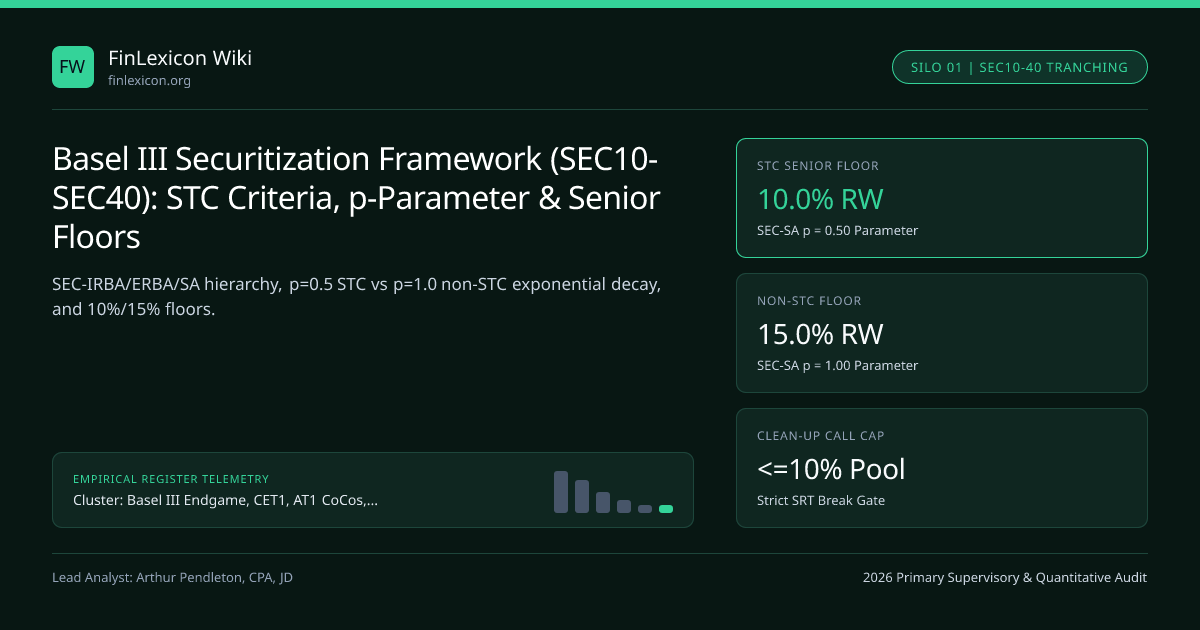
Structured credit tranching suffered catastrophic rating cliff effects in 2008 when AAA-rated CDO-squared and subprime mezzanine tranches carrying 7% Basel II risk weights defaulted en masse. Codified in Basel Framework chapters SEC10 through SEC40 (incorporating the Simple, Transparent and Comparable [STC] revisions), the modern securitization capital hierarchy enforces a 15% general senior tranche risk-weight floor (10% for qualifying STC tranches), bans re-securitization modeling (100% floor / p = 1.5), and calibrates non-neutral capital surcharges via the supervisory p-parameter.
Strict Three-Tier Securitization Hierarchy: SEC-IRBA -> SEC-ERBA -> SEC-SA (-> 1250%)#
Unlike Basel II—where external ratings took top priority—SEC11.3 mandates a top-down hierarchy linked to underlying pool data availability, as integrated into our Basel III Endgame & CET1 cornerstone guide:
- Securitization Internal Ratings-Based Approach (
SEC-IRBA, SEC30): Mandatory top tier whenever the bank has supervisory IRB approval for the underlying asset class and pool-level information to computeK_IRB(the IRB capital plus expected loss of the underlying pool). Uses a dynamic formulaicp-parameter (>= 0.30) sensitive to pool granularityN, average LGD, tranche thicknessT = D - A, and tranche maturityM_T(1 <= M_T <= 5years). - External Ratings-Based Approach (
SEC-ERBA, SEC20): Used whereK_IRBcannot be calculated and jurisdictions permit external ratings—incorporating explicit tranche maturity (1Yvs5Ylinear interpolation) and mezzanine tranche thicknessT(RW_adj = RW * [1 - min(T, 0.50)]) so thin 1%-thick BBB tranches carry nearly twice the RWA of thick 20% BBB tranches! (Note: Prohibited in the U.S. under Dodd-Frank Sec. 939A; U.S. rules jump directly to SSFA / SEC-SA!) - Standardized Approach (
SEC-SA, SEC40): Exponential decay formula anchored to standardized pool capitalK_SAadjusted for delinquent/defaulted pool shareW(K_A = (1 - W)*K_SA + W*0.50), using fixedp = 1.0for non-STC securitizations andp = 0.5for qualifying STC transactions! If evenK_SAis unknown, a 1,250% risk weight (full capital equivalent) applies.
Capital Non-Neutrality Explained: How the Supervisory p-Parameter Taxes Tranching#
If a bank securitized a USD 1.0 billion corporate loan pool (K_SA = 8.0%, or USD 80M standalone capital) and retained 100% of every tranche from 0% equity to 100% senior, what would its post-securitization capital equal? Because SEC-SA sets p = 1.0 (p > 0), total capital summed across all tranches equals (1 + p) times underlying pool capital—meaning p = 1.0 imposes a 100% structural model-uncertainty surcharge across the deal stack, while STC qualification (p = 0.5) halves that surcharge to 50%!
To prevent retaining all tranches from requiring more capital than holding the unsecuritized pool outright, SEC11.8 (Maximum Capital Requirement Cap) caps an originator’s or investor’s total securitization RWA at the RWA that would apply if the underlying exposures were held directly on balance sheet!
Attachment (A), Detachment (D), and Synthetic SRT Significant Risk Transfer Economics#
In a Synthetic Significant Risk Transfer (SRT) transaction executed by capital-optimization desks at BNP Paribas, Bank of America, Bank of Ireland, or Bank of Montreal, the originating bank retains the underlying corporate or SME loans on balance sheet, buys funded Credit-Linked Note (CLN) protection from private-credit investors on the junior/mezzanine slice (e.g., Attachment A = 0.0% to Detachment D = 8.5%), and retains the senior 8.5%–100.0% tranche.
Provided Detachment D exceeds K_A (or K_IRB) by a healthy margin and the deal satisfies clean-break SRT operational criteria (no implicit support, commensurate risk transfer under CRR Art. 244), the retained senior 8.5%–100% tranche drops to the 15% non-STC (or 10% EU STS / BCBS STC) risk-weight floor—compressing corporate RWA by 75%–85% and simultaneously shrinking standardized RWA inside the BCBS d424 72.5% output floor!
| Securitization Approach | Pool Parameter Anchor | Supervisory p-Parameter | Senior Tranche RW Floor | Jurisdictional Availability |
|---|---|---|---|---|
| SEC-IRBA (STC Qualifying) | Underlying IRB K_IRB | Formulaic >= 0.30 (0.5x scalar) | 10.0% risk weight | EU CRR III, UK PRA, APAC (No U.S. ERBA) |
| SEC-IRBA (Non-STC) | Underlying IRB K_IRB | Formulaic >= 0.30 | 15.0% risk weight | EU CRR III, UK PRA, APAC (No U.S. ERBA) |
| SEC-ERBA (STC / Non-STC) | External Rating + M_T + T | Embedded in lookup table | 10.0% STC / 15.0% Non-STC | EU, UK, APAC (Banned in U.S. Sec. 939A) |
| SEC-SA (STC / EU STS) | Delinquency-Adjusted K_A | p = 0.50 fixed | 10.0% risk weight | EU CRR III (incl. Synthetic STS), UK, APAC |
| SEC-SA (Non-STC / U.S. SSFA) | Delinquency-Adjusted K_A | p = 1.00 (U.S. SSFA 0.5->1.0) | 15.0% (20% legacy U.S. SSFA) | Global Fallback & Primary U.S. Standard |
Simple, Transparent and Comparable (STC / EU STS) Criteria vs U.S. Absence of STC#
To qualify for the 10% senior floor and p = 0.5 SEC-SA discount under SEC40.42 (and EU STS Securitization Regulation 2017/2402, extended to on-balance-sheet synthetic STS in the EU!), pools must be homogeneous, non-delinquent at cut-off, exclude active portfolio management or derivatives other than FX/rate hedges, and carry verified 5-year performance histories. Notably, U.S. banking agencies under the Fed and OCC declined to adopt STC discounts in U.S. ERBA, holding U.S. SEC-SA at p = 1.0 (proposed p = 1.0 vs legacy SSFA p = 0.5 debate!).
Re-Securitizations (p = 1.5, 100% Floor) and Clean-Up Call Restrictions#
Any securitization where even one underlying exposure is itself a securitization tranche (such as a CLO of ABS tranches) is classified as a re-securitization: SEC-IRBA and SEC-ERBA are prohibited, p jumps to 1.5 under SEC-SA, STC eligibility is barred, and the minimum senior risk weight floors at 100% across the Basel III Endgame & Capital Ratios topic hub.
- aparam = - 1 / ( p * KA ) | u = D - KA | l = max( A - KA , 0 )
- K_SSFA = ( exp(a * u) - exp(a * l) ) / ( a * (u - l) )
- RWSECSA = max( FloorRW , 12.5 * [ ((KA - A)/(D - A))1.0 + ((D - K_A)/(D - A))KSSFA ] ) (if A < KA < D)
- = max( FloorRW , 12.5 * KSSFA ) (if A >= K_A)
- Worked Synthetic SRT Audit ($1.0B Corporate Pool, Avg RW = 75% => KSA = 6.0%, W = 0% => KA = 0.06, Sold CLN = 0%–9.5%, Retained Sr: A=0.095, D=1.00, Non-STC p=1.0):
- a = -1 / (1.0 * 0.06) = -16.6667 | u = 1.00 - 0.06 = 0.94 | l = 0.095 - 0.06 = 0.035 | u - l = 0.905
- K_SSFA = ( exp(-15.667) - exp(-0.5833) ) / ( -16.6667 * 0.905 ) = (0 - 0.5580) / (-15.083) = 0.0370 -> Wait: at p=1.0, 12.5 * 0.0370 = 46.2%!
- Check STC (p = 0.5): a = -33.333 => K_SSFA = (0 - exp(-1.1667)) / (-33.333 * 0.905) = 0.3114 / 30.167 = 0.01032 => 12.5 * 0.01032 = 12.90% RW!
- At A = 12.5% (Non-STC p=1.0): l = 0.065 => exp(-1.0833)/14.58 = 0.0232 => 29.0% RW (at A=16.5% hits 15.0% Non-STC floor!)
Frequently asked questions
Why did our exact K_SSFA exponential formula show p = 1.0 needing A ~ 16.5% to hit the 15% floor while p = 0.5 hits 12.9% at A = 9.5%?
Because the exponential decay constant is a = -1 / (p * K_A), doubling p from 0.5 to 1.0 halves the decay rate above K_A, spreading the 100% non-neutrality capital surcharge far higher into the senior tranche—precisely why European banks prize EU Synthetic STS (p = 0.5) eligibility!
What is the difference between a Traditional Cash Securitization and a Synthetic SRT for bank capital?
In a traditional cash securitization, loans are legally sold to a bankruptcy-remote SPV; in a synthetic SRT, loans remain on the bank’s balance sheet (preserving client relationships without borrower notification) while credit risk on the junior/mezzanine tranche is transferred via a cash-collateralized Credit-Linked Note.
How does EU CRR III Output Floor calculation treat Synthetic STS securitizations?
For standardized output-floor Track B purposes, an IRB bank using SEC-IRBA in Track A must recompute retained senior SRT tranches under SEC-ERBA (if rated) or SEC-SA (p = 0.5 if STS-compliant, p = 1.0 if non-STS), making STS certification vital to prevent output-floor RWA blowback.
When does a Clean-Up Call option invalidate securitization capital relief under SEC11?
A clean-up call remains compliant only if exercise is completely discretionary to the originator, cannot be used to shield investors from losses, and is exercisable ONLY once 10% or less of the original underlying portfolio balance remains outstanding.
Publication record
- Published
- 14 November 2026
- Updated
- 15 November 2026
- Author
- Arthur Pendleton, CPA, JD
- Review
- Review not recorded
- Automated fact check
- Passed in the stored pipeline record
- Source URLs
- 3 recorded
AI assistance recorded: anthropic/claude-opus-4.6. This field does not establish human review or source verification.
Academic & Institutional Attribution
Cite This Research & Embed Live Data Card
Standard academic & institutional research paper citation format.
Arthur Pendleton, CPA, JD. (2026, November 14). Basel III Securitization Framework (SEC10–SEC40): STC Criteria, p-Parameter & Senior Floors. FinLexicon Wiki. https://finlexicon.org/wiki/sec10-securitization-erba-ssfa-p-parameter-tranche-thicknessRelated Basel Iii Endgame Capital Ratios & Institutional Briefings
Explore Basel Iii Endgame Capital Ratios Hub (20) →Basel Iii Endgame Capital Ratios
Basel III Endgame (BCBS d424), CET1 Capital Adequacy, 72.5% Output Floor & TLAC ArchitectureBasel Iii Endgame Capital Ratios
BCBS d424 72.5% Standardized RWA Output Floor: Phase-In Mechanics & Capital ImpactBasel Iii Endgame Capital Ratios
CET1 Regulatory Deductions (CAP30): Goodwill, DTAs, MSRs & the 10%/15% Threshold RuleBasel Iii Endgame Capital Ratios
AT1 Contingent Convertibles (CoCos): 5.125% vs 7.0% Triggers, Write-Down & PONV HierarchyBasel Iii Endgame Capital Ratios
U.S. Expanded Risk-Based Approach (ERBA) & AOCI Unrealized Securities Filter RemovalBasel Iii Endgame Capital Ratios
Countercyclical Capital Buffer (CCyB): Weighted-Average Reciprocity & Positive Neutral RatesBasel Iii Endgame Capital Ratios
G-SIB Systemic Surcharge: BCBS Method 1 Five-Category Score vs Fed Method 2 STWF ScalarBasel Iii Endgame Capital Ratios
FSB TLAC Term Sheet: 18% RWA / 6.75% Leverage Minimums & Clean Holding Company RulesIsda Csa Derivatives Collateral
ISDA Section 2(a)(iii) Condition Precedent: Payment Suspension, Lomas & 2014 Sunset AmendmentIsda Csa Derivatives Collateral
1992 ISDA Market Quotation & Loss vs 2002 Close-Out Amount: Section 6(e) Early Termination ValuationIsda Csa Derivatives Collateral
ISDA Section 5(a) Events of Default vs Section 5(b) Termination Events: Cross-Default & Threshold AmountsIsda Csa Derivatives Collateral
2016 ISDA Variation Margin CSA: New York Security Interest Pledge vs English Law Title Transfer
FinLexicon Wiki Data, Benchmarks & Contributor Records
CC BY 4.0 Open Data
Open Institutional Datasets (CSV / JSON) →
Download desk-compiled quantitative series & schemas.
2026 Reference Matrix
2026 Institutional Benchmarks & Thresholds →
Statutory capital, clearing, margin & rate conventions.
Editorial Records
Authors & Review Records →
View named contributors where those records are available.
Complete Index
Master Research & Dossier Archive →
Browse all published briefings by topic pillar & date.