
Basel Iii Endgame Capital Ratios
FRTB Market Risk (MAR21/MAR30): Sensitivities-Based Method (SbM), PLA Test & NMRF Capital
Basel III FRTB replaces 10-day 99% VaR with 97.5% Expected Shortfall across 10-to-120-day liquidity horizons, desk-level P&L Attribution gates, and MAR21 Sensitivities-Based Method charges.
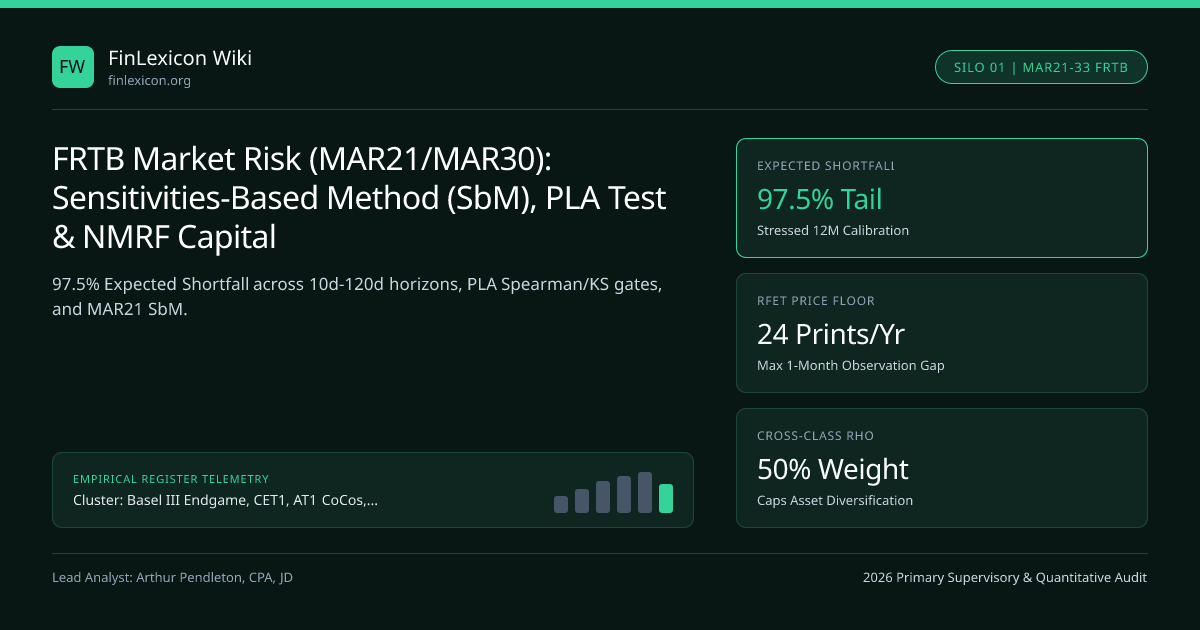
Codified in Basel Framework chapters MAR10 through MAR33 (finalized in BCBS d457 in January 2019), the Fundamental Review of the Trading Book (FRTB) overhauls market risk capital adequacy across three fault lines that failed in 2008: permeable banking-vs-trading book boundaries, tail-blind 10-day 99% Value-at-Risk models that assumed instant market liquidity, and all-or-nothing bank-wide internal model approvals.
Hardened Banking-vs-Trading Book Boundary and Internal Risk Transfer (IRT) Walls#
Under Basel II.5, banks could reclassify illiquid credit assets between the fair-value trading book and amortized-cost banking book based on subjective management "intent to trade." MAR12 replaces intent with prescriptive presumptions: unlisted equities, retail/SME credit, and real estate holdings are barred from the trading book, while listed equities, options, and market-making inventories must sit inside the trading book.
Moving an instrument across the boundary after origination requires extraordinary supervisory approval (e.g., permanent desk closure), and any capital relief generated at the switching date is disallowed via an irrevocable RWA surcharge! Furthermore, Internal Risk Transfers (IRTs) of credit or interest rate risk from the banking book to the trading book only earn capital recognition when hedged externally through a dedicated IRT trading desk, as cross-referenced in our Basel III Endgame & CET1 cornerstone guide.
MAR21 Standardized Approach: Sensitivities-Based Method (SbM) + DRC + RRAO#
Even Internal Models Approach (IMA) dealers must calculate the FRTB Standardized Approach monthly for every trading desk—both as an instant fallback if a desk fails model tests and as the market-risk input to the BCBS d424 72.5% RWA output floor. MAR21–MAR23 sums three pillars:
- Sensitivities-Based Method (SbM): Aggregates Delta (first-order linear sensitivity), Vega (implied volatility sensitivity), and Curvature (nonlinear option gamma tail loss beyond delta) across seven asset risk classes (GIRR, CSR non-securitizations, CSR securitizations non-CTP, CSR CTP, Equity, Commodity, and FX). Crucially, SbM computes portfolio capital under three correlation scenarios—Medium (1.0x), High (1.25x), and Low (0.75x)—and takes the maximum capital across the three to defeat correlation-breakdown hedges!
- Default Risk Charge (DRC): Jump-to-default loss given 100% LGD on equities, 75% on senior bonds, and net long/short issuer maturity scaling.
- Residual Risk Add-On (RRAO): Flat notional charge of 1.0% on exotic payoffs (gap, correlation, behavioral options) and 0.1% on other non-SbM residual risks.
MAR30 Internal Models Approach: 97.5% Expected Shortfall & Liquidity Horizons (10–120 Days)#
IMA replaces 99% VaR plus Stressed VaR with Expected Shortfall (ES) at the 97.5th percentile, capturing the average severity of tail losses beyond the VaR cutoff and calibrating shocks to the bank’s most severe 12-month historical stress window since 2007. Instead of assuming all positions liquidate within 10 trading days, MAR33.12 scales shocks across five regulatory liquidity horizons: 10 days (sovereign rates, G10 FX, large-cap equities), 20 days (IG credit, small-cap equities, FX vol), 40 days (HY credit,rates vol, liquid FX exotics), 60 days (energy/metals vol, IG securitizations), and 120 days (credit vol, structured correlation).
| FRTB Risk Factor Category | Assigned Liquidity Horizon | MAR21 SbM Delta Risk Weight (Illustrative) | RFET Modelability Difficulty | Primary Trading Desk Impact |
|---|---|---|---|---|
| Sovereign Rates (USD, EUR, GBP, JPY, AUD, CAD) | 10 trading days | 1.06% – 1.70% (by tenor vertex) | High pass rate (liquid swaps/futures) | G10 Rates Macro Desks |
| Large-Cap Equity Price / G10 FX Spot | 10 trading days | 15%–50% Equity / 15% (10.6% G10) FX | High pass rate | Cash Equities & Spot FX |
| IG Corporate Credit Spreads / Small-Cap Eq. | 20 trading days | 0.5% – 3.0% CSR by sector/rating | Moderate (off-the-run bonds fail RFET) | IG Flow Credit Desks |
| HY Corporate Credit / Interest Rate Vol | 40 trading days | 4.0% – 12.0% HY CSR; 55% GIRR Vega | Elevated NMRF risk in long-dated swaptions | High-Yield & Rates Options |
| Credit Volatility & Exotic Structured Credit | 120 trading days | 100% Vega RW + 1.0% Notional RRAO | Severe NMRF rate -> Standardized preferred | Structured Credit & Correlation |
Desk-Level Backtesting, P&L Attribution (Spearman & KS), and Non-Modelable Risk Factors#
IMA approval operates strictly trading-desk-by-trading-desk at major dealers supervised by the Federal Reserve, UK PRA, and ECB—note the EU deferred CRR III FRTB capital implementation via Article 461a delegated act to maintain level playing fields with U.S. ERBA timing.
Each desk must pass both daily VaR backtesting and the Profit & Loss Attribution (PLA) test comparing Risk-Theoretical P&L (RTPL, from pricing models inside the risk engine) against Hypothetical P&L (HPL, from front-office valuation engines on static positions) via Spearman rank correlation (>= 0.80 Green, 0.70–0.80 Amber, < 0.70 Red) and Kolmogorov-Smirnov (KS) distribution distance (<= 0.09 Green, 0.09–0.12 Amber, > 0.12 Red). Red-zone desks drop immediately to Standardized MAR21, while Amber-zone desks pay a smooth capital surcharge. Separately, any risk factor failing the Risk Factor Eligibility Test (RFET) (<24 real committed price observations per year or >1 month gap) becomes a Non-Modelable Risk Factor (NMRF) capitalized via standalone stressed scenarios without diversification!
Convergence Between FRTB SbM Risk Engines and Uncleared Margin ISDA SIMM#
Because FRTB SbM and ISDA SIMM v2.6 delta/vega/curvature margin share virtually identical CRIF sensitivity taxonomies across GIRR, Credit, Equity, Commodity, and FX, G-SIB quant infrastructure teams at BNP Paribas and Bank of America run unified adjoint algorithmic differentiation (AAD) Greeks pipelines across the Basel III Endgame & Capital Ratios topic hub.
- IMCC = rho * ESReducedUnconstrained + (1 - rho) * Sumi ESReducedAssetClassi (rho = 0.50)
- IMATotal = max( IMCC{t-1} + SES{t-1} , mc * Avg60d(IMCC) + Avg60d(SES) ) + DRCIMA (mc >= 1.50)
- Worked Liquidity Horizon Scaling ($10M 10-Day Base ES on 10d+20d+60d Desk: ES1=10, ES2=8, ES3=5, ES4=4):
- Term j=1 (Base 10d): 10.0^2 = 100.0
- Term j=2 (20d - 10d): (8.0 * sqrt((20-10)/10))^2 = (8.0 * 1.000)^2 = 64.0
- Term j=3 (40d - 20d): (5.0 * sqrt((40-20)/10))^2 = (5.0 * 1.414)^2 = 50.0
- Term j=4 (60d - 40d): (4.0 * sqrt((60-40)/10))^2 = (4.0 * 1.414)^2 = 32.0
- Horizon-Scaled ES = sqrt(100.0 + 64.0 + 50.0 + 32.0) = sqrt(246.0) = $15.68M (+56.8% over flat 10-day ES!)
Frequently asked questions
Why did BCBS switch from 99% Value-at-Risk to 97.5% Expected Shortfall under FRTB?
VaR is a quantile threshold that ignores how catastrophic losses become beyond the 99th percentile and violates mathematical sub-additivity (diversification can increase VaR); 97.5% Expected Shortfall produces roughly equivalent Gaussian capital to 99% VaR while averaging all extreme tail losses and Remaining coherent.
Why do many G-SIBs intentionally put exotic correlation and securitization desks on Standardized MAR21?
Under MAR30, securitizations are barred from IMA entirely, and exotic option desks suffer high PLA failure rates plus punitive un-diversified NMRF charges—making Standardized MAR21 (even with the 1.0% exotic RRAO) operationally cheaper and more predictable than IMA.
Why did the European Commission delay CRR III FRTB binding capital implementation via Article 461a?
Because EU CRR III took effect in January 2025 ahead of U.S. Basel III Endgame finalization, the European Commission exercised CRR Article 461a powers to postpone binding FRTB market risk own-funds charges while maintaining FRTB supervisory reporting so EU dealers are not competitively disadvantaged in global trading.
How does Curvature differ from standard Gamma in the MAR21 Sensitivities-Based Method?
Instead of a local second-derivative Taylor approximation—which breaks down for large shocks or barrier/digital payoffs—MAR21 Curvature revalues the full nonlinear portfolio under an upward and downward risk-weight shock and subtracts the linear Delta component to isolate exact excess tail convexity.
Publication record
- Published
- 14 November 2026
- Updated
- 15 November 2026
- Author
- Arthur Pendleton, CPA, JD
- Review
- Review not recorded
- Automated fact check
- Passed in the stored pipeline record
- Source URLs
- 3 recorded
AI assistance recorded: anthropic/claude-opus-4.6. This field does not establish human review or source verification.
Academic & Institutional Attribution
Cite This Research & Embed Live Data Card
Standard academic & institutional research paper citation format.
Arthur Pendleton, CPA, JD. (2026, November 15). FRTB Market Risk (MAR21/MAR30): Sensitivities-Based Method (SbM), PLA Test & NMRF Capital. FinLexicon Wiki. https://finlexicon.org/wiki/frtb-fundamental-review-trading-book-sensitivities-sbm-plaRelated Basel Iii Endgame Capital Ratios & Institutional Briefings
Explore Basel Iii Endgame Capital Ratios Hub (20) →Basel Iii Endgame Capital Ratios
Basel III Endgame (BCBS d424), CET1 Capital Adequacy, 72.5% Output Floor & TLAC ArchitectureBasel Iii Endgame Capital Ratios
Maximum Distributable Amount (MDA): CET1 Buffer Quartiles & AT1 Coupon RestrictionsBasel Iii Endgame Capital Ratios
Standardized Credit Risk Assessment (SCRA): Grade A, B & C Interbank Risk Weights (CRE20)Basel Iii Endgame Capital Ratios
U.S. Stress Capital Buffer (SCB): CCAR Nine-Quarter PPNR & Peak CET1 Drawdown MechanicsBasel Iii Endgame Capital Ratios
ECB SREP Pillar 2 Requirement (P2R) vs Pillar 2 Guidance (P2G) & UK PRA Pillar 2A/2BBasel Iii Endgame Capital Ratios
Basel CRE22 Credit Risk Mitigation: Comprehensive Haircuts, Repo VaR Removal & GuaranteesBasel Iii Endgame Capital Ratios
Basel III Securitization Framework (SEC10–SEC40): STC Criteria, p-Parameter & Senior FloorsBasel Iii Endgame Capital Ratios
BCBS d424 72.5% Standardized RWA Output Floor: Phase-In Mechanics & Capital ImpactLiquidity Coverage Nsfr Prudential
Central Bank Liquidity Facilities: Fed Standing Repo (SRF), Discount Window, BoE ILTR & HQLA MonetizationLiquidity Coverage Nsfr Prudential
Held-to-Maturity (HTM) Unrealized Losses, Uninsured Deposit Runs & the Solvency-Liquidity Doom LoopLiquidity Coverage Nsfr Prudential
Cross-Currency LCR (LCR30.45), Off-Balance-Sheet FX Swap Funding Gaps & CLS PvP LiquidityLiquidity Coverage Nsfr Prudential
NSFR Interdependent Assets & Liabilities (NSF30.35): 0% Pass-Through, Promotional Loans & CCP IM
FinLexicon Wiki Data, Benchmarks & Contributor Records
CC BY 4.0 Open Data
Open Institutional Datasets (CSV / JSON) →
Download desk-compiled quantitative series & schemas.
2026 Reference Matrix
2026 Institutional Benchmarks & Thresholds →
Statutory capital, clearing, margin & rate conventions.
Editorial Records
Authors & Review Records →
View named contributors where those records are available.
Complete Index
Master Research & Dossier Archive →
Browse all published briefings by topic pillar & date.