
Basel Iii Endgame Capital Ratios
Basel CRE22 Credit Risk Mitigation: Comprehensive Haircuts, Repo VaR Removal & Guarantees
Basel CRE22 recalibrates Comprehensive Approach financial collateral haircuts, bans own-estimate haircut modeling, enforces an 8% FX mismatch add-on, and narrows credit derivative substitution.
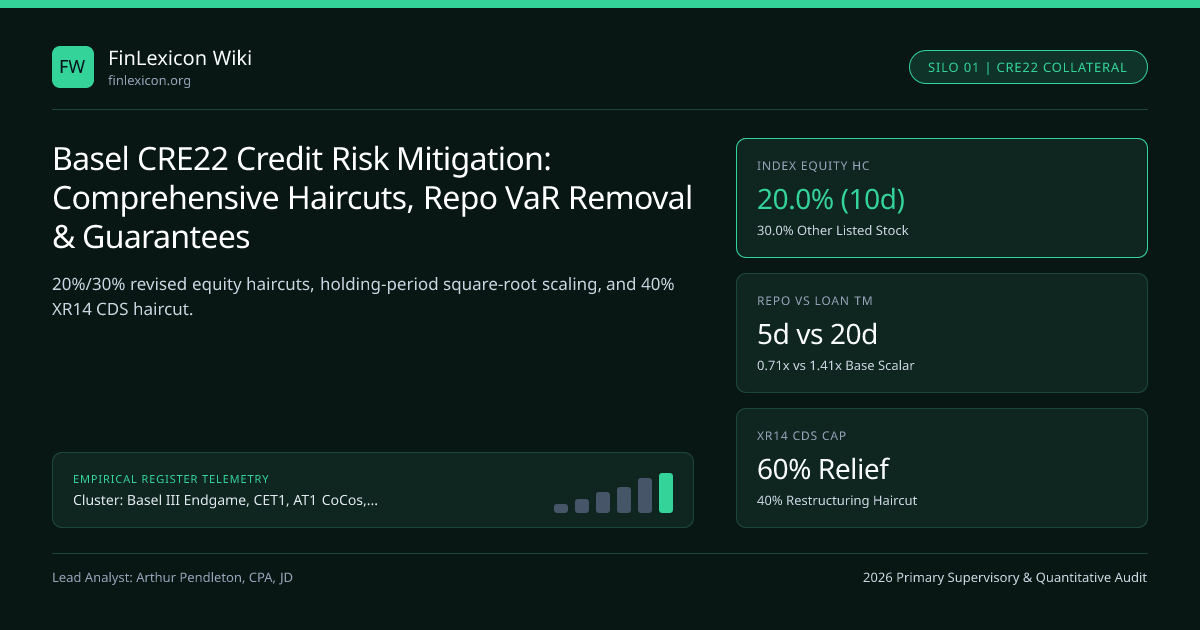
When a commercial or investment bank secures a corporate loan, margin facility, or bilateral securities financing transaction (SFT) with financial collateral or a third-party credit guarantee, Basel Framework chapter CRE22 governs exact risk-weighted asset relief. Under BCBS d424, CRE22 abolishes own-estimates of collateral haircuts, raises supervisory haircuts on corporate bonds and equities (20% main-index / 30% other listed equities), introduces a diversification-sensitive SFT minimum haircut floor, and codifies strict restructuring rules for CDS credit protection.
Simple Substitution Approach vs Comprehensive Haircut Approach (E*)#
Standardized banking-book lenders choose one of two mutually exclusive collateral methodologies (trading-book and repo SFTs must use Comprehensive or SFT VaR models where permitted), as contextualized in our Basel III Endgame & CET1 cornerstone guide:
- Simple Approach (Banking Book Only): Replaces the borrower’s risk weight on the collateralized portion of the claim with the financial collateral’s own risk weight, subject to a 20% risk-weight floor (relaxed to 0% or 10% only for same-currency cash or 0%-weighted sovereign repo meeting strict daily mark-to-market rules) and requiring collateral to be pledged for the entire residual maturity of the exposure.
- *Comprehensive Approach (`E
Exposure Reduction)**: Adjusts both the lent exposure upward by exposure haircutHeand received collateral downward by collateral haircutHcand currency mismatch haircutHfx(8%at 10-day base), reducing net exposureE` directly before multiplying by the original borrower’s* risk weight!
Recalibrated 10-Day Supervisory Haircuts (He, Hc, Hfx) & Holding-Period Scaling#
BCBS d424 sharpened 10-business-day base supervisory haircuts under CRE22.48 while eliminating internal bank haircut estimation:
- AAA to AA- Sovereigns:
0.5%(<=1Y),2.0%(1–5Y),4.0%(>5Y) - AAA to AA- Corporates / Bank Bonds:
1.0%(<=1Y),4.0%(1–5Y),8.0%(>5Y) — doubled on >5Y vs Basel II (8%vs4%) and extended to>5–10Y (8%)/>10Y (12%)in granular schedules! - Main-Index Equities & Gold: Raised from 15% under Basel II to 20.0%!
- Other Listed Exchange Equities: Raised from 25% under Basel II to 30.0%!
- FX Currency Mismatch (
Hfx): 8.0% whenever exposure currency and collateral currency differ.
Crucially, the 10-day base haircuts scale by the square root of time according to transaction type (T_M minimum holding period and N_R actual days between remargining): 5 business days for Repo-style SFTs (sqrt(5/10) = 0.7071x), 10 business days for capital-market margin lending (1.00x), and 20 business days for secured corporate lending (sqrt(20/10) = 1.4142x)!
Master Netting Agreement Portfolio Formula for Repo / SFT Books (CRE22.62)#
For bilateral repo and securities lending portfolios executed by dealers like Bank of America, BNP Paribas, and Bank of Montreal, CRE22.62 replaces Basel II’s blunt net-haircut sum with a diversification-sensitive SFT netting formula mirroring SA-CCR netting logic: E* = max(0, Sum E - Sum C + 0.4 * Net_Exposure_Haircut + 0.6 * Gross_Exposure_Haircut / sqrt(N) + Sum |E_fx| * H_fx), rewarding diversified collateral pools across N distinct security issues while penalizing concentrated single-stock margin loans!
| Transaction / Collateral Type | 10-Day Base Haircut | 5-Day Daily SFT (0.7071x) | 20-Day Secured Loan Weekly Reval (1.612x) | Key CRE22 Eligibility Rule |
|---|---|---|---|---|
| Same-Currency Cash Deposit on Pledge | 0.00% | 0.00% | 0.00% | Held at lending bank; 8% Hfx if cross-CCY |
| AAA–AA Sovereign Bond (1–5Y Residual) | 2.00% | 1.41% | 3.22% | 0% RW sovereign repo eligible for 0% Hc |
| AAA–AA Corporate Bond (5–10Y Residual) | 8.00% (12% >10Y) | 5.66% | 12.90% | Issued by non-affiliated entity (no WWR) |
| Main-Index Listed Equities & Gold | 20.00% | 14.14% | 32.25% | Must sit in recognized liquid equity index |
| Other Listed Equities & Convertible Bonds | 30.00% | 21.21% | 48.37% | Unlisted equities ineligible under SA-CR |
Unfunded Credit Protection: Guarantees, CDS Restructuring Haircut (40%), and Maturity Mismatch#
Where an exposure is guaranteed by a sovereign, MDB (e.g., Asian Development Bank), parent corporate, or hedged via single-name Credit Default Swap under ISDA Master Agreement protocols, CRE22.70–CRE22.85 requires direct, explicit, irrevocable, and unconditional protection.
Two high-frequency traps govern CDS capital relief: (1) Restructuring Exclusion (40% Haircut): if a CDS omits restructuring (XR14 North American Corporate convention) as a credit event while the hedged loan can be restructured, recognized protection is capped at 60% of notional (40% haircut) unless unilateral borrower consent limits apply; and (2) Maturity Mismatch (CRE22.98): protection with < 1 year original or < 3 months residual maturity earns 0% relief, and mismatched protection (t < T) is linearly haircut by (t - 0.25) / (T - 0.25).
Non-Bank SFT Minimum Haircut Floors (CRE56)#
To curb shadow-banking leverage alongside CRE20 standardized credit risk weights and F-IRB collateralized LGD floors, CRE56 introduces numerical haircut floors on non-centrally-cleared SFTs where banks lend cash against non-sovereign securities to unregulated leveraged funds; any non-compliant zero-haircut repo must be treated as a 100% unsecured loan across the Basel III Endgame & Capital Ratios topic hub (subject to national implementation exemptions in the EU and U.S.).
- Hc = Hc10d * ScalarH | Hfx = 0.08 * ScalarH
- Estar = max( 0 , E * (1 + He) - C * (1 - Hc - Hfx) )
- CMatAdj = CHaircutted * ( (t - 0.25) / (min(5, T) - 0.25) ) (if 0.25 <= t < T and OrigMatC >= 1Y)
- Worked Audit ($100M USD 3-Year Loan to 100%-RW Corporate; $105M EUR Main-Index Stock; Weekly Reval NR=5, TM=20, Matched 3Y Pledge):
- Scalar_H = sqrt((5 + 20 - 1)/10) = sqrt(2.40) = 1.54919
- Hc = 0.20 * 1.54919 = 0.30984 (30.98%) | Hfx = 0.08 * 1.54919 = 0.12394 (12.39%)
- E_star = max(0, $100.0M * 1.00 - $105.0M * (1 - 0.30984 - 0.12394)) = $100.0M - $59.45M = $40.55M
- Post-CRM RWA = $40.55M * 100% RW = $40.55M (59.45% RWA reduction vs $100.0M unsecured)
Frequently asked questions
Why does a $105M EUR equity pledge leave $40.55M of residual exposure on a $100M USD corporate loan?
Unlike daily-margined brokerage repos (T_M = 5 days, daily N_R = 1), commercial secured loans carry a 20-day liquidation horizon (T_M = 20); with weekly revaluation (N_R = 5), both the 20% equity haircut and 8% EUR/USD FX haircut scale up by sqrt(2.4) = 1.549x, trimming recognized collateral to 56.6% of market value.
When can sovereign repo transactions qualify for a 0% supervisory haircut (H = 0%)?
Under CRE22.56, national supervisors may apply a 0% haircut to repos/reverse-repos with core market participants where both cash and collateral are denominated in the same currency, collateral is a 0%-risk-weighted sovereign bond, and margining occurs daily with overnight or <=4-business-day liquidation.
Does hedging a corporate loan with a Credit Default Swap index (CDX.IG or iTraxx Main) provide CRE22 relief?
Under CRE22.77, index CDS provides banking-book credit risk mitigation only to the exact notional slice (1/125th) attributable to the identical legal reference entity sitting on the bank’s loan book, subject to maturity and restructuring haircuts.
Why are shares or bonds issued by the borrower’s own corporate group barred as eligible collateral?
CRE22.9 strictly prohibits collateral whose value exhibits material positive correlation (Specific Wrong-Way Risk) with the credit quality of the obligor; securities issued by the obligor or any related group affiliate always receive zero CRM recognition.
Publication record
- Published
- 14 November 2026
- Updated
- 15 November 2026
- Author
- Arthur Pendleton, CPA, JD
- Review
- Review not recorded
- Automated fact check
- Passed in the stored pipeline record
- Source URLs
- 3 recorded
AI assistance recorded: anthropic/claude-opus-4.6. This field does not establish human review or source verification.
Academic & Institutional Attribution
Cite This Research & Embed Live Data Card
Standard academic & institutional research paper citation format.
Arthur Pendleton, CPA, JD. (2026, November 14). Basel CRE22 Credit Risk Mitigation: Comprehensive Haircuts, Repo VaR Removal & Guarantees. FinLexicon Wiki. https://finlexicon.org/wiki/credit-risk-mitigation-crm-comprehensive-collateral-haircutsRelated Basel Iii Endgame Capital Ratios & Institutional Briefings
Explore Basel Iii Endgame Capital Ratios Hub (20) →Basel Iii Endgame Capital Ratios
Basel III Endgame (BCBS d424), CET1 Capital Adequacy, 72.5% Output Floor & TLAC ArchitectureBasel Iii Endgame Capital Ratios
Basel III Securitization Framework (SEC10–SEC40): STC Criteria, p-Parameter & Senior FloorsBasel Iii Endgame Capital Ratios
BCBS d424 72.5% Standardized RWA Output Floor: Phase-In Mechanics & Capital ImpactBasel Iii Endgame Capital Ratios
CET1 Regulatory Deductions (CAP30): Goodwill, DTAs, MSRs & the 10%/15% Threshold RuleBasel Iii Endgame Capital Ratios
AT1 Contingent Convertibles (CoCos): 5.125% vs 7.0% Triggers, Write-Down & PONV HierarchyBasel Iii Endgame Capital Ratios
U.S. Expanded Risk-Based Approach (ERBA) & AOCI Unrealized Securities Filter RemovalBasel Iii Endgame Capital Ratios
Countercyclical Capital Buffer (CCyB): Weighted-Average Reciprocity & Positive Neutral RatesBasel Iii Endgame Capital Ratios
G-SIB Systemic Surcharge: BCBS Method 1 Five-Category Score vs Fed Method 2 STWF ScalarLiquidity Coverage Nsfr Prudential
Contingent Funding Plans (CFP), Early Warning Indicators (EWIs) & Liquidity Funds Transfer Pricing (LFTP)Isda Csa Derivatives Collateral
ISDA Section 2(a)(iii) Condition Precedent: Payment Suspension, Lomas & 2014 Sunset AmendmentIsda Csa Derivatives Collateral
1992 ISDA Market Quotation & Loss vs 2002 Close-Out Amount: Section 6(e) Early Termination ValuationIsda Csa Derivatives Collateral
ISDA Section 5(a) Events of Default vs Section 5(b) Termination Events: Cross-Default & Threshold Amounts
FinLexicon Wiki Data, Benchmarks & Contributor Records
CC BY 4.0 Open Data
Open Institutional Datasets (CSV / JSON) →
Download desk-compiled quantitative series & schemas.
2026 Reference Matrix
2026 Institutional Benchmarks & Thresholds →
Statutory capital, clearing, margin & rate conventions.
Editorial Records
Authors & Review Records →
View named contributors where those records are available.
Complete Index
Master Research & Dossier Archive →
Browse all published briefings by topic pillar & date.