
Basel Iii Endgame Capital Ratios
ECB SREP Pillar 2 Requirement (P2R) vs Pillar 2 Guidance (P2G) & UK PRA Pillar 2A/2B
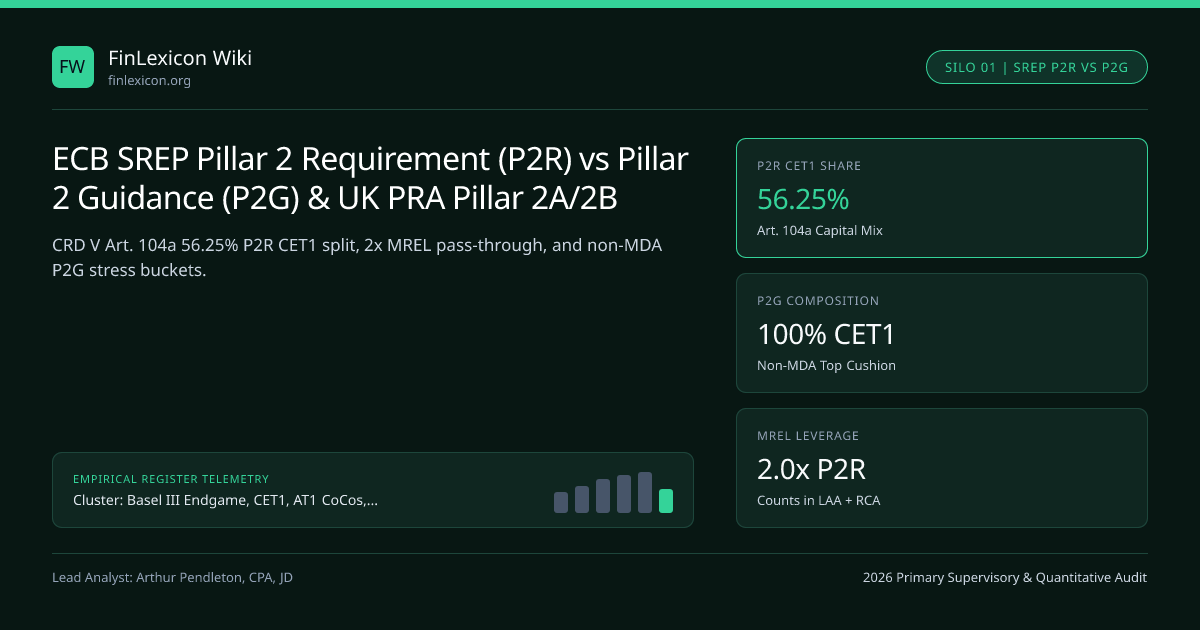
Under EU CRD V Article 104a and ECB SREP methodology, Pillar 2 Requirement (P2R) sits below the Combined Buffer Requirement with a 56.25% CET1 split, whereas Pillar 2 Guidance (P2G) sits above MDA.
Pillar 1 risk weights cannot capture bank-specific concentration risk, banking-book interest rate duration (IRRBB EVE/NII shocks), IT governance weaknesses, or sovereign spread concentrations. Under Basel Framework SRP20–SRP30—operationalized in Europe via the European Central Bank Supervisory Review and Evaluation Process (SREP) and in Britain via the UK Prudential Regulation Authority Pillar 2A/2B regime—supervisors split microprudential add-ons into legally binding Pillar 2 Requirements (P2R) below the MDA buffer stack and non-binding stress Pillar 2 Guidance (P2G) above it.
The Crucial 2016–2020 CRD V Split: Separating Binding P2R From Stress-Based P2G#
During the inaugural 2015 SSM SREP cycle, combining all Pillar 2 add-ons below the Combined Buffer Requirement inadvertently pushed several Eurozone banks dangerously close to automatic AT1 coupon stops, triggering an early-2016 selloff in European CoCos. In response, the EBA and ECB split Pillar 2 into two distinct layers now codified in CRD V Articles 104a and 104b (referenced in our Basel III Endgame & CET1 cornerstone guide):
- Pillar 2 Requirement (
P2R, Binding Below CBR): Covers ongoing idiosyncratic risks underestimated or omitted by Pillar 1 (credit concentration, IRRBB, NPL provisioning gaps, governance deficiencies). Because P2R sits directly atop Pillar 1 (8.0%) and below the Combined Buffer Requirement, every basis point of P2R directly lifts both the Maximum Distributable Amount (MDA) trigger and 2x inside SRB MREL calibration (LAA + RCA)! - Pillar 2 Guidance (
P2G, Non-MDA Buffer Above CBR): Derived from the bank’s biennial EBA/ECB Adverse Stress Test peak CET1 depletion (bucketed into four P2G ranges from0%–1.0%up to2.0%–4.75%after offsetting the 2.50% Capital Conservation Buffer). P2G must be met 100% with CET1, is not publicly mandatory to disclose (unlike P2R under CRR Art. 438), and breaching P2G never triggers automatic MDA coupon bans!
CRD V Article 104a Capital Composition Relief (56.25% CET1 / 18.75% AT1 / 25% T2)#
Prior to March 2020 (when the ECB front-loaded CRD V Article 104a during COVID-19), Eurozone banks had to satisfy 100% of P2R using pure Common Equity Tier 1. Article 104a harmonized P2R composition with Pillar 1 proportions (4.5/8.0 = 56.25% CET1, 1.5/8.0 = 18.75% AT1, 2.0/8.0 = 25.00% Tier 2).
For a major Eurozone bank like BNP Paribas, Allied Irish Banks, or Bank of Ireland carrying a 2.00% SREP P2R, Article 104a cut required CET1 from 2.00% down to 1.125% (-87.5 bps immediate MDA relief!), allowing 0.375% AT1 and 0.500% Tier 2—unless the Joint Supervisory Team exercises targeted authority to demand a higher CET1 share for specific NPL coverage shortfalls.
How the UK PRA Prevents Output Floor Double-Counting via Nominal/Adjusted Pillar 2A#
In the United Kingdom, UK PRA Pillar 2A mirrors EU P2R (56.25% CET1 / 43.75% AT1+T2) while the PRA Buffer (Pillar 2B) mirrors P2G. Critically, as the BCBS d424 72.5% RWA output floor and Basel 3.1 standardized risk weights expand RWA denominators for lenders like Bank of Scotland, keeping Pillar 2A fixed as a percentage of RWA would mechanically inflate pound-sterling Pillar 2A capital even though risk did not rise!
To prevent double-counting, the Bank of England / PRA sets Pillar 2A in sterling nominal/adjusted terms during RWA methodology transitions and retires SME/credit-concentration Pillar 2A add-ons already absorbed into stricter Basel 3.1 standardized weights—echoed by the ECB’s pledge to neutralize mechanical P2R/P2G double-counting under CRR III.
| Supervisory Add-On Feature | ECB Pillar 2 Requirement (P2R) | ECB Pillar 2 Guidance (P2G) | UK PRA Pillar 2A | U.S. CCAR Stress Capital Buffer (SCB) |
|---|---|---|---|---|
| Position in Stack | Below CBR (inside Total SREP Cap) | Above CBR (top of stack) | Below UK Combined Buffer | Replaces CCB inside CBR |
| Eligible Capital Quality | 56.25% CET1 / 18.75% AT1 / 25% T2 | 100% CET1 Only | 56.25% CET1 / 43.75% AT1+T2 | 100% CET1 Only |
| Triggers Automatic MDA? | Yes (elevates MDA 1-for-1) | No (supervisory dialogue only) | Yes (elevates UK MDA) | Yes (governs ERI payout quartiles) |
| Mandatory Public Pillar 3? | Yes (CRR Art. 438 mandatory) | No (voluntary issuer disclosure) | Disclosed in annual reports | Yes (published each June/August) |
| Feeds Into MREL / TLAC? | Yes (counts in LAA + RCA = 2x) | No (excluded from MREL base) | Yes (2x(P1 + P2A) UK MREL) | No (U.S. TLAC uses static 2.5% CCB) |
SREP Four-Element Scoring (1 to 4) and Non-Performing Loan P2R Add-Ons#
ECB Joint Supervisory Teams grade four core elements from Score 1 (low risk) to Score 4 (high risk): Business Model viability, Internal Governance & Risk Management, Risks to Capital (Credit, Market, Operational, IRRBB), and Risks to Liquidity/Funding. Weak governance or aged unprovisioned legacy NPLs trigger dedicated deterministic P2R surcharges until remediated.
Repeated P2G Breaches and Pillar 2R Leverage Ratio (P2R-LR / P2G-LR)#
Under CRD VI and updated SSM rules, if an institution repeatedly fails to restore its P2G over an extended remediation timeline, supervisors may reclassify part of P2G into binding P2R; additionally, the ECB assigns parallel P2R-LR and P2G-LR add-ons on the 3.0% Tier 1 Leverage Ratio for excessive sovereign-carry or repo leverage across the Basel III Endgame & Capital Ratios topic hub.
- OCRCET1MDA = 4.50% + (0.5625 * P2RTotal) + CCB (2.50%) + max(GSII, O_SII) + SyRB + CCyB
- FullCET1Guide = OCRCET1MDA + P2G_CET1
- Worked Eurozone Bank SREP Audit (P2R = 2.20%, O-SII = 1.50%, CCyB = 0.75%, P2G = 1.25%, Fully Issued AT1/T2):
- P2R CET1 Slice = 0.5625 * 2.20% = 1.2375% (AT1 Slice = 0.4125%, Tier 2 Slice = 0.5500%)
- Total SREP Capital Requirement (TSCR) = 8.00% + 2.20% = 10.20% Total Capital
- Overall Capital Requirement (OCR / Binding CET1 MDA Trigger) = 4.50% + 1.2375% + 2.50% + 1.50% + 0.75% = 10.4875%
- All-In CET1 Target Including P2G = 10.4875% + 1.25% = 11.7375% (+ ~125 bps Management Cushion => ~13.0% Reported CET1)
Frequently asked questions
Why does a 25 bps increase in ECB P2R force a 50 bps increase in MREL issuance?
Under EU BRRD II Article 45c, P2R enters both the Loss Absorption Amount (8% + P2R) and the post-resolution Recapitalization Amount (8% + P2R); thus +25 bps of P2R expands total MREL by +50 bps of RWA!
Can a Eurozone bank simultaneously face both a G-SII buffer and an O-SII buffer?
Under CRD V Article 131(14)–(15), where a group faces both a G-SII and an O-SII buffer on a consolidated basis, the higher of the two applies; however, Systemic Risk Buffers (SyRB) are now additive to G-SII/O-SII up to a 5% combined supervisory review threshold.
How does the ECB prevent double-counting between the 2.5% Capital Conservation Buffer and P2G?
Because both CCB and P2G absorb macroeconomic stress losses, the ECB’s two-step P2G bucketing methodology calibrates P2G ranges *net* of the 2.50% CCB so mild stress depletions (<300 bps) can receive near-zero P2G.
Must European banks publicly disclose their Pillar 2 Guidance (P2G) to bondholders?
CRR Article 438 mandates public disclosure of binding Pillar 2 Requirements (P2R), whereas P2G disclosure remains legally optional (subject to EU Market Abuse Regulation assessment if material), though several banks voluntarily disclose P2G buckets for investor clarity.
Publication record
- Published
- 14 November 2026
- Updated
- 15 November 2026
- Author
- Arthur Pendleton, CPA, JD
- Review
- Review not recorded
- Automated fact check
- Passed in the stored pipeline record
- Source URLs
- 3 recorded
AI assistance recorded: anthropic/claude-opus-4.6. This field does not establish human review or source verification.
Academic & Institutional Attribution
Cite This Research & Embed Live Data Card
Standard academic & institutional research paper citation format.
Arthur Pendleton, CPA, JD. (2026, November 14). ECB SREP Pillar 2 Requirement (P2R) vs Pillar 2 Guidance (P2G) & UK PRA Pillar 2A/2B. FinLexicon Wiki. https://finlexicon.org/wiki/pillar-2r-vs-pillar-2g-srep-supervisory-capital-stackingRelated Basel Iii Endgame Capital Ratios & Institutional Briefings
Explore Basel Iii Endgame Capital Ratios Hub (20) →Basel Iii Endgame Capital Ratios
Basel III Endgame (BCBS d424), CET1 Capital Adequacy, 72.5% Output Floor & TLAC ArchitectureBasel Iii Endgame Capital Ratios
Basel CRE22 Credit Risk Mitigation: Comprehensive Haircuts, Repo VaR Removal & GuaranteesBasel Iii Endgame Capital Ratios
Basel III Securitization Framework (SEC10–SEC40): STC Criteria, p-Parameter & Senior FloorsBasel Iii Endgame Capital Ratios
BCBS d424 72.5% Standardized RWA Output Floor: Phase-In Mechanics & Capital ImpactBasel Iii Endgame Capital Ratios
CET1 Regulatory Deductions (CAP30): Goodwill, DTAs, MSRs & the 10%/15% Threshold RuleBasel Iii Endgame Capital Ratios
AT1 Contingent Convertibles (CoCos): 5.125% vs 7.0% Triggers, Write-Down & PONV HierarchyBasel Iii Endgame Capital Ratios
U.S. Expanded Risk-Based Approach (ERBA) & AOCI Unrealized Securities Filter RemovalBasel Iii Endgame Capital Ratios
Countercyclical Capital Buffer (CCyB): Weighted-Average Reciprocity & Positive Neutral RatesLiquidity Coverage Nsfr Prudential
Collateral Swaps, Securities Lending & Liquidity Upgrade Trades: LCR30.36 Unwind & LCR40.48 OutflowsLiquidity Coverage Nsfr Prudential
Contingent Funding Plans (CFP), Early Warning Indicators (EWIs) & Liquidity Funds Transfer Pricing (LFTP)Isda Csa Derivatives Collateral
ISDA Section 2(a)(iii) Condition Precedent: Payment Suspension, Lomas & 2014 Sunset AmendmentIsda Csa Derivatives Collateral
1992 ISDA Market Quotation & Loss vs 2002 Close-Out Amount: Section 6(e) Early Termination Valuation
FinLexicon Wiki Data, Benchmarks & Contributor Records
CC BY 4.0 Open Data
Open Institutional Datasets (CSV / JSON) →
Download desk-compiled quantitative series & schemas.
2026 Reference Matrix
2026 Institutional Benchmarks & Thresholds →
Statutory capital, clearing, margin & rate conventions.
Editorial Records
Authors & Review Records →
View named contributors where those records are available.
Complete Index
Master Research & Dossier Archive →
Browse all published briefings by topic pillar & date.