
Basel Iii Endgame Capital Ratios
FSB TLAC Term Sheet: 18% RWA / 6.75% Leverage Minimums & Clean Holding Company Rules
The FSB Total Loss-Absorbing Capacity (TLAC) standard requires G-SIBs to maintain 18.0% of RWA and 6.75% of leverage exposure in bail-in capital and subordinated clean-holding-company debt.
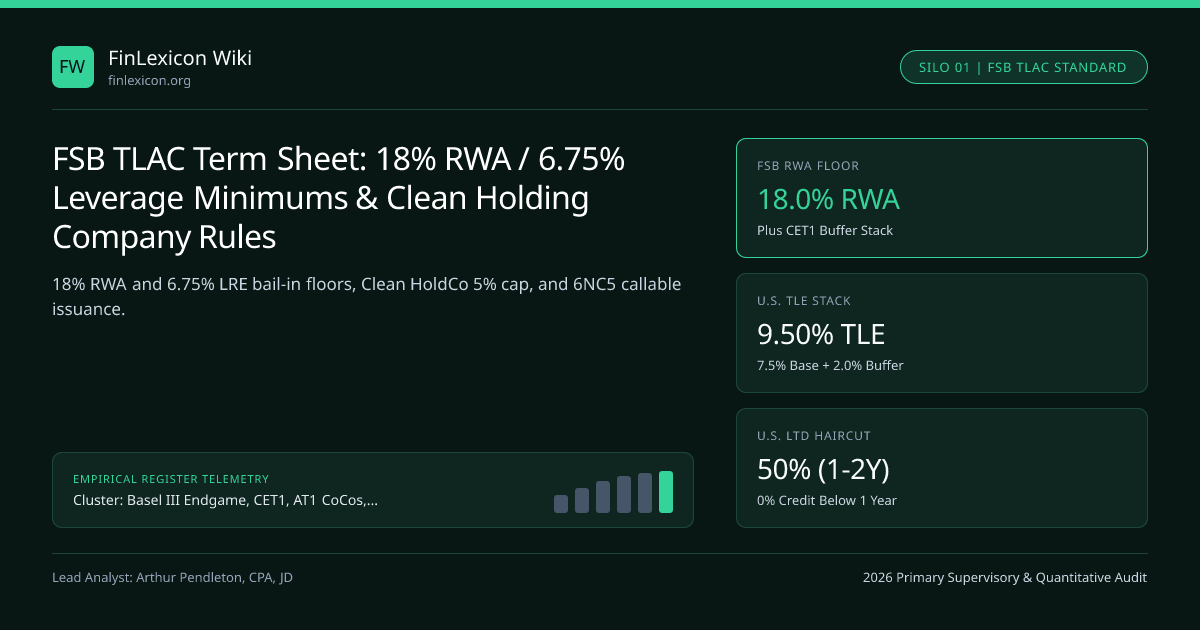
Adopted by the Financial Stability Board in November 2015 and fully phased in at 18.0% of risk-weighted assets and 6.75% of the Basel III leverage ratio denominator, the Total Loss-Absorbing Capacity (TLAC) Standard ensures that failing G-SIBs can be resolved over a single weekend via creditor bail-in without interrupting critical operating subsidiaries. Tracked under the TLAC-MREL 2026 Benchmark Standard, external TLAC combines Tier 1/2 regulatory capital (excluding CET1 used for regulatory buffers) with long-term unsecured debt subordinated to operating liabilities.
Dual Denominator Floors (18% RWA / 6.75% LRE) and the 33% Long-Term Debt Expectation#
Section 4 of the FSB TLAC Term Sheet mandates two concurrent external minimums for each resolution entity of a G-SIB: 18.0% of RWA (before adding the CET1 Combined Buffer Requirement on top!) and 6.75% of the Leverage Ratio Exposure (LRE) measure. In the United States, Federal Reserve Regulation YY (12 CFR 252.61–252.63) gold-plates the leverage component to 7.5% of Total Leverage Exposure plus a 2.0% external TLAC leverage buffer (= 9.5% total!), alongside a standalone External Long-Term Debt (LTD) minimum equal to 6.0% + G-SIB_Surcharge of RWA and 4.5% of Total Leverage Exposure.
Requiring a dedicated LTD tranche—echoing the FSB’s expectation that debt instruments represent at least 33% of minimum TLAC—guarantees that even after a failing bank depletes 100% of its going-concern CET1 equity, resolution authorities like the FDIC or Bank of England possess a fresh pool of bail-in debt to convert into new post-resolution equity, as synthesized in our Basel III Endgame & CET1 cornerstone guide.
Three Routes to Subordination: Structural, Statutory, and Contractual#
To prevent "No Creditor Worse Off than in Liquidation" (NCWO) legal challenges from halting bail-in when insured deposits, cleared derivatives, and repo liabilities are exempted, Section 11 of the FSB Term Sheet requires TLAC debt to rank junior to excluded operational liabilities through one of three architectures:
- Structural Subordination (U.S., UK, Switzerland, Japan): Top-tier bank holding companies (e.g., Bank of America Corp.) issue external TLAC debt and downstream proceeds to operating bank subsidiaries, leaving holding-company bondholders structurally junior to all operating-bank depositors and swap counterparties.
- Statutory Subordination (Germany Prior to SNP Harmonization): National insolvency statutes subordinate plain-vanilla senior unsecured bonds below operational liabilities.
- Contractual Subordination (France, Spain, EU BRRD Senior Non-Preferred): Operating banks without non-operating holding companies—such as BNP Paribas—issue a distinct statutory/contractual tier of Senior Non-Preferred (SNP) bonds ranking between Tier 2 and Senior Preferred operational liabilities.
Clean Holding Company Restrictions and the 5% Excluded Liabilities Cap#
Structural subordination breaks down if the parent resolution holding company also issues short-term commercial paper, enters external OTC derivatives, or guarantees third-party operational obligations that rank pari passu with TLAC bonds. Section 11 (and 12 CFR 252.64 in the U.S.) enforces strict Clean Holding Company prohibitions: U.S. G-SIB parent holding companies cannot issue debt with original maturity under 365 days, enter external QFCs with third parties, or hold unrelated non-TLAC third-party liabilities exceeding 5% of the holding company’s total regulatory capital plus eligible LTD.
| TLAC Dimension | FSB Global Term Sheet | U.S. Fed Reg YY (12 CFR 252) | UK Bank of England MREL/TLAC | EU CRR III / BRRD II G-SII |
|---|---|---|---|---|
| Risk-Based Minimum | 18.0% RWA + CET1 Buffers | 18.0% RWA + 2.5% + GSIB M1 + CCyB | 2x (Pillar 1 + P2A) or 18% RWA | 18.0% RWA + CBR (Pillar 1 MREL) |
| Leverage Minimum | 6.75% Leverage Exposure | 7.5% TLE + 2.0% Buffer = 9.5% | 6.75% UK Leverage Exposure | 6.75% Total Exposure Measure |
| Standalone Debt Floor | >=33% expectation | 6.0% + GSIB_M2 RWA; 4.5% TLE | Structural HoldCo subordination | 8% TLOF subordination rule |
| 1–2Y Maturity Haircut | 100% credit >=1Y (<1Y = 0%) | 50% haircut on 1–2Y External LTD | 100% credit >=1Y (<1Y = 0%) | 100% credit >=1Y (<1Y = 0%) |
| Subordination Architecture | Structural, Statutory, or Contr. | Strict Clean HoldCo Structural | Strict HoldCo Structural | Senior Non-Preferred or HoldCo |
Residual Maturity Haircuts (< 1 Year Zero, 1–2 Years 50% Under U.S. LTD)#
Under FSB Section 9, debt instruments cease to qualify as external TLAC entirely once residual contractual maturity falls below one year (365 days); where an issuer holds an embedded call option, maturity is measured to the earliest call date if redemption incentives exist, whereas investor put options always accelerate maturity to the earliest put date. Note a critical U.S. Reg YY strictness: for standalone U.S. External LTD compliance, senior debt with remaining maturity between 1 and 2 years suffers a 50% haircut, forcing G-SIB treasuries to issue 6NC5 or 11NC10 callable structures that call exactly 12 months before final maturity!
Internal TLAC (75%–90% Scaling) andBasel CAP30 Cross-Holdings Deductions#
To reassure host supervisors such as MAS or HKMA that home resolution authorities will upstream foreign subsidiary losses rather than ring-fencing domestic operations, FSB Section 18 mandates Internal TLAC pre-positioned at material sub-groups scaled at 75% to 90% of standalone external TLAC. Simultaneously, Basel CAP30 deducts any bank’s holdings of other G-SIBs’ TLAC bonds (complementing EU BRRD II MREL subordination rules and G-SIB Method 1/Method 2 surcharges) from its own Tier 2 capital above narrow 5%/10% market-making baskets to block systemic contagion across the Basel III Endgame & Capital Ratios topic hub.
- ExternalTLACRatio = ( CET1Total + AT1 + Tier2 + EligibleTLACDebt - CBRDollar ) / RWA_Floored >= 18.0%
- EffectiveTotalStack = 18.0% + CCB (2.5%) + GSIB_Surcharge + CCyB
- Worked U.S. G-SIB Audit ($1,200B RWA, $2,800B TLE, Method 1 = 2.0%, Method 2 = 3.0%, CCyB = 0.0%):
- TLAC RWA Stack (uses Method 1 in Reg YY buffer): 18.0% + 2.5% + 2.0% = 22.50% * $1,200B = $270.0B
- TLAC Leverage Stack: (7.50% + 2.00% Buffer) * $2,800B = 9.50% * $2,800B = $266.0B (RWA Binds at $270.0B)
- Standalone U.S. LTD RWA Minimum (uses Method 2!): (6.0% + 3.0%) * $1,200B = 9.0% * $1,200B = $108.0B
- Standalone U.S. LTD Leverage Minimum: 4.50% * $2,800B = $126.0B (Leverage Binds External LTD at $126.0B!)
Frequently asked questions
Why cannot CET1 counted toward the 18% TLAC minimum also satisfy the Capital Conservation or G-SIB buffer?
FSB Term Sheet Section 6 prohibits double-counting so that a bank experiencing initial stress can draw down its CET1 buffers without immediately breaching its statutory 18% minimum TLAC requirement and prematurely triggering resolution.
Why do G-SIBs embed a par call option one year before final maturity (e.g., 6NC5 or 11NC10)?
Once a TLAC bond crosses below 365 days remaining to maturity, its regulatory TLAC value drops to 0% while the issuer still pays a subordinated credit spread; calling at par at T-12 months (with supervisory approval) avoids carrying expensive non-qualifying funding.
Does calling a TLAC-eligible senior HoldCo bond within 5 years require prior central bank approval?
Yes. Under FSB Section 9, EU CRR Article 77/78a, and U.S. Reg YY, any early redemption, call, or open-market repurchase of eligible TLAC/MREL debt generally requires prior supervisory permission confirming post-redemption compliance.
What did U.S. banking agencies propose for Regional Bank ($100B+) Long-Term Debt after 2023?
Following the Silicon Valley Bank and Signature Bank failures—where uninsured depositors bore losses alongside the FDIC Deposit Insurance Fund—federal agencies proposed extending a 6% RWA / 3.5% average-asset/leverage External LTD requirement to Category II–IV regional banks above $100B.
Publication record
- Published
- 14 November 2026
- Updated
- 15 November 2026
- Author
- Arthur Pendleton, CPA, JD
- Review
- Review not recorded
- Automated fact check
- Passed in the stored pipeline record
- Source URLs
- 3 recorded
AI assistance recorded: anthropic/claude-opus-4.6. This field does not establish human review or source verification.
Academic & Institutional Attribution
Cite This Research & Embed Live Data Card
Standard academic & institutional research paper citation format.
Arthur Pendleton, CPA, JD. (2026, November 14). FSB TLAC Term Sheet: 18% RWA / 6.75% Leverage Minimums & Clean Holding Company Rules. FinLexicon Wiki. https://finlexicon.org/wiki/fsb-tlac-term-sheet-18-percent-rwa-clean-holding-companyRelated Basel Iii Endgame Capital Ratios & Institutional Briefings
Explore Basel Iii Endgame Capital Ratios Hub (20) →Basel Iii Endgame Capital Ratios
Basel III Endgame (BCBS d424), CET1 Capital Adequacy, 72.5% Output Floor & TLAC ArchitectureBasel Iii Endgame Capital Ratios
EU BRRD II MREL Calibration: SPE vs MPE Resolution & Senior Non-Preferred Debt HierarchyBasel Iii Endgame Capital Ratios
Enhanced Supplementary Leverage Ratio (eSLR) & Total Leverage Exposure (LEV20–LEV30)Basel Iii Endgame Capital Ratios
Basel III Standardized Credit Risk (CRE20): LTV Mortgage Buckets & ADC Real Estate WeightsBasel Iii Endgame Capital Ratios
Foundation IRB (F-IRB) Migration & A-IRB PD/LGD Input Floors (CRE30–CRE32)Basel Iii Endgame Capital Ratios
Operational Risk Standardized Measurement Approach (SMA): BIC Buckets & ILM=1 DiscretionBasel Iii Endgame Capital Ratios
FRTB Market Risk (MAR21/MAR30): Sensitivities-Based Method (SbM), PLA Test & NMRF CapitalBasel Iii Endgame Capital Ratios
Maximum Distributable Amount (MDA): CET1 Buffer Quartiles & AT1 Coupon RestrictionsLiquidity Coverage Nsfr Prudential
Asymmetric NSFR Derivatives Treatment (NSF30): Cash VM Offsets & the 20% Gross Liability Add-OnLiquidity Coverage Nsfr Prudential
BCBS 248 Intraday Liquidity Monitoring Tools: RTGS Peak Net Debit & Time-Specific ObligationsLiquidity Coverage Nsfr Prudential
IRRBB Standards (BCBS d368 / SRP31): Six EVE Shock Scenarios, 15% Tier 1 Outlier Test & Delta-NIILiquidity Coverage Nsfr Prudential
Non-Maturity Deposits (NMD) Behavioral Modeling: Deposit Betas, Core Caps & SRP31 Duration Ceilings
FinLexicon Wiki Data, Benchmarks & Contributor Records
CC BY 4.0 Open Data
Open Institutional Datasets (CSV / JSON) →
Download desk-compiled quantitative series & schemas.
2026 Reference Matrix
2026 Institutional Benchmarks & Thresholds →
Statutory capital, clearing, margin & rate conventions.
Editorial Records
Authors & Review Records →
View named contributors where those records are available.
Complete Index
Master Research & Dossier Archive →
Browse all published briefings by topic pillar & date.