
Ifrs9 Cecl Credit Provisioning
IFRS 7, ASC 326 Vintage Charge-Off Tables & ISA 540 / PCAOB AS 2501 External Audit of Credit Loss Estimates
Forward-looking Expected Credit Loss models represent the highest-risk Critical Audit Matter (CAM / KAM) in global banking—policed by IFRS 7 stage migration matrices, US GAAP ASC 326 origination-vintage gross write-off tables, and ISA 540 / PCAOB AS 2501 independent challenger models.
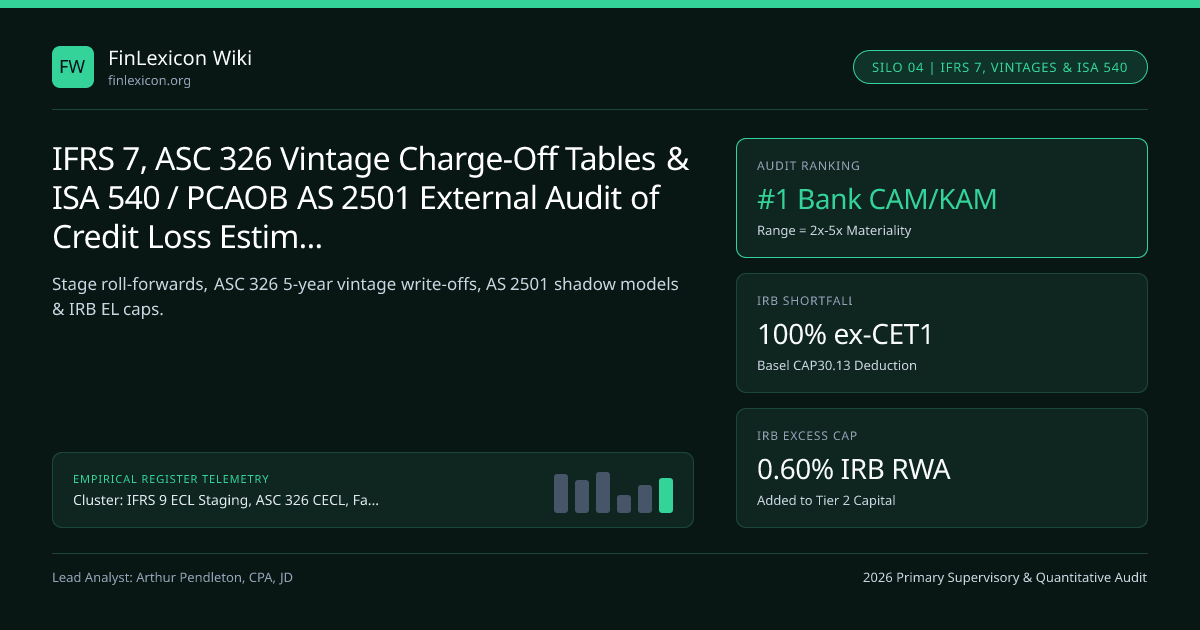
Open the annual report (Form 10-K or Universal Registration Document) of every single G-SIB on Earth—Bank of America, BNP Paribas, Bank of Montreal, or ANZ Bank—and flip to the Independent Auditor’s Report: Allowance for Expected Credit Losses (IFRS 9 / ASC 326 CECL) is the #1 Critical Audit Matter (CAM under PCAOB) or Key Audit Matter (KAM under IAASB)! Because a 15 bps tweak in macro scenario weights or SICR thresholds swings pre-tax profit by $500M–$1.5B, standard-setters paired forward-looking ECL with deep IFRS 7, ASC 326 Vintage, and ISA 540 / PCAOB AS 2501 audit architectures.
IFRS 7.35H–35M Loss Allowance Roll-Forward vs US GAAP ASC 326-20-50-6 Origination-Vintage Matrices#
Notice the fascinating structural contrast between what IFRS 7 and US GAAP ASC 326 force banks to disclose in their quarterly/annual footnotes, anchored in our IFRS 9, CECL & Fair Value cornerstone guide:
- IFRS 7 (
Paragraphs 35H, 35I & 35M— Stage Migration & Credit Grade Matrix):
- Requires a dual Gross Carrying Amount AND ECL Allowance roll-forward across Stage 1, Stage 2, Stage 3, and POCI, isolating explicit line items for:
Transfers Stage 1 -> Stage 2,Transfers Stage 2 -> Stage 3,Cure Transfers Stage 2 -> Stage 1,New Originations,Derecognitions,Write-Offs, andMacro/Model Parameter Changes! - IFRS 7.35M adds a Credit Risk Rating Grade × Stage matrix (
Investment Grade / Sub-Investment / Watchlist / Defaultedsplit across Stage 1, 2, 3).
- US GAAP (
ASC 326-20-50-6+ASU 2022-02— Origination-Year Vintage Matrix + Gross Write-Offs!):
- Because US GAAP CECL has no Stage 1/2/3 buckets, FASB mandated the famous Vintage Credit-Quality Disclosure: for every portfolio segment (
C&I,CRE,Residential Mortgage,Auto), public business entities cross-tabulate Amortized Cost by Credit Quality Indicator (FICOband or Internal Risk Rating) across the 5 most recent individual origination years (2026,2025,2024,2023,2022,Prior, plusRevolving)! - Added by ASU 2022-02: every single origination-year column MUST also report current-year Gross Write-Offs (
Charge-Offs) by origination vintage—immediately exposing if a bank’s2022or2023underwriting vintage is blowing up!
Reconciling Financial-Statement IFRS 7 / ASC 326 Footnotes With Basel Pillar 3 (DIS40: CR1, CR2, CR8)#
Institutional credit analysts cross-check audited financial statements against Basel Pillar 3 (DIS40) reports supervised by BCBS, ECB, and OCC—remembering three classic reconciliation traps:
- Consolidation Scope Divergence: Financial statements (
IFRS 10/ASC 810) consolidate insurance subsidiaries (e.g., BNP Paribas Cardif), whereas Regulatory Pillar 3 (CR1/CR2) deconsolidates insurance subsidiaries (equity-accounting/deducting them instead!). - Accounting Stage 3 vs Basel Default (
CRE36): Mostly aligned, except for jurisdictional90-DPDmateriality thresholds or non-credit-impaired distressed flags. - Expected Loss (
EL) vs AccountingECL(CAP10.19/CRE35): On IRB portfolios, Basel compares total eligible accounting reserves (Stage 1 + Stage 2 + Stage 3) against *Basel 1-Year IRB Regulatory Expected Loss (`PD_TTC LGD_Downturn * EAD)**: any **accounting shortfall** is **deducted 100% from CET1**, while any **accounting excess** adds back to **Tier 2 capital (capped at 0.60% of Credit RWA`)**!
| Disclosure / Prudential Standard | Core Required Table | Primary Analytical Signal for Investors | Jurisdictional Scope |
|---|---|---|---|
IFRS 7.35H–I (Stage Roll-Forward) | Gross Loan & ECL roll-forward across Stg 1 / Stg 2 / Stg 3 / POCI | Net Stage 1 -> Stage 2 inflow velocity & cure rate | EU, UK, Canada, Australia, HK, SG |
IFRS 7.35M (Credit Grade Matrix) | Internal/External Rating × Stage (1, 2, 3) exposure grid | Detects sub-investment-grade loans still parked in Stage 1! | All IFRS Jurisdictions |
ASC 326-20-50-6 (Vintage Table) | FICO / Risk Grade × 2026..2022 + Prior + Revolv. + Gross Write-Offs | Pinpoints exact underwriting year (e.g., 2022 CRE) souring! | United States (SEC PBEs) |
Basel Pillar 3 CR1 / CR2 / CR8 | Performing/NPE stock, flow & IRB EL vs Accounting Provision | Quantifies CET1 EL shortfall deduction or Tier 2 add-back | Global BCBS Banks |
How External Auditors Test ECL Under ISA 540 (Revised) & PCAOB AS 2501#
Because an IFRS 9 / CECL reserve has a Estimation Uncertainty Range (Reasonable Range) that is often 2x to 5x wider than whole-financial-statement Audit Materiality (e.g., reasonable ECL range = $5.1B–$6.3B vs $250M audit materiality!), IAASB ISA 540 (Revised) and *PCAOB AS 2501 (Auditing Accounting Estimates)* require Big-4 audit engagement teams + internal quant specialists to deploy three lines of audit verification:
- ITGC & Data Lineage Controls: End-to-end reconciliation of origination dates, FICO/internal ratings, collateral LTVs, and modifications from core loan ledgers into ECL engines.
- Independent Auditor "Challenger / Shadow Models": Audit quants build independent econometric satellite and SICR staging scripts on high-risk portfolios (
CRE, leveraged lending, unsecured cards) to construct an Auditor’s Independent Point Estimate & Reasonable Range. - Stand-Back Management Bias Evaluation (
ISA 540.32/AS 2501.27): Auditing whether macro scenario weights and Post-Model Adjustments (`PMAs`) systematically cluster near the optimistic or pessimistic edge quarter after quarter!
Backtesting Predicted 12-Month Stage 1 ECL vs Realized Next-Year Defaults#
Both external auditors and bank Model Validation (SR 11-7 / SS1/23) run annual vintage outcome backtests comparing prior-year Stage 1 PD/LGD predictions against actual defaults across the IFRS 9, CECL & Fair Value Accounting topic hub.
SEC Comment Letters & ESMA Enforcement Priorities on ECL Granularity#
Both the U.S. SEC Division of Corporation Finance and ESMA routinely issue comment letters whenever banks report large qualitative PMA swings without disaggregated quantitative sensitivity tables.
- If IRBELComparisonNet < 0 ("Shortfall") : CET1DeductionCAP3013 = |IRBELComparison_Net| (100% CET1 Cut!)
- If IRBELComparisonNet > 0 ("Excess") : Tier2AddBackCAP1019 = min( IRBELComparisonNet , 0.0060 * RWACredit_IRB )
- Standardized Approach (SA) General Reserve Rule (Basel CAP10.18):
- General Credit Reserves (Stage 1 + Stage 2 / Non-Specific CECL) on SA Exposures -> Added to Tier 2 up to 1.25% of SA Credit RWA!
Frequently asked questions
How can a forward-looking IFRS 9 allowance EVER have a "Shortfall" against 1-year Basel IRB Expected Loss?
During benign economic expansions, IFRS 9 Stage 1 (~88% of a healthy bank’s book) uses low Point-in-Time (PiT) PDs and unbiased economic LGDs, whereas Basel IRB Expected Loss uses higher Through-the-Cycle (TTC) PDs (floored at 5 bps) multiplied by severe Downturn LGDs (floored at 10%–25%)—frequently making 1-year IRB EL *higher* than benign IFRS 9 ECL!
Can a bank net an Excess provision on its Standardized (SA) retail portfolio against an EL Shortfall on its IRB corporate portfolio?
Strictly NO! Under Basel CRE35.4, banks must partition total accounting credit allowances strictly between Standardized Approach (SA) exposures and IRB exposures—you can never use excess SA general reserves to offset an IRB EL CET1 shortfall deduction!
Why did investors lobby FASB so aggressively to restore "Gross Charge-Offs by Vintage" in ASU 2022-02?
FASB’s original 2016 ASU 2016-13 vintage example included gross write-offs by origination year in an illustrative table without making it clearly mandatory in text—once ASU 2022-02 codified mandatory vintage gross write-offs, analysts gained realized loss curves for every underwriting cohort!
Why is an ECL Reasonable Range allowed to be 4x wider than Audit Materiality without triggering a Qualified Audit Opinion?
Under ISA 540.36 and PCAOB AS 2501, an accounting estimate with high inherent macro uncertainty is not misstated merely because the range of reasonable outcomes exceeds materiality—so long as management’s point estimate sits unbiasedly inside the auditor’s reasonable range and IFRS 7 / ASC 326 sensitivity disclosures are complete!
Publication record
- Published
- 13 November 2026
- Updated
- 15 November 2026
- Author
- Arthur Pendleton, CPA, JD
- Review
- Review not recorded
- Automated fact check
- Passed in the stored pipeline record
- Source URLs
- 4 recorded
AI assistance recorded: anthropic/claude-opus-4.6. This field does not establish human review or source verification.
Academic & Institutional Attribution
Cite This Research & Embed Live Data Card
Standard academic & institutional research paper citation format.
Arthur Pendleton, CPA, JD. (2026, November 14). IFRS 7, ASC 326 Vintage Charge-Off Tables & ISA 540 / PCAOB AS 2501 External Audit of Credit Loss Estimates. FinLexicon Wiki. https://finlexicon.org/wiki/ifrs-7-pillar-3-credit-risk-vintage-disclosures-audit-isa-540Related Ifrs9 Cecl Credit Provisioning & Institutional Briefings
Explore Ifrs9 Cecl Credit Provisioning Hub (20) →Ifrs9 Cecl Credit Provisioning
IFRS 9 Expected Credit Loss, US GAAP ASC 326 CECL, Fair Value Hierarchy & Hedge Accounting GuideIfrs9 Cecl Credit Provisioning
Deferred Tax Assets (IAS 12 & ASC 740 Valuation Allowances) vs Basel III CAP30 10% / 17.65% CET1 DeductionsIfrs9 Cecl Credit Provisioning
Held-to-Maturity (HTM) Tainting (ASC 320), IFRS 9.4.4.1 Reclassification & AFS/FVOCI Bond Loss RulesIfrs9 Cecl Credit Provisioning
IFRS 9 Stage 1, Stage 2 & Stage 3 ECL Migration: 12-Month vs Lifetime PD, Net Interest & Cure RulesIfrs9 Cecl Credit Provisioning
US GAAP ASC 326 (CECL): Day-One Lifetime Loss, R&S Reversion & ASU 2025-08 M&A Double-Count ReformIfrs9 Cecl Credit Provisioning
IFRS 9 vs CECL Procyclicality in Stress & Basel CET1 Regulatory Capital Transitional Phase-InsIfrs9 Cecl Credit Provisioning
IFRS 9 SICR Quantitative Calibration: Relative Lifetime PD Ratios vs Absolute Basis-Point ThresholdsIfrs9 Cecl Credit Provisioning
IFRS 9 SPPI Cash-Flow Test & May 2024 IASB Amendments: ESG Sustainability-Linked Loans & Non-Recourse DebtCentral Clearing Ccp Waterfall
EU CCP Recovery & Resolution Regulation (CCPRRR 2021/23) vs US Dodd-Frank Title II/VIII: NCWO & Bail-InCentral Clearing Ccp Waterfall
CCP Initial Margin Models (Expected Shortfall vs SPAN 2): 5-Day House vs 7-Day Client MPOR & PortingMonetary Policy
Japan's current account surplus and corporate adjustmentMonetary Policy
One policy, many realities - why differences matter for monetary policy
FinLexicon Wiki Data, Benchmarks & Contributor Records
CC BY 4.0 Open Data
Open Institutional Datasets (CSV / JSON) →
Download desk-compiled quantitative series & schemas.
2026 Reference Matrix
2026 Institutional Benchmarks & Thresholds →
Statutory capital, clearing, margin & rate conventions.
Editorial Records
Authors & Review Records →
View named contributors where those records are available.
Complete Index
Master Research & Dossier Archive →
Browse all published briefings by topic pillar & date.