
Liquidity Coverage Nsfr Prudential
Basel III LCR, NSFR, HQLA Haircuts & Intraday Prudential Liquidity Architecture
Basel III prudential banking liquidity standards pair the 30-day 100% Liquidity Coverage Ratio (LCR) and Level 1/2A/2B HQLA haircuts with the 1-year Net Stable Funding Ratio (NSFR) and BCBS 248 intraday buffers.
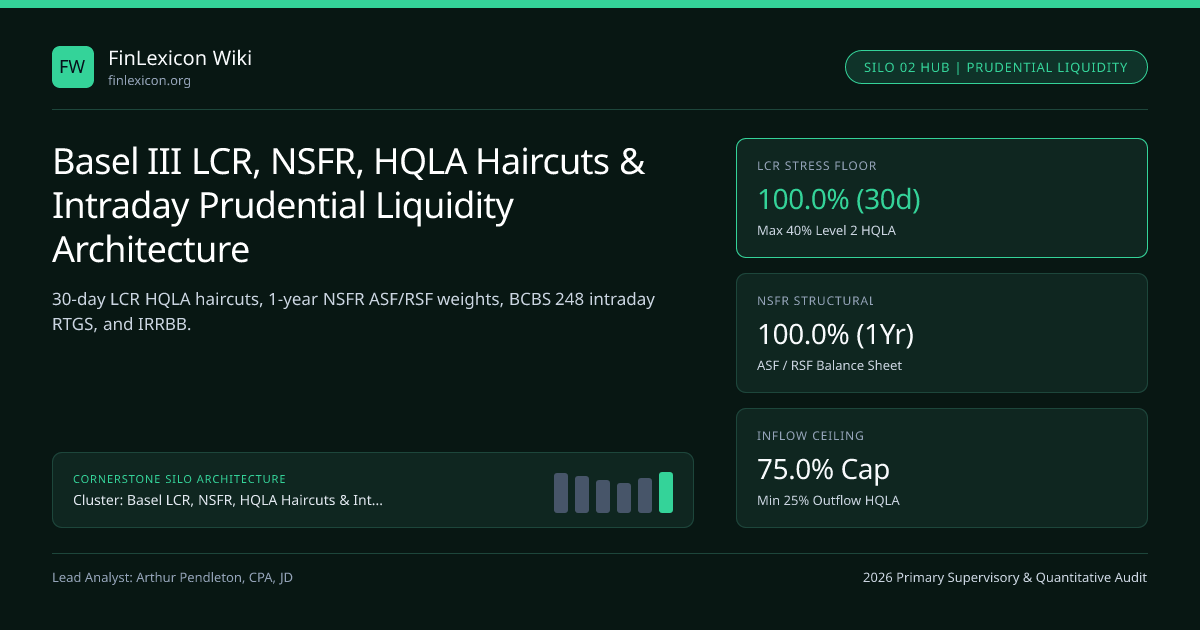
Solvency ratios alone failed to prevent the 2008 wholesale repo freeze or the March 2023 uninsured-deposit runs because illiquid assets cannot settle same-day wire redemptions at par. Codified across Basel Framework chapters LCR10–LCR40 and NSF10–NSF30, global prudential banking liquidity supervision rests on two complementary 100% minimum ratios—the 30-day Liquidity Coverage Ratio (LCR) & Level 1 HQLA Standard and the one-year structural Net Stable Funding Ratio (NSFR)—reinforced by BCBS 248 intraday RTGS monitoring and SRP31 banking-book interest rate risk.
Two-Horizon Liquidity Defense: Acute 30-Day Stress Survival vs 365-Day Structural Funding#
Prior to Basel III, banks funded multi-year commercial loans and structured securities using overnight asset-backed commercial paper and bilateral repo, assuming wholesale money markets would roll indefinitely. Supervised globally by BCBS / BIS, the U.S. Federal Reserve System, the European Central Bank, and the UK Prudential Regulation Authority, the dual liquidity pillar eliminates cliff maturity transformation across two distinct time horizons.
First, LCR requires unencumbered High-Quality Liquid Assets to cover 100% of stressed net cash outflows over a combined idiosyncratic and market-wide 30-calendar-day crisis, governed by HQLA Level 1, 2A, and 2B haircuts and the 40% adjusted unwind cap. Second, NSFR prohibits funding "cliff-building" just beyond Day 31 by requiring Available Stable Funding (ASF) maturity weights to exceed Required Stable Funding (RSF) asset encumbrance weights across a one-year horizon.
Stressed Outflow Run-Off Calibration, 75% Inflow Caps, and Derivatives HLBA#
The denominator of LCR subtracts capped contractual inflows from stressed gross outflows across every liability and off-balance-sheet line. Liability run-off tiers examined in LCR 30-day retail, operational, and wholesale deposit run-off rates step sharply from 3%–5% on insured retail accounts to 25% on operational clearing balances and 40%–100% on non-operational corporate and financial deposits. Simultaneously, undrawn credit versus liquidity facility LCR drawdown factors charge up to 30%–100% on committed backstop lines.
To prevent banks from relying purely on scheduled loan repayments while holding zero liquid reserves, the LCR 75% aggregate cash inflow cap forces every institution to hold HQLA equal to at least 25% of gross outflows. Margin calls on OTC swap portfolios are captured via the 24-month Historical Look-Back Approach (HLBA) for derivatives collateral, while structural swap funding faces asymmetric NSFR derivatives replacement cost and 20% gross liability add-ons.
Intraday RTGS Settlement Queues, Cross-Currency Swaps, and Repo Upgrade Traps#
A bank reporting a 130% end-of-day LCR can still fail at 11:00 a.m. if payment counterparties withhold incoming wires on Fedwire, TARGET2, or CHAPS. Accordingly, treasuries at Bank of America, BNP Paribas, and Bank of England clearing participants deploy BCBS 248 intraday liquidity monitoring and RTGS peak net debit caps alongside significant-currency FX swap LCR and CLS PvP compression.
Securities lending desks must also police collateral upgrade swaps and 30-day LCR unwind cliffs, while promotional pass-through development banks evaluate NSFR interdependent asset and liability zero-percent weights verified across FinLexicon regulatory benchmarks.
| Prudential Metric & Basel Chapter | Time Horizon | Minimum Threshold | Primary Numerator | Primary Denominator |
|---|---|---|---|---|
| Intraday Liquidity (BCBS 248 / SRP) | Real-time T+0 (Minute-by-Minute) | Zero missed time-specific wires | Central bank reserves + intraday repo lines | Peak cumulative net debit RTGS position |
| Liquidity Coverage Ratio (LCR10–40) | 30 calendar days | 100% (usable in stress) | Stock of Level 1 (0% hc) + L2A (15%) + L2B (25–50%) | Gross stressed outflows minus min(Inflows, 75% Out) |
| U.S. Reg WW LCR (12 CFR Part 249) | 30 days + Peak-Day Mismatch | 100% (85%/70% Cat III/IV scalar) | Eligible U.S. HQLA (municipal cap rules) | Net cumulative 30d outflow + Peak-Day Add-On |
| Net Stable Funding Ratio (NSF10–30) | 1 year (365 days) | 100% ongoing structural | Available Stable Funding (Tier 1/2 + retail + >1Y debt) | Required Stable Funding (illiquid loans + encumbered) |
| IRRBB Outlier Test (SRP31 / d368) | Full cash-flow repricing life | Delta-EVE <= 15% of Tier 1 Capital | Worst of 6 supervisory yield-curve shocks | Tier 1 regulatory capital (CET1 + AT1) |
Post-2023 Lessons: HTM Duration Traps, IRRBB Shocks, and NMD Deposit Betas#
The March 2023 failures of Silicon Valley Bank and Signature Bank—supervised prior to receivership alongside FDIC resolution frameworks—exposed the lethal intersection between interest rate risk in the banking book and uninsured digital bank runs. Counting underwater long-duration bonds at market value inside HQLA (or locking them inside unmonetized amortized-cost buckets) creates acute Held-to-Maturity (HTM) unrealized loss and deposit run traps.
Consequently, ALCO governance unites IRRBB BCBS d368 six-shock EVE and NII sensitivity tests with Non-Maturity Deposit (NMD) core pass-through behavioral modeling, operationalizing pre-pledged central bank Standing Repo Facility and Discount Window HQLA monetization so bonds convert into cash reserves without fire-sale HTM tainting.
Jurisdictional Tailoring, ILAAP Survival Horizons, and Liquidity Funds Transfer Pricing#
In the United States, Regulation WW (12 CFR Part 249) modified LCR and peak-day maturity mismatch rules add a forward peak-day outflow surcharge inside the 30-day window while applying 100%, 85%, or 70% tailoring scalars across Categories I–IV. In Europe, the UK, and APAC (MAS, APRA), banks embed multi-currency stress tests inside supervisory ILAAP 90-day survival horizons and reverse stress tests, allocating buffer carry costs back to business lines through Contingent Funding Plans (CFP) and Liquidity Funds Transfer Pricing (LFTP). Explore all twenty standards in the Basel LCR, NSFR & Prudential Liquidity topic hub and our quantitative methodology.
- NSFR = Sumi ( CarryingLiabilityi * ASFFactori ) / [ Sumj ( CarryingAssetj * RSFFactorj ) + Sumk ( OBSk * RSFOBSk ) ] >= 100%
- Worked Dual-Ratio Bank Audit ($220B Balance Sheet):
- Stock of HQLA (Post-Haircut & 40% Cap) = $46.8B | 30d Gross Outflows = $52.0B | 30d Contractual Inflows = $16.0B
- Inflow Cap Check = min($16.0B, 0.75 * $52.0B = $39.0B) = $16.0B => Net Cash Outflows = $52.0B - $16.0B = $36.0B
- LCR = $46.8B / $36.0B = 130.0% (+30.0% / $10.8B Surplus HQLA)
- Available Stable Funding (ASF) = $138.0B | Required Stable Funding (RSF) = $118.5B => NSFR = 116.5%
Frequently asked questions
Are banks legally permitted to let their LCR fall below 100% during an actual financial crisis?
Yes! Basel LCR20.5 explicitly states that during periods of acute idiosyncratic or systemic financial stress, banks are expected to monetize their HQLA stockpile and allow reported LCR to dip temporarily below 100% under supervisory oversight rather than hoarding liquidity via fire sales.
Why can a bank report a 135% LCR and still fail within 48 hours during a digital deposit run?
LCR assumes standard 3%–10% retail and 25%–40% corporate 30-day run-off rates; if concentrated uninsured venture-capital or tech corporate depositors withdraw 25%–85% of total deposits in 24–48 hours while long-dated bonds sit locked in unpledged HTM accounts, actual outflows overwhelm statutory LCR weights.
How does central bank encumbrance affect HQLA eligibility versus NSFR Required Stable Funding?
Any bond pledged as collateral for more than 30 days (or securing a term loan) is encumbered and completely excluded from LCR HQLA; in NSFR, assets encumbered for 6 to 12 months receive at least a 50% RSF charge, and >=12 months receive a 100% RSF charge.
Do U.S. regional banks below $100 billion in assets have to comply with LCR and NSFR?
Under the 2019 U.S. Tailoring Rules (12 CFR Part 249), banking organizations below $100 billion (and Category IV banks between $100B and $250B with <$50B in weighted short-term wholesale funding) were exempted from formal Reg WW LCR and NSFR, relying instead on Reg YY Internal Liquidity Stress Tests.
Publication record
- Published
- 15 November 2026
- Updated
- 15 November 2026
- Author
- Arthur Pendleton, CPA, JD
- Review
- Review not recorded
- Automated fact check
- Passed in the stored pipeline record
- Source URLs
- 4 recorded
AI assistance recorded: anthropic/claude-opus-4.6. This field does not establish human review or source verification.
Academic & Institutional Attribution
Cite This Research & Embed Live Data Card
Standard academic & institutional research paper citation format.
Arthur Pendleton, CPA, JD. (2026, November 14). Basel III LCR, NSFR, HQLA Haircuts & Intraday Prudential Liquidity Architecture. FinLexicon Wiki. https://finlexicon.org/wiki/basel-lcr-nsfr-hqla-haircuts-prudential-liquidity-guideRelated Liquidity Coverage Nsfr Prudential & Institutional Briefings
Explore Liquidity Coverage Nsfr Prudential Hub (20) →Liquidity Coverage Nsfr Prudential
HQLA Level 1, 2A & 2B Haircuts: 40%/15% Composition Caps & Secured Funding Unwind (LCR30)Liquidity Coverage Nsfr Prudential
LCR 30-Day Deposit Run-Off Rates (LCR40): Stable Retail (3%/5%), Operational (25%) & Financial (100%)Liquidity Coverage Nsfr Prudential
LCR 75% Aggregate Cash Inflow Cap: Performing Loan Rollovers, SFTs & the 25% HQLA FloorLiquidity Coverage Nsfr Prudential
LCR Derivatives Collateral Outflows: 24-Month Historical Look-Back Approach (HLBA) & Rating TriggersLiquidity Coverage Nsfr Prudential
Undrawn Credit vs Liquidity Facilities in LCR40: Corporate (10%/30%), Bank (40%) & SPV (100%)Liquidity Coverage Nsfr Prudential
NSFR Available Stable Funding (ASF) Factors (NSF30): Tier 1/2 Capital, Retail & Sub-1Y CliffsLiquidity Coverage Nsfr Prudential
NSFR Required Stable Funding (RSF) Weights (NSF30): Asset Encumbrance, 65% Mortgages & NPLsLiquidity Coverage Nsfr Prudential
Asymmetric NSFR Derivatives Treatment (NSF30): Cash VM Offsets & the 20% Gross Liability Add-OnIsda Csa Derivatives Collateral
2002 ISDA Master Agreement, VM/IM CSA, ISDA SIMM v2.6, SA-CCR & Close-Out Netting ArchitectureIfrs9 Cecl Credit Provisioning
IFRS 9 Expected Credit Loss, US GAAP ASC 326 CECL, Fair Value Hierarchy & Hedge Accounting GuideCentral Clearing Ccp Waterfall
CCP Default Waterfalls, CPMI-IOSCO PFMI, VMGH, LSOC Segregation & Treasury Central Clearing GuideBasel Iii Endgame Capital Ratios
BCBS d424 72.5% Standardized RWA Output Floor: Phase-In Mechanics & Capital Impact
FinLexicon Wiki Data, Benchmarks & Contributor Records
CC BY 4.0 Open Data
Open Institutional Datasets (CSV / JSON) →
Download desk-compiled quantitative series & schemas.
2026 Reference Matrix
2026 Institutional Benchmarks & Thresholds →
Statutory capital, clearing, margin & rate conventions.
Editorial Records
Authors & Review Records →
View named contributors where those records are available.
Complete Index
Master Research & Dossier Archive →
Browse all published briefings by topic pillar & date.